We are used to looking up at the Milky Way, that faint band of light stretched across the night sky. But what does its center truly look like? For thousands of years, that magnificent core, veiled by dust, has lived mostly in the imagination. Now an unprecedented window is slowly opening. It bears the name of a pioneer, and it carries a plain but profound purpose: to let us finally see our own home.
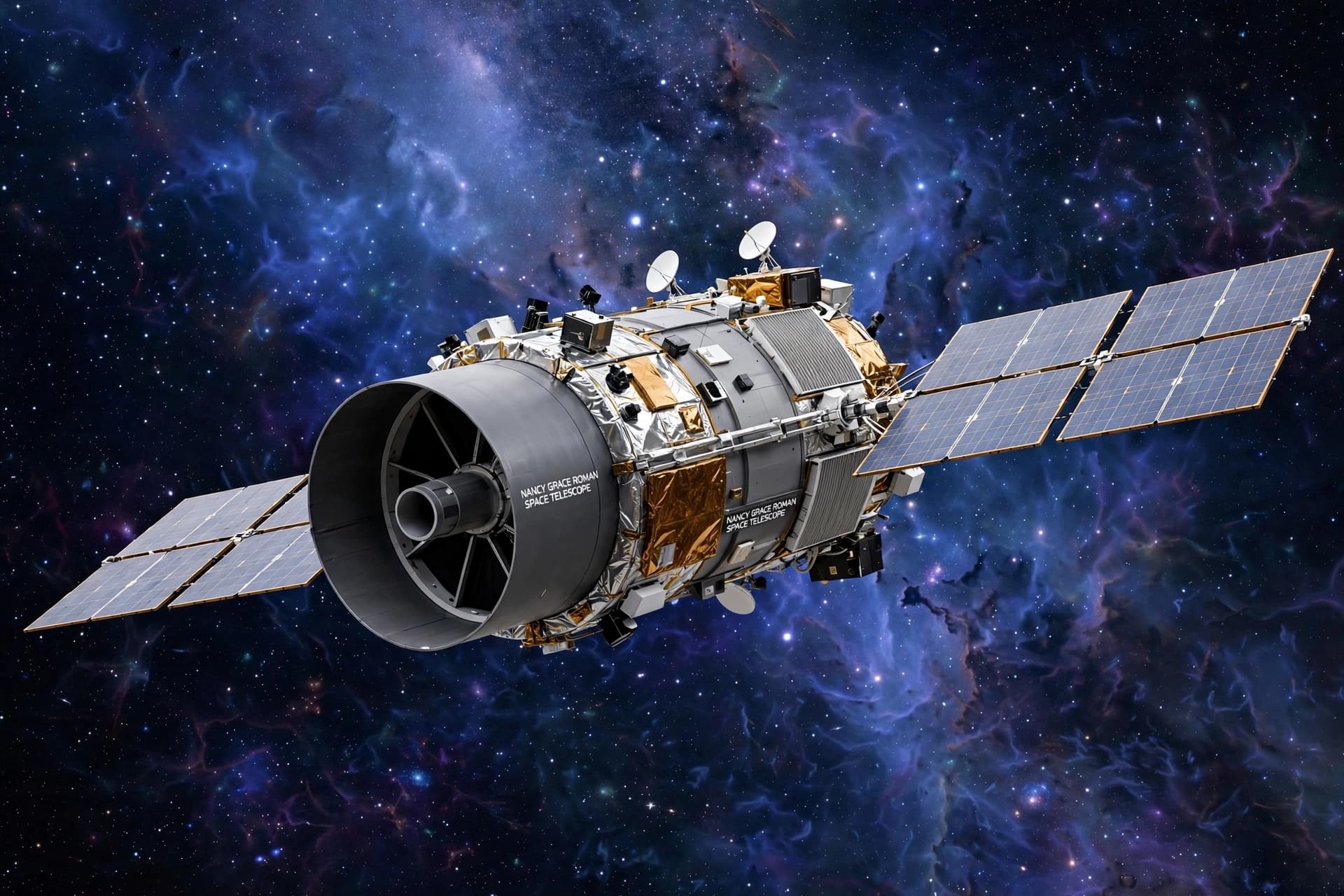
The Nancy Grace Roman Space Telescope, which launched on August 30, 2026, inherits much from Hubble. It shares the same 2.4-meter primary mirror and observes in both visible and infrared light. But it possesses a capability Hubble never had: a field of view more than a hundred times wider. This means Roman can capture a far larger patch of sky in a single exposure, raising survey efficiency to an entirely new order of magnitude.
For the study of our galaxy, Roman's most critical instrument is its infrared eye. The galactic plane is thick with interstellar dust, like a heavy fog that blocks visible light. Infrared radiation, however, can pass through that dust, allowing Roman to glimpse the stellar nurseries, star clusters, and hidden objects deep in the galactic core. Julie McEnery, project scientist at NASA's Goddard Space Flight Center, described the mission's meaning this way: the galactic plane survey will transform our understanding of the Milky Way, letting us explore its mysterious far side and its star-packed heart.
The planned galactic plane survey will cover nearly 700 square degrees, cataloging roughly twenty billion stars. But what truly excites astronomers is the dimension of time. By observing the same patch of sky repeatedly, Roman can catch subtle changes in brightness and position, revealing phenomena that a single observation would miss. Gravitational microlensing is one such tool. When a foreground object, perhaps a star, a planet, or even a black hole, passes in front of a background star, its gravity briefly magnifies the light behind it. Roman will use this effect to search for objects ranging from planets to isolated black holes.
The galactic bulge time-domain survey will aim at the galaxy's most crowded central region. There, Roman is expected to find roughly a hundred thousand new transiting planets, along with about twenty-five hundred revealed through microlensing, including worlds smaller than Mars or farther from their host stars than other methods can reach. Meanwhile, the pulsations, flares, and rotations of the stars themselves will be recorded systematically, forming an unprecedented high-definition portrait of the cosmos.
Roman does not work alone. Together with Chile's Vera Rubin Observatory and the European Space Agency's Euclid telescope, it forms a new trio of survey observatories. What sets Roman apart is its high-resolution infrared eye fixed on the galaxy's densest regions, finding change in the time domain and revealing essence within that change. Kishaile De at Columbia University leads the effort to build the tools that will turn Roman's data into discoveries, and he put it plainly: if we want Roman to produce galactic discoveries in its first two years, the tools must be ready before the data arrives.
From a core hidden by dust to the stellar cradles scattered across the disk, Roman will turn the Milky Way from a blurred band of light into a dynamic epic we can watch frame by frame. Once this window opens, our understanding of our place in the universe may never look the same.
Note: The images in this article were generated by AI.
Sources: Science | AAAS, NASA, Nature, The Conversation, Columbia University
Published by Banx Network. This article is part of the Banx decentralized media programme, powered by the BXE token on the XRP Ledger.