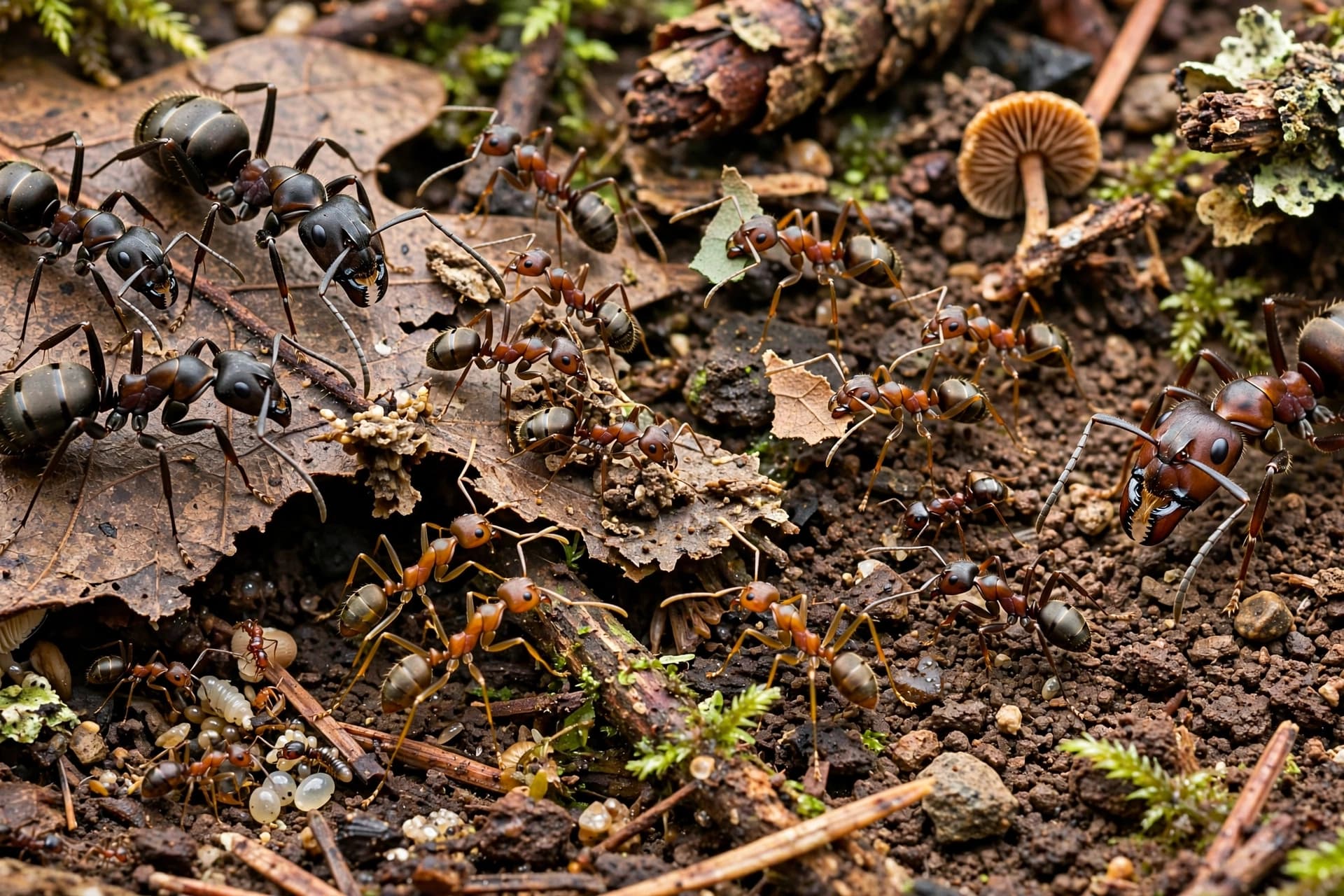
There is a particular irony in the story of life's resilience—that the same catastrophe which erased the dominant creatures of an age should become the unlikely foundation for another's quiet triumph. Sixty-six million years ago, an asteroid struck the Earth with a force that ended the reign of the dinosaurs and cast a shroud over the planet. Yet in the darkness that followed, while the great beasts starved and the forests withered, something small and unassuming was beginning a journey that would lead it to become one of the most successful families of social insects on Earth. Ants, it turns out, owed their rise not just to luck, but to a hidden mechanism within their own DNA.
A new study published in Science Advances has identified the genomic catalyst for this evolutionary explosion: transposable elements, often called "jumping genes." These are DNA sequences capable of moving and replicating within a genome. For decades, they were dismissed as "genomic parasites," selfish bits of code that multiplied without benefit to their host . But a growing body of research suggests they can also serve as engines of innovation, and this new work shows they may have been the very spark that allowed ants to diversify into the more than 15,000 species that exist today.
An international team led by Dr. Lukas Schrader at the University of Münster analyzed and compared the genomes of 163 ant species, reconstructing the evolutionary history of transposable elements over the past 100 million years . What they found was striking. The ant lineages carrying the most transposable elements in their genomes are also the most species-rich today. More significantly, the researchers identified independent bursts of transposable element activity in the ancestors of the largest ant groups in the early Paleogene—about 66 million years ago, shortly before those lineages diversified into the thousands of species alive now .
The timing coincides almost perfectly with the asteroid impact. The cataclysm created a world of scarce vegetation and abundant decaying matter—a heyday for fungi that decompose plant material, and for the ants that were already developing a relationship with them . But the study points to something more fundamental than ecological opportunity. The transposable elements were moving within the ants' own genomes, reshaping them, creating new genetic variations upon which natural selection could act. "We have now found the genomic mechanism that connects these ecological upheavals to the subsequent rapid diversification of the ants," Schrader explained .
The team also linked these jumping genes to the expansion of gene families involved in chemical communication. Odorant receptors, essential for the social life of ants, played a particularly important role. Ants navigate, recognize nestmates, and coordinate their colonies almost exclusively by smell. The ability to recognize and interpret chemical signals may have been enhanced by this restless activity within their own genomes, allowing them to build the complex societies that now dominate so many terrestrial ecosystems .
Comparable patterns have been identified in other animal groups, with bursts of transposable element activity coinciding with more recent phases of increased speciation in primates and bats . The discovery suggests that the asteroid did not simply eliminate the old world; it set the stage for a new one, and the ants were ready. They had the ecological groundwork laid by their fungal partnerships, and they had the genomic plasticity to adapt, diversify, and thrive. In the quiet aftermath of catastrophe, the smallest among them found opportunity in the ruins, and they have been building on it ever since.
AI Image Disclaimer: The images accompanying this article were generated by artificial intelligence and are for illustrative purposes only.
Sources: EurekAlert!, University of Münster, Science Advances
Published by Banx Network. This article is part of the Banx decentralized media programme, powered by the BXE token on the XRP Ledger.