There is a particular romance to the idea that Earth's oceans arrived from the sky, carried in the frozen hearts of comets and asteroids that struck a young and molten planet. It has the shape of a good story: a delivery from the cosmos, a gift of water that made life possible. But a new study suggests that the romance may be unnecessary, that the water in our oceans may have been manufactured here, in the hellish atmosphere of a planet still being born.
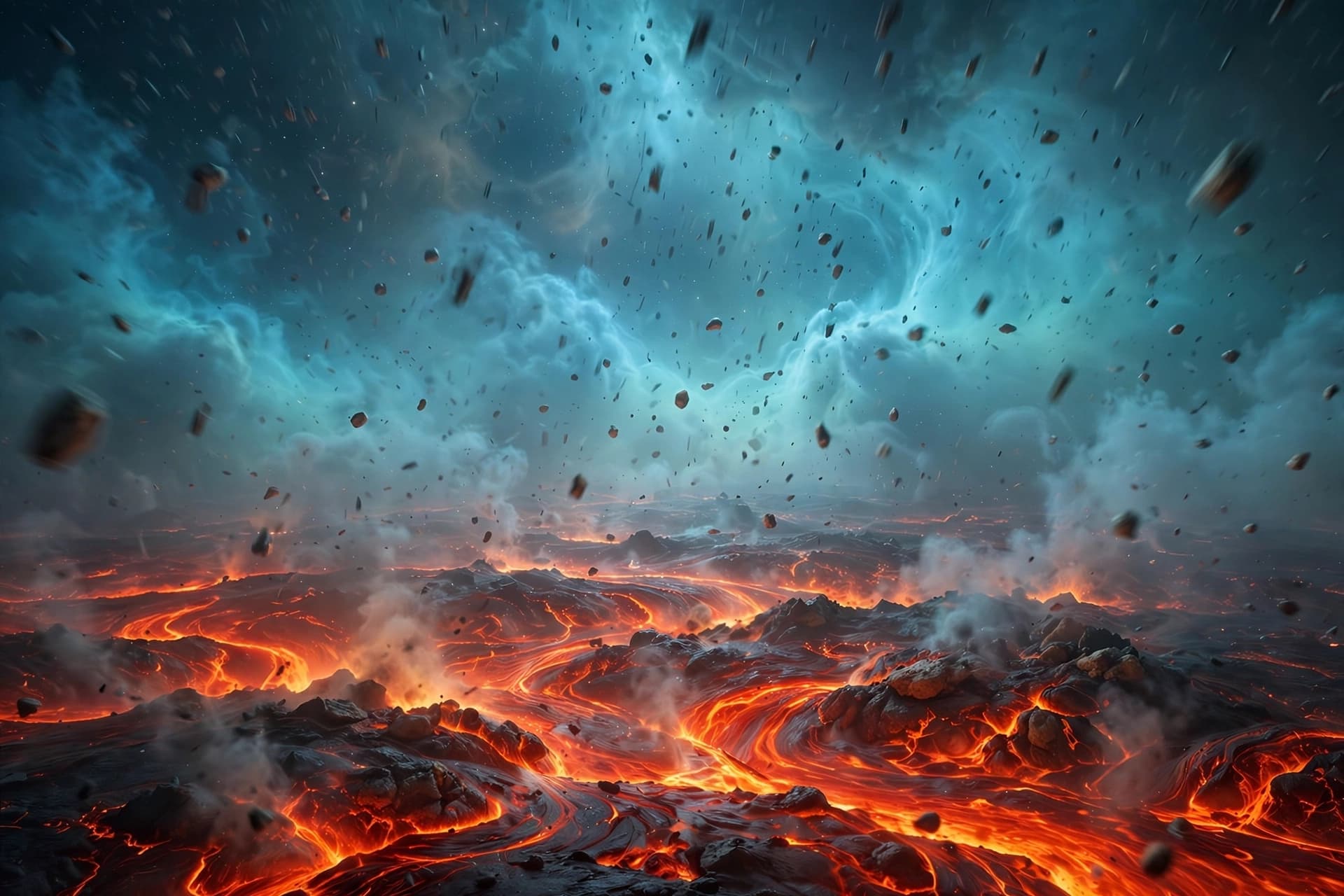
The research, published in Nature Geoscience, was led by Susmita Garai and Zachary Sharp at the University of New Mexico. Their experiments tested a mechanism tied to pebble accretion, a model of planet formation in which a growing planet captures millimeter- to centimeter-sized rocky particles from the solar nebula . When a protoplanet becomes massive enough—roughly 0.3 Earth masses—it develops a thick, hot atmosphere rich in hydrogen. Pebbles falling through that atmosphere are heated to the point of melting, and the iron oxide in the silicate rock reacts with the hydrogen, producing metallic iron and water vapor.
The experiments were designed to test whether this reaction could occur under plausible early Earth conditions. The team heated silicate rock samples at temperatures between 1,200 and 1,400 degrees Celsius in streams of hydrogen and, for comparison, helium . In the hydrogen experiments, nearly 80 percent of the iron oxide was converted into metallic iron, producing water vapor. The helium controls showed no such reaction, confirming that hydrogen was essential to the process.
Sharp described the results with a sense of wonder. "Looking out over a large body of water, it is hard to imagine that that water may have been produced 4 ½ billion years ago in a hell-like atmosphere, but it very well may have," he said . The extrapolation from the experiments suggests that hundreds of oceans' worth of water could have been produced in this way during Earth's formation .
The findings do not rule out cometary delivery entirely. The researchers are careful to note that the experiments demonstrate a plausible mechanism, not a definitive accounting of Earth's water budget. Determining how much of the planet's water originated this way will require further research . But the implications extend beyond Earth. If water can be produced locally on any rocky planet with the right conditions—iron-bearing silicates, high temperatures, and a hydrogen-rich atmosphere—then the number of potentially habitable worlds in the universe may be far greater than previously imagined.
Sharp framed the broader significance directly. "Previous ideas about the source of water to Earth rely on an external source, such as comets or meteorites," he said. "Here we show that virtually any Earth-sized planet should have water by this newly identified mechanism" . The mechanism does not require the precise gravitational choreography that would be needed to deliver water-rich bodies from the outer solar system to a planet in the inner solar system. It requires only the ordinary physics of a growing planet and the chemistry of its atmosphere.
The study also offers a possible explanation for other chemical features of Earth. The metallic iron produced in the reaction absorbs phosphorus from the molten silicate, and if that iron later sank to form the core, it could explain why Earth's mantle is relatively poor in phosphorus compared with Mars . The low iron-to-magnesium ratio of the primitive mantle may also fit the proposed sequence. These are secondary lines of evidence, not proof, but they are consistent with the mechanism.
For now, the question of where Earth's water came from is not fully settled. The new research adds a third possibility to the two that have dominated the discussion—cometary delivery and asteroidal delivery. The water may have been here all along, produced in the same furnace that built the planet. If that is true, then the story of our oceans is not one of arrival but of generation, not a gift from the sky but a consequence of the ground beneath our feet.
Image note: The visuals accompanying this article were generated using artificial intelligence and do not depict the actual experiments or the researchers involved.
Sources: Universe Today, UNM Newsroom, Scinexx, TechNews, Nature Geoscience
Published by Banx Network. This article is part of the Banx decentralized media programme, powered by the BXE token on the XRP Ledger.