Sometimes archaeology depends on objects that no longer exist. In this case, researchers have returned to a grainy black-and-white photograph taken decades ago, using modern digital techniques to examine hieroglyphs from an ancient Egyptian artifact that has since disappeared. Their analysis may strengthen the case that Meretneith, a queen of Egypt's First Dynasty, held a position closer to that of a ruling king than previously established.
Meretneith lived more than 5,000 years ago, during the First Dynasty of ancient Egypt. She was already known to historians as an unusually important royal figure. Her large burial complex at Abydos contained numerous graves and evidence of substantial resources, while an ancient king list identified her as the mother of King Den. These clues have long suggested that she held considerable political authority.
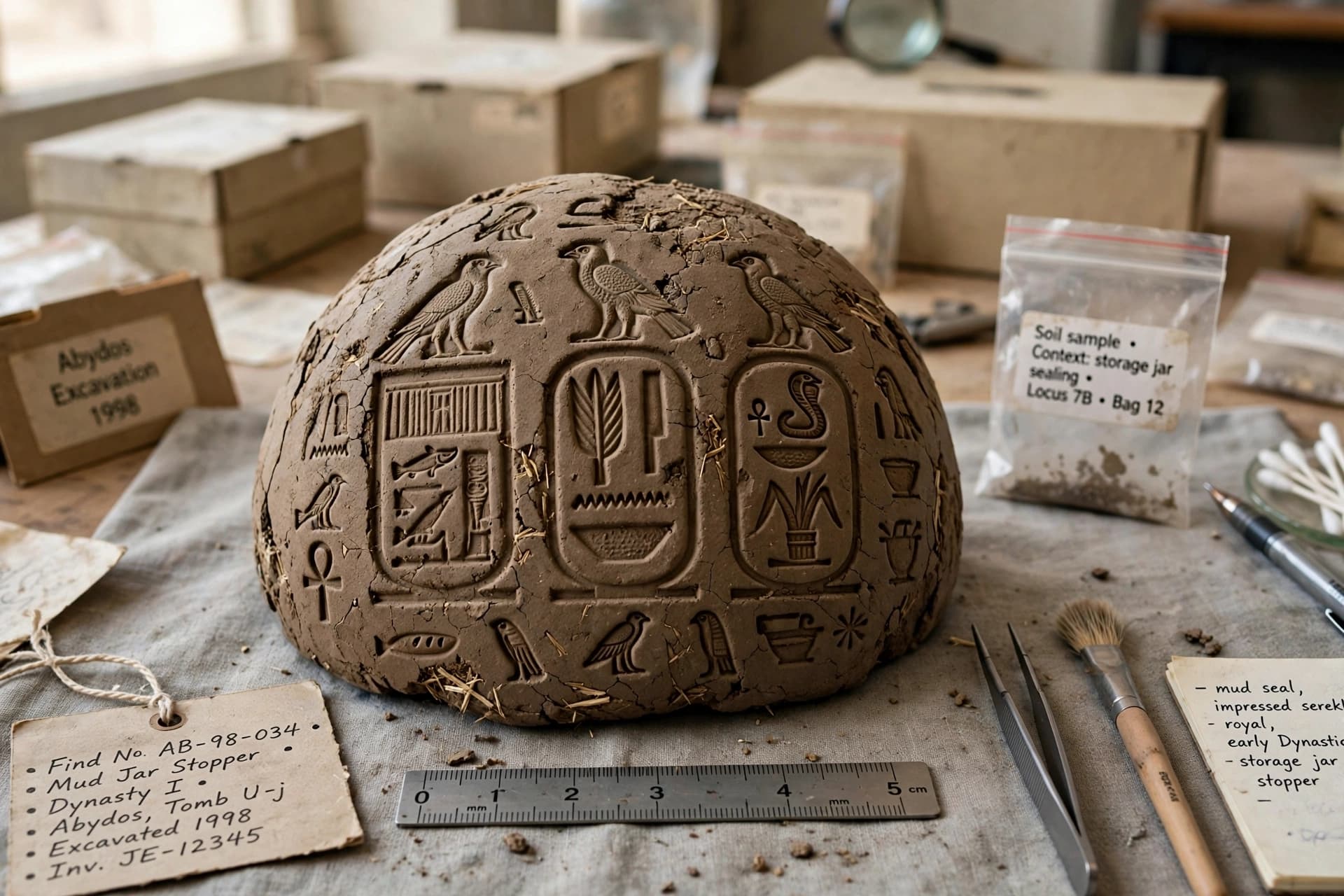
The new research centers on a mud stopper photographed by British Egyptologist Walter B. Emery in the 1940s. Emery reported finding several such objects near a tomb at Saqqara. The stopper appeared to contain four royal emblems known as serekhs, symbols associated with Egyptian rulers. Emery proposed that two of them belonged to Meretneith, but the interpretation remained disputed because the original photograph was difficult to read.
The physical artifacts and Emery's original glass photographic plate are now apparently unavailable. Researchers Susan Kelly and Crystal Miller therefore worked with a surviving digital copy of the old photograph. They enhanced its contrast, isolated the hieroglyphs, inverted the image and converted the markings into a scalable digital form that allowed them to examine the symbols more clearly.
According to the researchers, two of the serekhs appear consistent with Meretneith's name and associated religious symbols. Because the serekh was a distinctive royal emblem, they argue that the evidence supports interpreting Meretneith as a ruler rather than merely as a royal woman acting temporarily on behalf of another king. Their study suggests she may have exercised authority during a political career lasting roughly three decades.
The proposed interpretation could alter how Meretneith's position is understood. She is already recognized as one of the most powerful women of Egypt's earliest dynastic period, but historians have debated whether she should be regarded as an independent ruler, a co-ruler or a regent for her son Den. The new analysis argues for a stronger interpretation of her sovereignty.
Yet the question is not settled. Eva-Maria Engel of Humboldt University, who was not involved in the study, has disputed the interpretation and told Live Science that the enhanced image does not demonstrate that Meretneith appears on the stopper. Other scholars have likewise recognized Meretneith's importance while stopping short of describing her as a female pharaoh. The disagreement illustrates the limits of reconstructing ancient history from a single degraded image.
What makes the discovery especially intriguing is the way old and new methods meet. A photograph taken in the mid-20th century has become the surviving record of an artifact from Egypt's earliest royal period, while digital imaging now allows researchers to extract details that were difficult to distinguish when the photograph was first published. Whether the inscription ultimately settles Meretneith's status remains open, but it has given scholars another reason to revisit one of Egypt's earliest royal biographies.
AI Image Disclaimer: Any historical reconstruction accompanying this article is AI-generated and should not be mistaken for an authentic image of Meretneith or the original artifact.
Sources: Smithsonian Magazine Prague Egyptological Studies The Conversation Live Science Egypt Exploration Society
Published by Banx Network. This article is part of the Banx decentralized media programme, powered by the BXE token on the XRP Ledger.