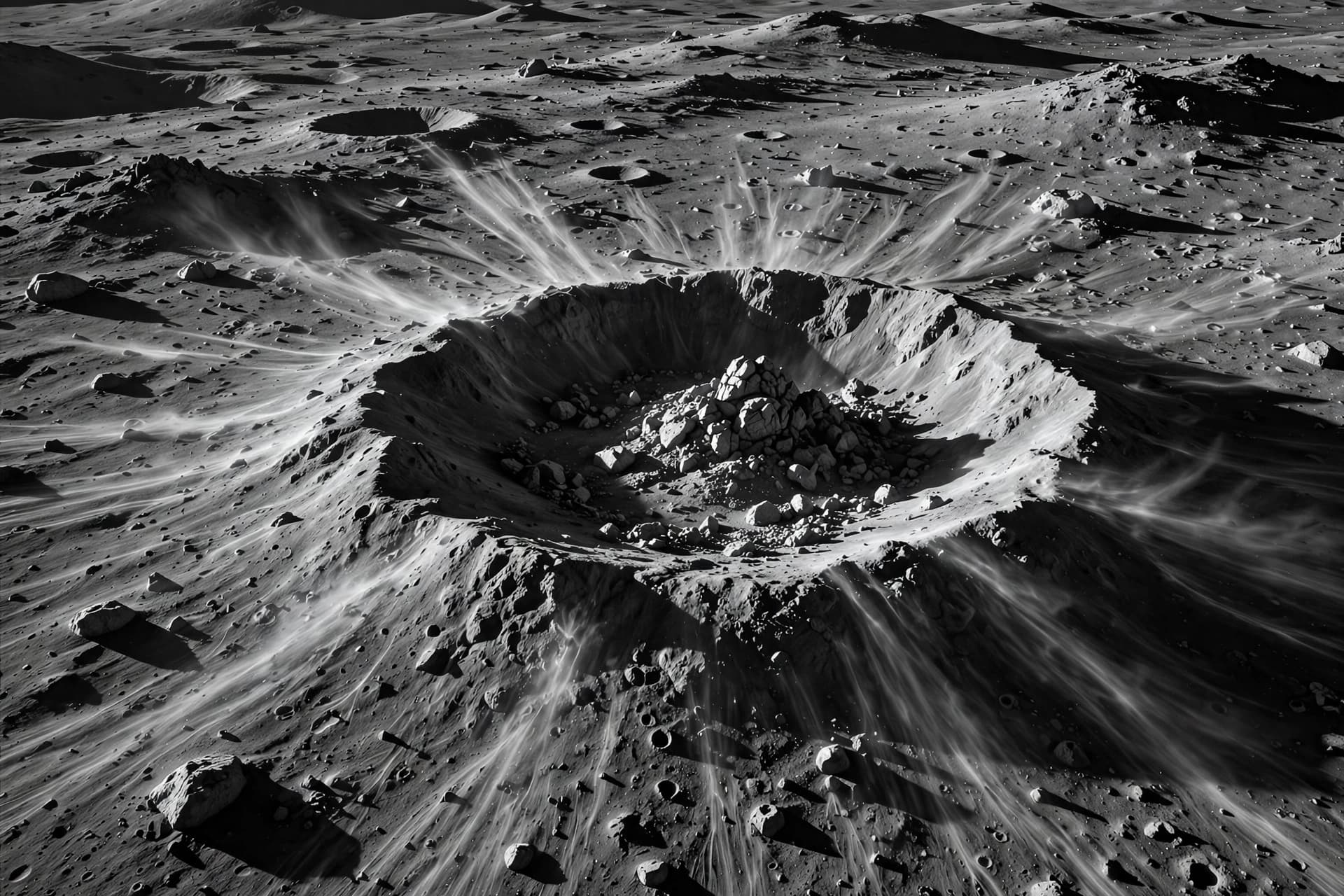
The moon has long been a symbol of constancy, its face unchanged to the naked eye for millennia. Yet, beneath this serene exterior, our celestial neighbor is still subject to the violent whims of the cosmos. Recently, a lunar orbiter captured images of a fresh crater, a stark white scar against the darker regolith, marking a rare and significant impact event. This discovery serves as a vivid reminder that the solar system is a dynamic place, where collisions continue to shape worlds long after their formation. It is a moment of scientific excitement, offering a glimpse into the ongoing geological history of our closest companion.
The term "once-in-a-lifetime" reflects the rarity of observing such a fresh impact so clearly. Most craters are ancient, their features softened by eons of micrometeorite bombardment and space weathering. A new crater, however, retains sharp edges and bright ejecta rays, providing scientists with a pristine laboratory to study the mechanics of impact. This event invites us to appreciate the power of cosmic forces and the precision of modern surveillance technology that allows us to witness them in near real-time.
The crater was identified by data from NASA’s Lunar Reconnaissance Orbiter (LRO), which has been mapping the moon’s surface since 2009. The orbiter’s high-resolution cameras detected the change by comparing recent images with older archives. The new feature, likely formed by a meteoroid striking the surface at high speed, exhibits characteristics typical of fresh impacts, including a bright halo of disturbed soil. This brightness fades over time due to exposure to solar wind, making the window for observation limited and valuable.
Scientists estimate that the impactor was relatively small, perhaps only a few meters in diameter, but traveling at tremendous velocity. Upon impact, the energy released would have been equivalent to several tons of TNT, excavating a hole tens of meters wide. While such events are common on a geological timescale, catching one shortly after it occurs is uncommon. This timing allows researchers to study the immediate effects of the impact, such as the distribution of ejecta and the potential for seismic activity.
The discovery has implications for understanding the current rate of impacts on the moon. By cataloging these fresh craters, scientists can refine models of the near-Earth object population. This data is crucial for assessing the risk of similar impacts on Earth, although our atmosphere protects us from most smaller debris. For the moon, which lacks an atmospheric shield, every impact leaves a permanent mark, contributing to the slow but steady evolution of its surface.
Furthermore, studying fresh craters helps in planning future lunar missions. Understanding the frequency and distribution of impacts is essential for selecting safe landing sites for astronauts and robotic explorers. Areas with recent activity may pose higher risks, while stable regions can be prioritized for long-term habitats. This practical application underscores the importance of continuous monitoring as humanity prepares to return to the lunar surface.
The LRO’s ability to detect such changes highlights the advancements in space exploration technology. What once required decades of observation can now be achieved through automated comparison algorithms and high-definition imaging. This efficiency allows scientists to focus on analysis rather than just detection, accelerating the pace of discovery. It is a testament to the enduring value of orbital missions in expanding our knowledge of the solar system.
Public interest in such discoveries remains high, as they connect us to the tangible reality of space. Seeing a new crater form makes the abstract concept of cosmic collisions concrete and immediate. It reminds us that we live in an active universe, where change is constant and observation is key to understanding our place within it.
The identification of a new lunar crater is a significant scientific event that enhances our understanding of impact processes. As we continue to monitor the moon, let us appreciate the insights gained from these rare observations. They serve as a bridge between the ancient past and the present, revealing the ongoing story of our celestial neighborhood.
AI Image Disclaimer: Images used in this article are AI-generated illustrations intended to represent lunar surfaces and impact craters without depicting specific proprietary data from NASA.
Sources: NASA Space.com Phys.org The Planetary Society
Published by Banx Network. This article is part of the Banx decentralized media programme, powered by the BXE token on the XRP Ledger.