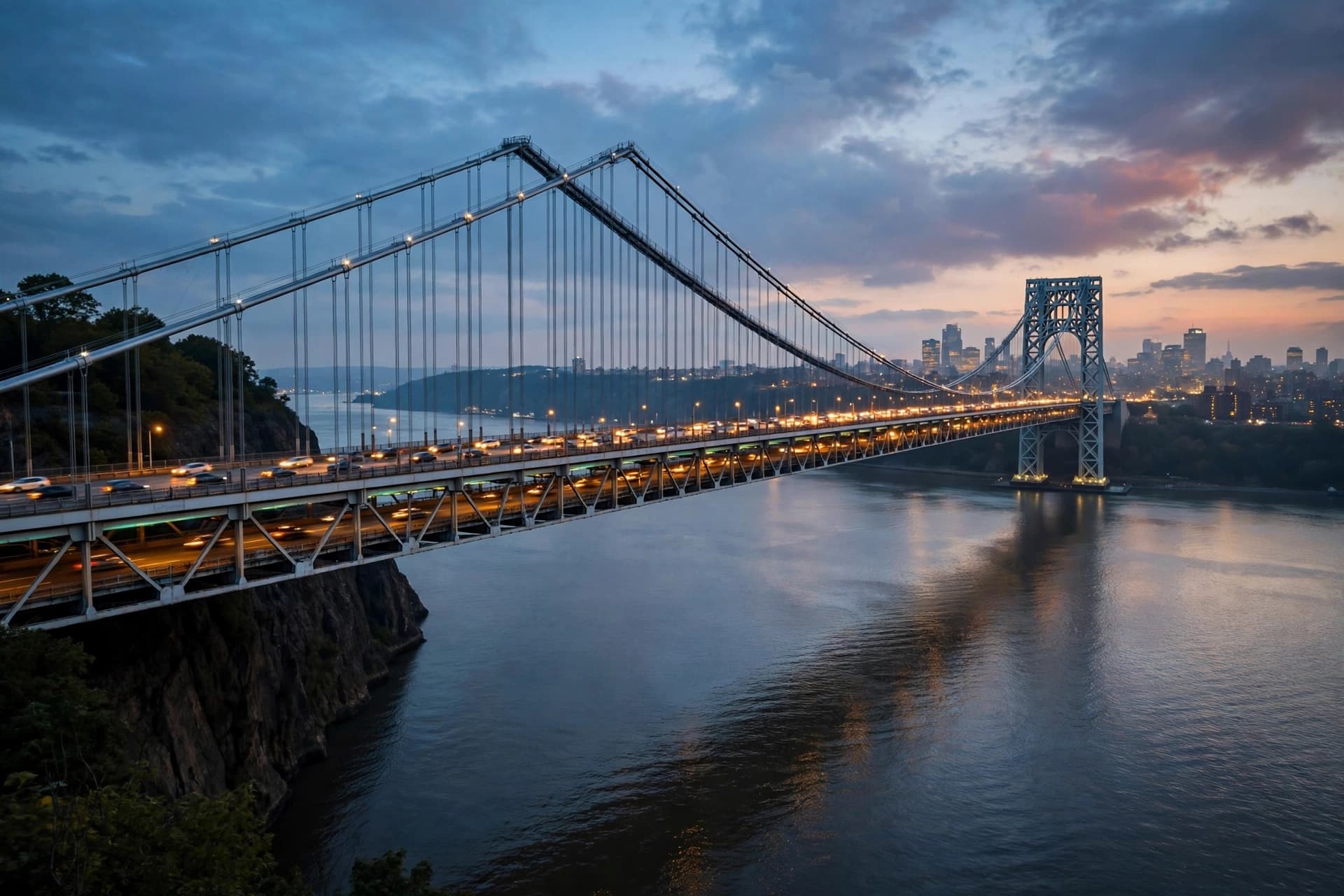
The George Washington Bridge carries thousands of commuters each evening, a river of metal and patience flowing between Manhattan and New Jersey. Most of those journeys end with a driveway, a front door, the small relief of arriving home. On Tuesday evening, one of them ended with a single gunshot through a rear window, a car lurching into a median, and a family left to navigate a grief that no traffic delay could ever explain.
Victor Romero, a sixty-two-year-old retired NYPD detective, was arraigned Thursday on a charge of first-degree manslaughter in the fatal shooting of Koran Irvine, a forty-six-year-old Con Edison technician and father of two from Valley Cottage, New York . Police had initially charged Romero with murder, but prosecutors downgraded the charge before his appearance in Manhattan Criminal Court, where he pleaded not guilty and was held on one million dollars bail .
The sequence of events, as described by prosecutors and surveillance footage, began with a near-collision on the approach to the bridge. Romero, driving a black Range Rover, allegedly tailgated Irvine aggressively across the span before pulling alongside and firing a single shot into Irvine's Volkswagen hatchback . The bullet entered through the rear passenger window and struck Irvine in the shoulder. His car crossed several lanes and struck the center median. He was pronounced dead at a hospital in New Jersey .
Romero did not stop. According to prosecutors, he sped around Irvine's vehicle and continued onto the Palisades Interstate Parkway toward his home in Haverstraw . He was arrested the following day at his security job in Manhattan, where police recovered a revolver he said he carried daily. Two additional handguns were later found at his residence .
The downgrade from murder to manslaughter drew sharp reaction from Irvine's family, who filled two rows of the courtroom. "This man was an ex-police officer, so he should know better," said Irvine's aunt, Gale Forde. "He purposely pointed his weapon, shot into a car, killing my nephew. And his charge was manslaughter, not murder" . Prosecutors said the manslaughter charge reflects an allegation that Romero caused Irvine's death while intending to cause serious physical injury, rather than intentionally killing him. They noted that a grand jury could still consider a murder charge .
Romero's attorney, Alan Abramson, described his client as a "heroic police officer" with a sterling record, noting that Romero received the NYPD's Combat Cross after being shot during an off-duty confrontation with armed robbers at his family's laundromat in 2000 . Romero retired from the department in 2001 on a disability pension. Abramson said Romero cooperated with police and voluntarily surrendered.
What lingers beyond the legal arguments is the ordinariness of the setting. A bridge at rush hour. A commute home from work. A near-miss that could have ended with a honked horn and a shaken head. Instead, a man is dead, a family is mourning, and a retired officer who once carried a badge now sits in a cell, the distance between those two identities measured in a single, irreversible moment.
Visuals in this article were created using AI and are for illustrative purposes only.
Sources: AP News, New York Daily News, Times Herald-Record, Newsday, The Canadian Press
Published by Banx Network. This article is part of the Banx decentralized media programme, powered by the BXE token on the XRP Ledger.