There is something almost elegiac in the silent end of a machine that once listened to the other side of the world. For thirty-eight years, a satellite known as USA 32 circled the Earth, its mission long over, its purpose declassified only months ago. Then, on September 13, it broke apart without warning, scattering fragments across one of the most crowded regions of low Earth orbit. No one yet knows why.
The satellite, also codenamed FARRAH III, was launched by the National Reconnaissance Office on September 5, 1988, to intercept Soviet radar and radio signals from space . Its cylindrical shape earned it the nickname "tuna can," and its mission remained secret until earlier this year. It stopped functioning decades ago but continued to orbit at an altitude of approximately 775 kilometers, well above the International Space Station and most commercial satellites .
The U.S. Space Force's Space-Track confirmed the fragmentation on September 17, four days after the event occurred . The agency did not specify a cause or the number of fragments created. Private satellite-tracking company s2a Systems photographed the largest remaining piece, confirming that the spacecraft had indeed broken into multiple objects . Spaceweather.com noted that the debris likely spread into a ring around Earth within 24 hours, given the satellite's orbital velocity .
Several explanations are being considered. The most likely, according to analysts, is simple age. After nearly four decades of exposure to the extreme temperature swings of low Earth orbit, a pressurized fuel tank or aging battery cell may have ruptured . Spaceweather.com described the scenario plainly: "Old spacecraft carry batteries and leftover propellant. After 38 years of heating and cooling, a pressurized tank or a battery cell on USA 32 may have simply ruptured" .
Other possibilities include a collision with untracked debris or a small meteoroid, though no collision was reported and such events are often predictable in advance . A meteor strike remains possible, given the speeds involved and the difficulty of tracking small natural objects . Anti-satellite weaponry has not been ruled out, though there is currently no evidence to support that theory . Earlier this month, U.S. Air Force Secretary Troy Meink disclosed that the United States had deployed unspecified weapons in orbit, a revelation that adds a note of unease to an already uncertain situation .
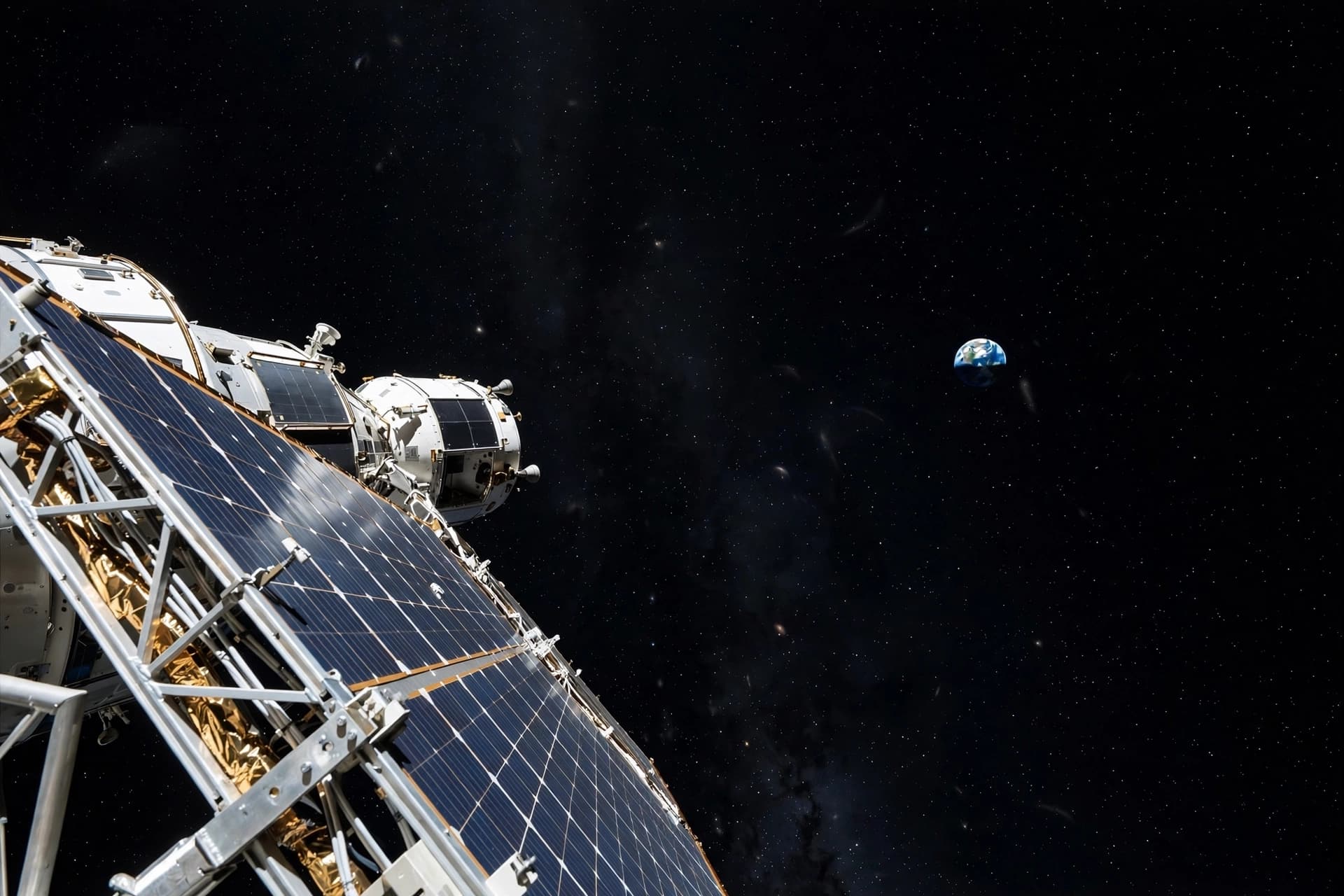
The immediate concern is debris. The region where USA 32 broke apart is home to at least 200 other satellites and already contains remnants from a 2009 collision between American and Russian spacecraft . The newly created fragments, whose number remains unknown, could pose a "real threat" to operational spacecraft in the area, according to Spaceweather.com . The International Space Station orbits at roughly 400 kilometers, about half the altitude of the breakup, and neither it nor China's Tiangong station is currently in the primary danger zone . But orbital dynamics can change over time, and debris can drift.
The event has renewed attention to the Kessler syndrome, a scenario in which the density of objects in low Earth orbit becomes high enough that collisions cascade, each impact creating more debris and increasing the likelihood of further collisions . No such cascade has occurred, and the breakup of a single defunct satellite does not trigger one. But each new fragment adds to a count that has been growing for decades.
For now, the cause remains unknown, the debris is being tracked, and the satellite that once listened to the Soviet Union has become a cloud of pieces circling the planet it once monitored. The investigation will take months, perhaps years. The fragments will take longer to decay.
AI Image Disclaimer: All visuals in this article were produced by artificial intelligence and are illustrative only.
Sources: Live Science (via Yahoo Tech), WION, Ynetnews, Spaceweather.com, Space-Track
Published by Banx Network. This article is part of the Banx decentralized media programme, powered by the BXE token on the XRP Ledger.