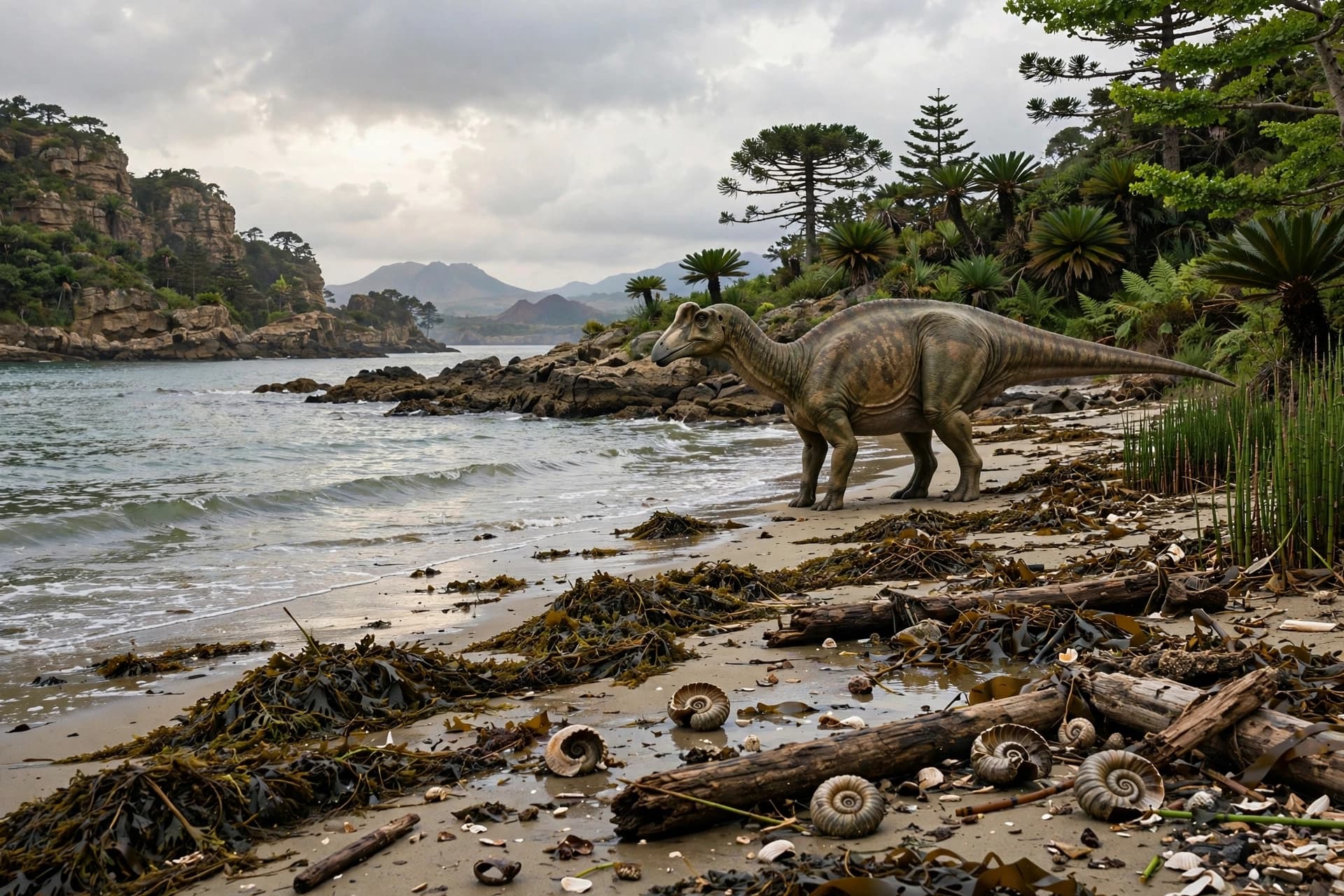
There is a quiet meal hidden in the fossil record, a dietary habit so ordinary that it left no dramatic trace in the rock—only a subtle chemical signature in the teeth of creatures that lived a hundred million years ago. A new study suggests that some dinosaurs, and the animals they preyed upon, were not purely land-bound eaters. They were beachcombers, supplementing their diet with seaweed and other marine matter washed ashore by ancient storms.
The research, published in Frontiers in Ecology and Evolution, was led by Dr. Clayton Forster, a geologist at the University of Arkansas. The team analyzed carbon isotope ratios in the fossilized tooth enamel of dinosaurs, crocodiles, turtles, and fish from sites along the Western Interior Seaway—a vast inland sea that once split North America—and the ancient Gulf of Mexico coastline . They compared these coastal fossils with those from landlocked formations.
Plants contain two types of carbon isotopes: "light" C-12 and "heavy" C-13. The ratio between them, expressed as δ13C, acts as a chemical fingerprint that passes from food into the body of the consumer, leaving a record in tooth enamel . In living animals, the δ13C value in enamel is typically 11 to 13 parts per thousand higher than that of their food. But dinosaur teeth have consistently shown an even larger gap—a mystery that had puzzled scientists.
The coastal fossils offered an explanation. Their δ13C values were consistently higher than those from landlocked sites, regardless of latitude or geological age . The pattern held across fish, crocodiles, turtles, and large herbivorous dinosaurs, suggesting a shared dietary source that was low in the food chain and available only near the coast. "Few organisms meet these criteria besides marine macroalgae or macrophytes—seaweeds," Forster said .
The process at work is called marine subsidization. Storms and tides wash marine matter ashore, where land-dwelling animals consume it. This phenomenon is common today in coastal ecosystems, especially when land-based food is scarce, such as during droughts . The study is the first to identify this process in prehistoric ecosystems.
Not all dinosaurs partook, however. Tenontosaurus tilletti, a large herbivore found across many Cretaceous locations, showed δ13C values consistent with a purely land-plant diet . This confirms that the elevated carbon signatures reflect genuine dietary choices rather than some geological distortion of the fossil record after death.
Forster emphasized the broader implication: "Our study emphasizes the connections between terrestrial and marine ecosystems. They are deeply intertwined and have been for hundreds of millions of years" . The dinosaurs of the Cretaceous coastlines were not isolated from the sea beside them. They ate from it, however indirectly, and the evidence has been waiting in their teeth ever since.
AI Image Disclaimer: The images accompanying this article were generated by artificial intelligence and are intended for conceptual illustration only.
Sources: Frontiers in Ecology and Evolution, University of Arkansas, EurekAlert, Scimex, The Guam Daily Post
Published by Banx Network. This article is part of the Banx decentralized media programme, powered by the BXE token on the XRP Ledger.