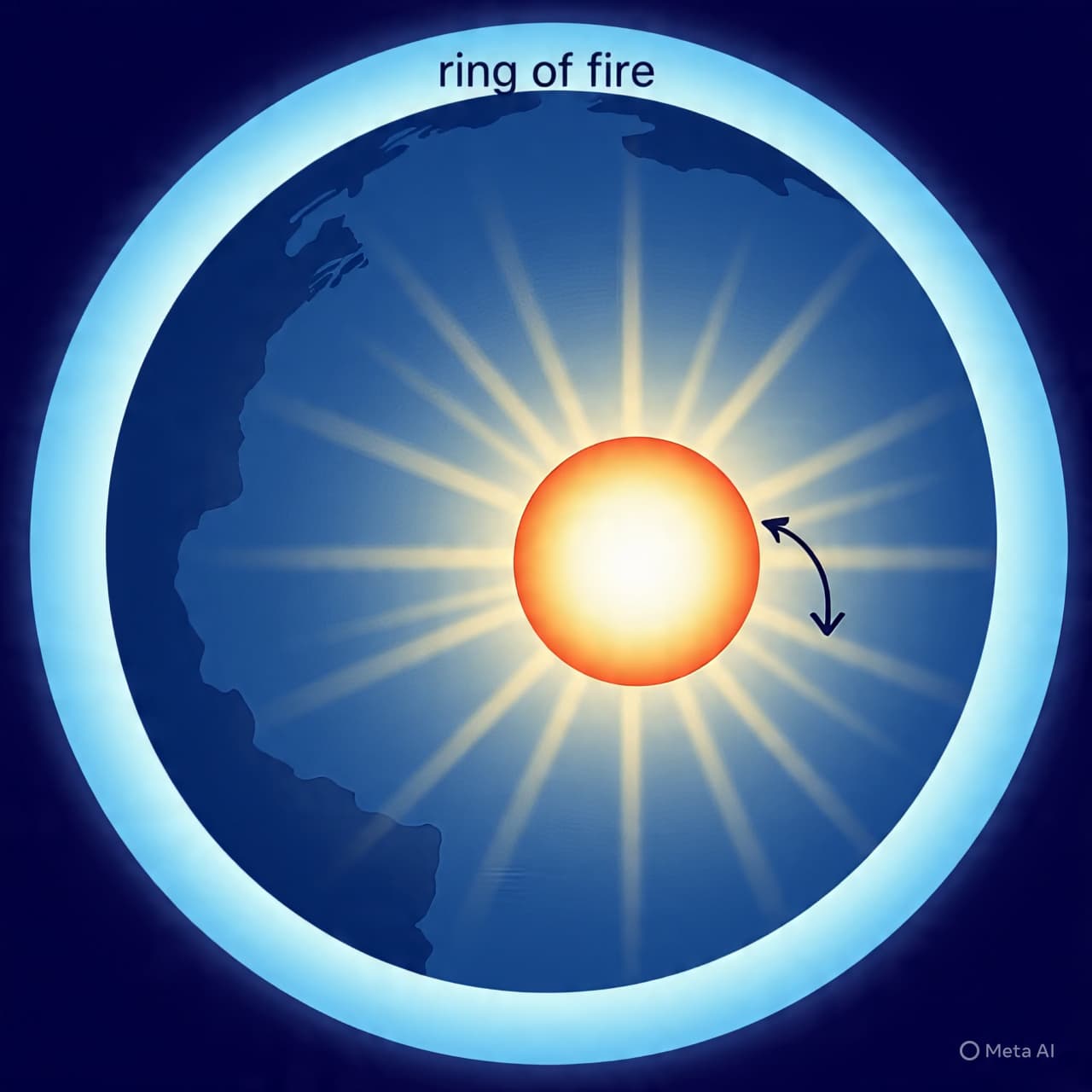
There’s something about looking skyward on a crisp Southern Hemisphere summer day that invites wonder — but on February 17–18, 2026, the heavens offered something exceptional: a “Ring of Fire” solar eclipse, a celestial dance between the Moon and the Sun that captured the imagination of scientists, researchers, and anyone lucky enough to glimpse it. For a brief moment, the Moon passed directly between Earth and the Sun, and because it was slightly farther from our planet in its orbit, it didn’t completely blot out the solar disk. Instead, the Sun’s outer edge formed a brilliant, luminous circle — a glowing ring of daylight encircling the dark Moon — against the isolated backdrop of Antarctica’s icy expanse. Other regions watched in quieter fashion as the Sun took on a bite‑like shape in the sky, a reminder of the intricate geometry that governs our skies.
Most people never see such an event in person. The annular “ring of fire” phase — when that halo appeared — was visible only along a narrow corridor traversing remote parts of Antarctica, touching down in places where only a handful of scientists, support staff, and perhaps a few curious penguins could witness it firsthand. Research stations such as Concordia and Mirny, perched on the continent’s interior and coast, lay within this corridor and offered observations that few others on Earth will ever experience. There, for a couple of fleeting minutes, sky watchers saw the striking silhouette of the Moon framed by a glowing solar rim, while the vast frozen landscape watched silently below.
Because this rare “Ring of Fire” event unfolded over such isolated terrain, much of the wider world experienced only a partial solar eclipse — a gentle nibble taken out of the Sun’s brightness — as the Moon’s silhouette crept across the solar disk. Parts of southern Africa, Madagascar, and southern South America saw these partial phases, adding an extra layer of intrigue for skywatchers scattered across distant lands. In these regions, the Sun appeared dimmer or unusually shaped for a short period, prompting eclipse glasses and safe viewing setups among enthusiasts eager not to miss even a partial cosmic spectacle.
What makes an annular eclipse unique is the Moon’s apparent size at the moment of alignment. Because the Moon was near its farthest point from Earth — a celestial distance known as apogee — it seemed just a little too small to completely obscure the Sun. This subtle difference transformed what might have been a total eclipse into one of the most visually dramatic phenomena in the sky: the tenuous, shimmering ring of sunlight that frames the darkened Moon like a fiery circlet. It’s a reminder of the delicate balance and motion within our solar system, where slight variations in orbit translate to breathtaking moments on Earth.
For those not within the narrow band of annularity, technology and livestreams offered a window into the event — bringing images from remote stations and satellites into homes around the globe. For researchers stationed in Antarctica, the event was more than awe‑inspiring; it was a data point in ongoing studies of solar physics, Earth–Moon dynamics, and how solar eclipses weave into the rhythms of cosmic timing. And while the “Ring of Fire” is rare, it is part of a broader eclipse season in 2026, with other solar and lunar phenomena slated to follow in the months ahead.
In the end, the spectacle over the frozen south was a quiet reminder of the timelessness of the sky and the occasional splendor that occurs when celestial mechanics line up just right — a fleeting ring of sunlight that, for a brief moment, connected scientists, skywatchers, and those looking upward with a shared sense of wonder.
AI Image Disclaimer “Visuals are created with AI tools and are not real photographs.”
📌 Sources
• Rare “ring of fire” solar eclipse dazzles southern skies over Antarctica.
• Annular eclipse details and visibility patterns across Antarctica and surrounding regions.
• Partial eclipse visibility in southern Africa and South America.
Published by Banx Network. This article is part of the Banx decentralized media programme, powered by the BXE token on the XRP Ledger.