There is a quiet paradox at the heart of aging research: certain kinds of mitochondrial damage, the very stuff of cellular decline, can actually extend life in some organisms. For years, scientists have puzzled over how this works—why a defect that should cripple a cell might instead grant it more time. New research in the roundworm C. elegans offers an answer, and it involves calcium, actin, and a kind of molecular cage that keeps damaged mitochondria from spiraling out of control.
The study, published in Nature Communications, was led by researchers investigating the link between the endoplasmic reticulum (ER) and mitochondria—two organelles that communicate closely through calcium signaling. The team focused on a calcium channel called the inositol triphosphate receptor, or InsP3R, which sits on the ER membrane and controls the flow of calcium into mitochondria . In worms with a mutation in Complex I of the mitochondrial respiratory chain, this channel turned out to be essential for the lifespan extension that the mutation confers.
What surprised the researchers was what the calcium was doing. They found that the mitochondrial calcium uniporter—the channel that takes calcium into the mitochondrial matrix—was not required for either respiration or longevity in these mutants . The InsP3R's effect was independent of calcium entering the mitochondria directly. Instead, the channel appeared to be orchestrating something structural.
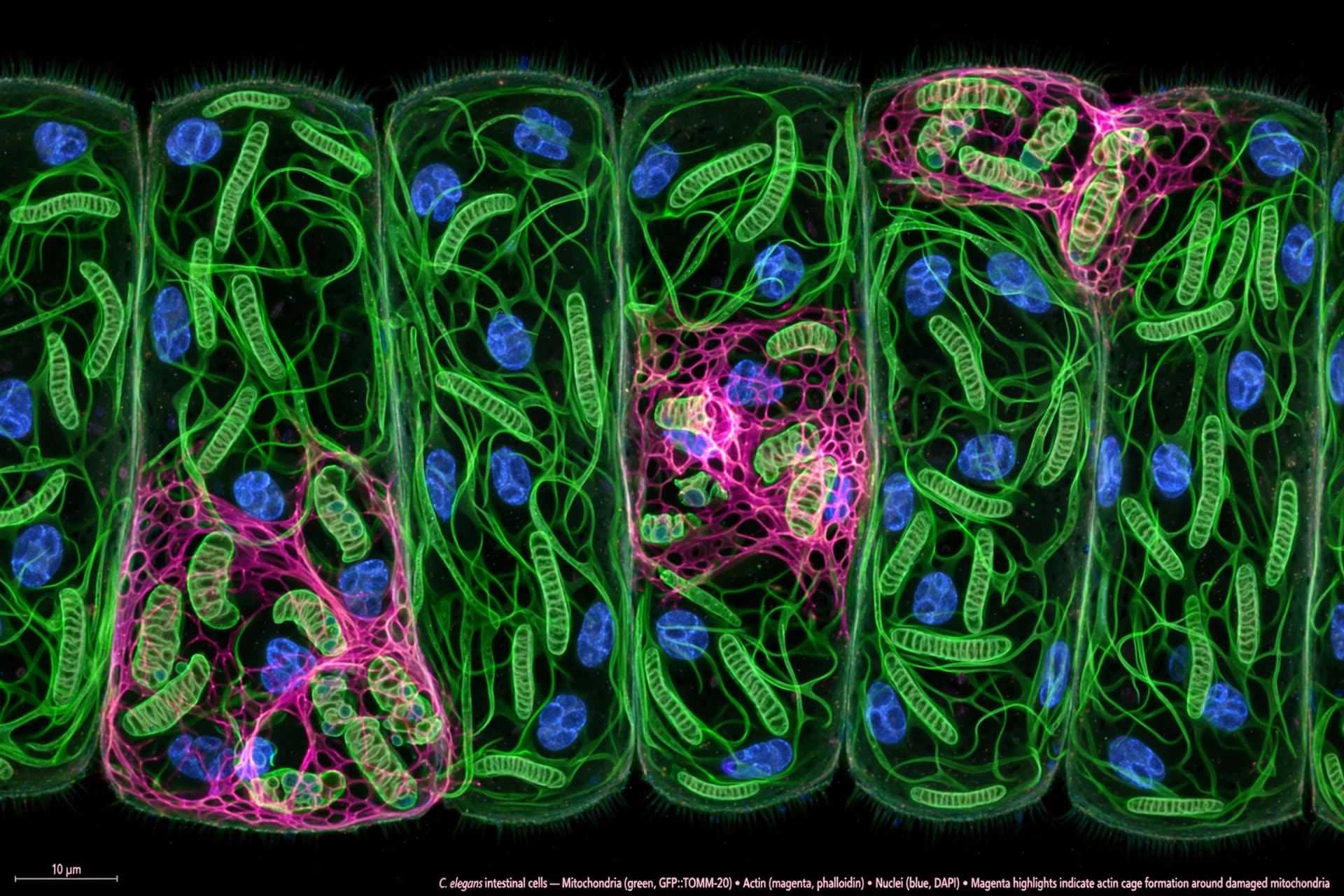
Transcriptomic profiling and imaging revealed that when InsP3R signaling was impaired, the worms' mitochondrial networks underwent a maladaptive expansion—they grew larger and more interconnected, but the mitochondria themselves were dysfunctional . The researchers traced this to a conserved actin remodeling network centered on Arp2/3, a protein complex that helps build actin filaments. The InsP3R, it seemed, was promoting the formation of actin cages that segregate and constrain damaged mitochondria, keeping them in check and allowing the cell to clear them through autophagy .
When the researchers disrupted this actin remodeling, they mimicked the effects of losing InsP3R—mitochondria expanded abnormally, and the longevity benefit disappeared. Conversely, when they forced the mitochondria to fragment, the expansion was ameliorated and lifespan was rescued . The findings suggest that the InsP3R-dependent actin network acts as a quality control mechanism, segregating dysfunctional mitochondria and promoting their turnover.
The work adds a structural dimension to existing models of mitochondrial longevity, which have focused primarily on metabolic and transcriptional rewiring . It also identifies a potential target for interventions aimed at promoting healthier aging. By understanding how cells manage damaged mitochondria, researchers may find ways to help them do so more effectively—not just in worms, but in the complex organisms that share the same basic machinery.
AI Image Disclaimer: The images accompanying this article were generated by artificial intelligence and are intended for conceptual illustration only.
Sources: Nature Communications, NIH RePORTER, bioRxiv
Published by Banx Network. This article is part of the Banx decentralized media programme, powered by the BXE token on the XRP Ledger.