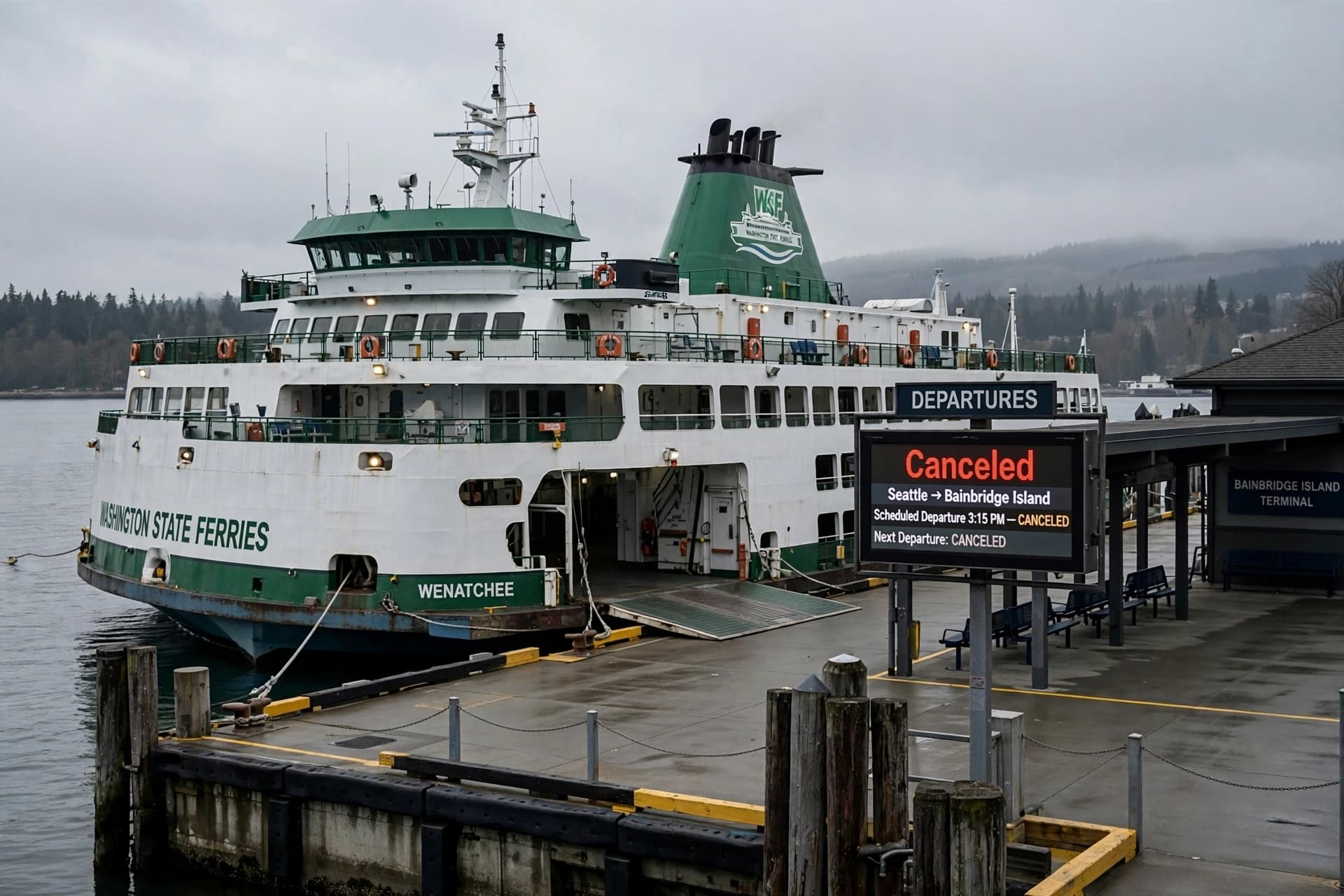
There is a particular kind of disruption that arrives not from a storm or a mechanical failure but from the people who keep the system running—a disruption that is measured in canceled sailings and stranded commuters, but that speaks to something deeper: the accumulated frustration of workers who feel their labor is undervalued and their voices unheard. Across Puget Sound on Monday, that frustration took the form of a coordinated sick-out. Twenty-three engine room employees called in sick. The workers qualified to replace them declined to fill in. And by the end of the morning, 13 of Washington State Ferries' 18 vessels—72 percent of the fleet—were out of service, leaving thousands of commuters scrambling for alternatives .
The impact was immediate and widespread. Entire routes were shut down: Seattle-Bainbridge Island, Edmonds-Kingston, and the Vashon-Southworth-Fauntleroy triangle—all heavy commuter corridors carrying workers into Seattle—had no boats operating. The Port Townsend-Coupeville route was canceled entirely, then returned in the afternoon when a position was filled. The Mukilteo-Clinton route ran a single boat, with half its scheduled trips canceled and drivers waiting an estimated three hours to cross . The Anacortes-San Juans route had two of three ferries out of service, with up to seven sailings canceled .
The Marine Engineers' Beneficial Association, the union representing the engine room workers, said it did not coordinate the sick-out. Instead, it described the action as a "frantic cry for help from an abused and frustrated group of highly-skilled and committed workers" . The union did not say whether the staffing crisis would continue beyond Monday. The ferry system said it expected employees to return to work as soon as possible and was investigating what contributed to the number of callouts .
The grievances behind the action are not new. Ferry workers have long complained of uncompetitive wages and a reliance on overtime that drives burnout. A survey of more than 80 union members conducted in June found that more than 60 percent were either somewhat or very likely to retire or leave the ferry system for another job. Over half reported poor morale among their colleagues . The ferry agency has countered that chief engineers have a base salary of $157,000 that can rise to $350,000 with overtime, retirement accrual, and paid time off—figures that suggest the dispute is not about base pay alone but about working conditions and the sustainability of a system that depends on chronic overtime .
State law prohibits work stoppages or strikes among ferry workers. But the sick-out, whether coordinated or spontaneous, achieved what a strike would have: a visible demonstration of the system's dependence on a workforce that feels pushed to its limits. Kitsap Transit added two additional fast ferry sailings between Bremerton and Seattle to accommodate displaced commuters . For everyone else, the day was a reminder that the infrastructure we rely on is only as reliable as the people who operate it—and that when those people feel unheard, the consequences are measured not in press releases but in empty docks and canceled plans.
AI Image Disclaimer: All images in this article were generated by artificial intelligence and are for illustrative purposes only.
Sources: KUOW, News From The States, KOMO News, Nonstop Local News, Yakima Herald-Republic
Published by Banx Network. This article is part of the Banx decentralized media programme, powered by the BXE token on the XRP Ledger.