For decades, the global financial system has been built around institutions, correspondent banks, payment networks, clearing houses and central banks.
It works.
But it is also remarkably complicated.
Moving money across borders can involve multiple intermediaries, separate ledgers, foreign-exchange conversions, compliance checks and reconciliation processes. A payment may appear instantaneous to a customer while the underlying movement and settlement of funds remains fragmented across financial institutions and jurisdictions.
Now, that architecture is beginning to change.
Blockchain technology, tokenisation, stablecoins, central bank digital currencies and tokenised bank deposits are challenging assumptions that have defined financial infrastructure for generations.
The Bank for International Settlements has described tokenisation as a potential foundation for the next generation of the monetary and financial system, particularly because it can combine messaging, reconciliation and settlement into a more integrated process.[1]
The question is no longer whether finance will become more digital.
It already has.
The more important question is what the financial system will look like when money and financial assets become programmable, transferable 24 hours a day and increasingly native to digital networks.
And within that transformation sits XRP.
XRP was created as the native digital asset of the XRP Ledger, a blockchain designed around payments and value transfer. The ledger supports cross-currency transactions, atomic settlement and mechanisms through which XRP can act as a bridge between different assets.[2]
That does not mean XRP is destined to replace banks, national currencies or existing payment systems.
But it does mean XRP represents an interesting experiment in something the traditional financial system has historically struggled with:
moving value between different financial networks without requiring every participant to maintain a direct relationship with every other participant.
If the financial system is entering an era of tokenised money and assets, XRP's role could become less about cryptocurrency speculation and more about the infrastructure required to connect fragmented pools of liquidity.
1. The Financial System Was Built for Another Era
The modern financial system evolved incrementally.
Banks developed correspondent relationships.
Central banks developed settlement systems.
Payment networks created standards for moving information.
Clearing houses reduced counterparty risk.
Stock exchanges developed increasingly sophisticated electronic infrastructure.
The internet then digitised much of the information layer.
But one important distinction remained:
information could move globally almost instantly, while financial settlement often remained dependent on institutions operating across different systems.
Sending an email does not require a bank in London to maintain a direct financial relationship with a bank in Tokyo.
Moving money can.
This creates a fundamental asymmetry.
The internet became global.
Financial infrastructure remained partially fragmented.
That fragmentation is one reason cross-border payments continue to attract attention from central banks, regulators and financial institutions.
The Financial Stability Board's G20 roadmap has established targets for making cross-border payments faster, cheaper, more transparent and more accessible.[3]
Yet progress remains difficult.
The FSB's 2025 progress report warned that improvements had not yet translated into meaningful global improvements for end users and suggested the 2027 targets were unlikely to be achieved on schedule.[4]
The problem is therefore not simply technological.
It is architectural.
2. The Correspondent Banking Problem
Imagine a company in Britain paying a supplier in another country.
The sender's bank may need to communicate with another institution.
That institution may interact with another bank.
Foreign exchange may need to occur somewhere in the chain.
Compliance checks may take place at different stages.
Balances need to be reconciled.
Each participant has its own systems, records, operating hours and risk controls.
None of this is necessarily inefficient because the institutions are incompetent.
It is inefficient because the system evolved through layers.
The result is a financial network composed of interconnected but separate databases.
Blockchain proposes a different architecture.
Instead of every institution maintaining completely separate records and reconciling them later, multiple participants can interact with a shared ledger where transactions are recorded according to common rules.
That creates the possibility of settlement becoming part of the transaction itself.
This distinction is critical.
3. From Messaging Money to Moving Money
Traditional financial infrastructure often separates several stages:
Instruction → messaging → clearing → reconciliation → settlement
Tokenisation potentially compresses these stages.
A programmable financial network can combine:
instruction + asset transfer + settlement + automated conditions
into a single process.
The BIS has highlighted precisely this potential, arguing that tokenisation can integrate messaging, reconciliation and settlement into a single operation.[1]
The IMF has similarly argued that tokenisation can embed ownership and transfer directly into assets, allowing smart contracts to coordinate trades, ownership transfers and payments.[5]
This is potentially transformative.
A tokenised bond could theoretically settle automatically when payment is received.
Collateral could move automatically when conditions are triggered.
A cross-border payment could execute according to predefined rules.
A financial asset could remain transferable around the clock rather than being constrained by the operating hours of multiple intermediaries.
The financial system begins to resemble software.
And that is where XRP becomes interesting.
4. What Exactly Is XRP?
XRP is the native asset of the XRP Ledger.
The distinction between XRP, the XRP Ledger and Ripple is important.
XRP is the digital asset.
The XRP Ledger is the blockchain network on which XRP operates.
Ripple is a separate technology company that develops financial products and infrastructure and has incorporated XRP and the XRP Ledger into certain payment solutions.
They are not interchangeable terms.
The XRP Ledger was designed around payments and supports direct XRP transfers, cross-currency transactions, escrow, payment channels and other financial functions.[6]
The network's consensus mechanism allows transactions to settle in near real time, with XRPL documentation describing typical settlement times of roughly three to six seconds.[7]
The important concept is therefore not simply:
"XRP is a cryptocurrency."
It is:
"XRP is a liquid digital asset operating on a ledger designed to move value."
That distinction becomes increasingly important as financial markets explore tokenisation.
5. XRP as a Bridge Asset
One of the most interesting potential roles for XRP is as a bridge asset.
Consider two currencies:
USD → ? → EUR
Traditional financial infrastructure may require relationships, liquidity and settlement arrangements between financial institutions dealing in both currencies.
A digital bridge asset creates another possibility:
USD → XRP → EUR
The XRP Ledger supports cross-currency payments in which XRP can effectively bridge different assets when doing so provides a suitable path through the ledger's liquidity.[8]
The concept is simple.
Instead of requiring every currency pair to have deep direct liquidity, a sufficiently liquid intermediary asset could connect multiple markets.
This is similar conceptually to how major currencies have historically functioned in foreign exchange markets.
The difference is that XRP is digitally native.
It does not represent a claim on a bank deposit.
It is transferable directly on its underlying ledger.
And the transaction can settle without requiring the asset itself to be moved through a traditional correspondent banking chain.
That is the theory.
The challenge is turning that theory into deep, reliable liquidity at institutional scale.
6. Liquidity Is the Real Battle
Speed is easy to talk about.
Liquidity is harder.
A blockchain can settle a transaction in seconds.
But if there is insufficient liquidity between the currencies being exchanged, settlement speed becomes irrelevant.
This is one of the biggest questions surrounding XRP's potential role in global finance.
A bridge asset needs more than technological efficiency.
It needs:
deep liquidity narrow spreads reliable market makers institutional access regulatory compatibility sufficient trading volume stable infrastructure predictable settlement confidence from financial institutions
The financial system does not adopt infrastructure merely because it is technically impressive.
It adopts infrastructure when it is economically useful and sufficiently trusted.
This is why XRP's future role cannot be measured simply by transaction speed.
The more important metric may eventually be how much real financial activity can reliably move through the network.
7. XRP Does Not Have to Replace Fiat
One of the biggest misconceptions surrounding crypto is that digital assets necessarily need to replace national currencies.
They do not.
XRP could potentially function as an intermediary asset without becoming the world's primary unit of account.
A British company can continue accounting in pounds.
A Japanese company can continue accounting in yen.
A European company can continue accounting in euros.
The bridge asset would exist between them.
Conceptually:
GBP → XRP → JPY
The businesses do not need to price their goods in XRP.
They simply use a digital asset as part of the settlement process.
This distinction could become increasingly important as the global financial system becomes more tokenised.
The future may not be:
fiat versus crypto.
It could instead be:
fiat + tokenised money + stablecoins + tokenised assets + digital settlement assets.
8. The Rise of Stablecoins Changes the Equation
XRP is not entering an empty market.
Stablecoins are becoming one of the most important competing models for blockchain-based payments.
A stablecoin attempts to represent a stable value, typically by referencing a fiat currency such as the US dollar.
That gives stablecoins an obvious advantage for certain payment applications.
If a business wants to send $1 million, it may prefer a digital token designed to remain approximately equal to $1 rather than an asset whose market price can fluctuate significantly.
This creates an important question:
Why would financial institutions need XRP if stablecoins can move dollars and euros directly?
The answer could lie in interoperability.
A dollar stablecoin is useful within its ecosystem.
A euro stablecoin is useful within its ecosystem.
A tokenised bank deposit is useful within its banking ecosystem.
A CBDC is useful within its jurisdictional framework.
But the global financial system will contain many different forms of digital money.
That creates a new problem.
How do they interact?
9. The Coming Multi-Money World
The future financial system may contain:
tokenised bank deposits stablecoins CBDCs tokenised securities tokenised government bonds digital commercial paper tokenised commodities cryptocurrencies traditional bank money
The result could be a highly fragmented digital economy.
One network could issue a tokenised dollar.
Another could issue a tokenised euro.
A bank could create tokenised deposits.
A central bank could issue digital central-bank money.
A securities platform could tokenize government bonds.
Each system could technically operate perfectly.
But the world economy does not operate inside a single system.
It operates between systems.
That means interoperability could become one of the most valuable problems to solve.
10. XRP and the Interoperability Problem
The next generation of finance may therefore need something more sophisticated than simply putting assets on blockchains.
It needs those blockchains to communicate.
The XRP Ledger itself is developing cross-chain functionality designed to allow assets to move between the XRPL and other blockchains.[9]
That points toward a broader vision.
Instead of one blockchain becoming the universal financial network, multiple networks could coexist.
The financial system could become a network of networks.
XRP could potentially function as one of the assets used to move value between those networks.
That would be a very different role from becoming "global money."
It would be closer to becoming a digital liquidity bridge.
11. The Financial System Is Already Moving Toward Tokenisation
This transformation is not purely a crypto-sector theory.
Traditional financial institutions and central banks are actively experimenting with tokenisation.
The BIS has developed Project Agorá, a major public-private initiative involving central banks and financial institutions to explore tokenised wholesale cross-border payments.[10]
In May 2026, the BIS reported that the Agorá prototype demonstrated the feasibility of atomic cross-border settlement using tokenised central bank reserves and tokenised commercial bank deposits.[10]
This is significant.
The institutions experimenting with the future of finance are not simply asking:
"How do we put cryptocurrency into banking?"
They are asking:
"How do we redesign settlement itself?"
That is a much bigger question.
12. The Tokenised Financial System
Imagine a future financial transaction.
A company purchases a tokenised government bond.
Its bank holds tokenised deposits.
The bond exists on a programmable ledger.
The payment and security transfer execute simultaneously.
Compliance conditions are automatically verified.
Settlement occurs immediately.
Collateral requirements update automatically.
The transaction is recorded on a shared infrastructure.
There is no need to wait for multiple institutions to reconcile their records at the end of the day.
This is the direction that tokenisation could take financial markets.
The BIS has described a future architecture in which tokenised central bank reserves, commercial bank money and financial assets could coexist within interconnected programmable infrastructure.[1]
The IMF has similarly highlighted the potential for tokenisation to reduce certain settlement and intermediation frictions while warning that new forms of technological and systemic risk could emerge.[5]
The financial system is therefore not simply becoming digital.
It could become programmable.
13. Where Does XRP Fit?
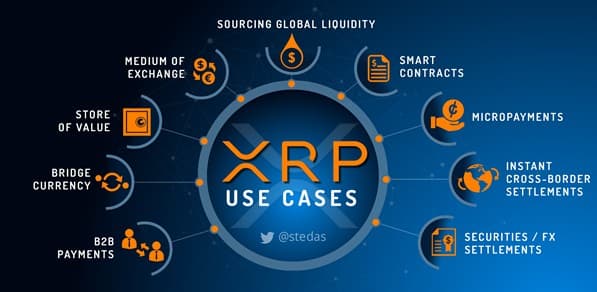
There are several possible roles.
1. Bridge liquidity
XRP could facilitate conversion between different currencies or tokenised assets.
2. Settlement asset
Institutions could use XRP to transfer value across participating networks.
3. Collateral
Digital assets can potentially be used as collateral within increasingly tokenised financial markets.
4. Liquidity routing
The XRP Ledger's decentralised exchange and payment paths can facilitate conversions between assets.[8]
5. Cross-network settlement
As blockchain interoperability develops, XRP could potentially become one asset used to move value between ecosystems.
None of these outcomes is guaranteed.
But they represent the architectural reason XRP continues to attract attention.
14. Ripple Is Not the Same Thing as XRP
This distinction deserves its own section because it is frequently misunderstood.
Ripple is a company.
XRP is a digital asset.
The XRP Ledger is an open blockchain.
Ripple develops products that can use blockchain infrastructure and digital assets to facilitate payments.
Ripple's current payments offering states that its cross-border payment infrastructure can use the XRP Ledger and digital assets for near-real-time settlement.[11]
But the existence of Ripple's products does not automatically mean every transaction uses XRP.
Nor does the growth of Ripple as a company automatically prove that XRP will become global settlement infrastructure.
The two should be analysed separately.
The long-term XRP thesis depends on whether the asset itself provides sufficient economic utility within a changing financial system.
15. XRP Versus Stablecoins
The debate between XRP and stablecoins may become increasingly important.
Feature XRP Stablecoins Primary design Digital asset / liquidity bridge Stable-value digital token Price stability Variable Designed to track reference currency Settlement Native blockchain settlement Blockchain settlement Cross-currency role Potential bridge asset Usually tied to specific currency Main challenge Volatility and liquidity depth Issuer, reserve, regulatory and interoperability risks Potential role Connecting liquidity Digital representation of money
The two technologies do not necessarily have to eliminate each other.
They could coexist.
A financial institution might use stablecoins for certain transactions while using another digital asset for liquidity or conversion between currencies.
The future financial system could therefore contain multiple settlement instruments.
16. CBDCs Create Another Layer
Central bank digital currencies represent another possibility.
A CBDC would effectively digitise central bank money for particular use cases.
That could provide governments and central banks with a powerful tool for modernising payment infrastructure.
But CBDCs also create an interoperability challenge.
If Britain has one digital currency architecture, the euro area has another and Japan has another, global payments still require mechanisms connecting them.
This is why interoperability could become as important as the individual digital currencies themselves.
The BIS has explicitly explored multi-currency programmable platforms and tokenised central-bank money through projects such as Agorá.[10]
The future could therefore contain:
CBDCs + tokenised deposits + stablecoins + blockchain networks + digital bridge assets.
The winning architecture may not be one asset.
It may be the system that allows all of them to interact.
17. The Death of the 9-to-5 Financial System?
Perhaps one of the most important consequences of tokenised finance is time.
Traditional financial markets operate according to schedules.
Banks have business hours.
Markets have opening and closing times.
Settlement systems have operating windows.
Weekends can interrupt financial activity.
Blockchain networks do not inherently need those limitations.
The XRP Ledger operates continuously.
That creates the possibility of financial infrastructure operating:
24 hours a day 7 days a week 365 days a year.
This could become increasingly important for global commerce.
A company in London should not necessarily have to wait for another jurisdiction's banking system to open before completing a financial transaction.
A tokenised financial system could make settlement more like the internet:
always available.
18. The Rise of Programmable Money
The next stage is even more interesting.
Money may become programmable.
Consider an international trade transaction.
A buyer sends payment.
The seller's digital asset is automatically released.
Customs documentation is verified.
Insurance conditions are checked.
The transaction settles.
The payment becomes final.
All of this could occur through programmable infrastructure.
This is one of the major attractions of tokenisation.
The financial transaction stops being merely a transfer of value.
It becomes a programmable event.
XRP could potentially participate in such systems as one component of the settlement layer.
19. But Programmability Creates New Risks
The transformation is not automatically positive.
When financial systems become software, software risks become financial risks.
A smart contract can contain an error.
A blockchain bridge can become a target.
A digital asset can experience extreme volatility.
A stablecoin can face a reserve or redemption crisis.
A network can become concentrated around particular infrastructure providers.
The IMF has warned that tokenisation can reduce certain inefficiencies while also creating new risks through greater interconnectedness, automated contracts and concentration of infrastructure.[12]
The faster financial systems operate, the faster problems can propagate.
Instant settlement can reduce counterparty exposure.
But it can also reduce the time institutions have to react.
Efficiency and resilience therefore have to evolve together.
20. Regulation Will Shape the Architecture
Financial infrastructure cannot simply develop outside the regulatory system.
Banks must comply with:
anti-money-laundering rules sanctions requirements capital requirements consumer protection market-abuse regulations data rules settlement-finality laws
Blockchain does not eliminate those requirements.
It changes how they might be implemented.
Future financial networks may therefore embed compliance directly into their architecture.
Identity could become programmable.
Transaction permissions could be automated.
Suspicious activity could be monitored in real time.
Settlement rules could be encoded into financial instruments.
This is one reason central banks and regulators are increasingly interested in tokenisation.
They are not necessarily trying to replace the financial system.
They are exploring how to modernise it without destroying the foundations that make it trustworthy.
21. XRP's Regulatory History Matters
XRP's regulatory history also cannot be ignored.
The SEC's long-running litigation against Ripple produced important distinctions concerning different types of XRP sales.
The federal court found that certain institutional sales constituted unregistered offers or sales of investment contracts, while programmatic sales on secondary markets were treated differently.[13]
The litigation subsequently moved toward resolution, while regulatory considerations around direct institutional sales remained relevant.[14]
This history matters because financial institutions need legal certainty.
A bank is unlikely to build critical infrastructure around an asset if its legal status is unclear in every major jurisdiction.
Therefore, regulatory clarity could become just as important as transaction speed or technology.
22. XRP's Biggest Challenge May Not Be Technology
The XRP Ledger already demonstrates that digital value can move quickly.
The harder problem is adoption.
Financial infrastructure is difficult to replace because institutions have invested decades and enormous amounts of capital into existing systems.
Banks cannot simply switch overnight.
They have customers.
They have regulators.
They have legacy databases.
They have compliance systems.
They have liquidity relationships.
They have operational risk departments.
They have contractual obligations.
Therefore, the transition to blockchain-based finance is likely to be gradual.
The most realistic scenario may not be:
Old financial system → XRP
It may be:
Old financial system → hybrid financial system → increasingly tokenised financial system.
XRP would have to prove its value at every stage.
23. The Network Effect
Financial infrastructure is ultimately about network effects.
A payment network becomes more useful when more participants use it.
A liquidity pool becomes deeper when more participants provide liquidity.
An exchange becomes more useful when more assets are available.
A settlement network becomes more valuable when more institutions connect to it.
This creates a difficult early-stage problem.
Why should banks use a new settlement network if other banks are not using it?
And why should other banks join if there is insufficient liquidity?
The answer must come from genuine economic advantages.
If XRP can reduce liquidity costs, settlement friction or intermediary dependency, adoption becomes economically rational.
If it cannot, technological elegance will not be enough.
24. The Corporate Treasury Question
Another potential development is the emergence of companies that hold digital assets as treasury assets.
Evernorth's planned XRPN public-market strategy provides an interesting example of how corporate structures are beginning to experiment with XRP exposure.
That model is fundamentally different from using XRP for payments.
One is a treasury and capital-markets strategy.
The other is financial infrastructure.
But they reflect the same broader development:
digital assets are increasingly being considered within traditional corporate finance rather than existing solely inside crypto-native markets.
The significance may ultimately be less about any single company and more about whether digital assets become normal components of institutional financial strategy.
25. Could XRP Become a Global Liquidity Layer?
This is where the thesis becomes ambitious.
Imagine a world where:
dollars are tokenised euros are tokenised pounds are tokenised government bonds are tokenised corporate securities are tokenised stablecoins circulate globally CBDCs connect national economies banks issue tokenised deposits financial institutions operate blockchain-based settlement systems
The system would be extraordinarily powerful.
But it would also be fragmented.
There could be hundreds or thousands of digital financial networks.
The most valuable infrastructure might therefore not be the network that contains every asset.
It might be the infrastructure that connects the networks.
That is where XRP's bridge-asset thesis becomes particularly interesting.
26. Three Possible Futures Scenario One: XRP Remains Primarily a Crypto Asset
Tokenisation grows.
Stablecoins dominate digital payments.
CBDCs develop.
Banks create their own tokenised settlement systems.
XRP remains an important cryptocurrency but does not become a major component of institutional financial infrastructure.
In this scenario, XRP's value comes primarily from the broader digital-asset economy and activity on the XRP Ledger.
Scenario Two: XRP Becomes a Major Settlement Asset
Cross-border finance becomes increasingly tokenised.
Institutions require neutral liquidity between different currencies and blockchain networks.
XRP develops deep institutional liquidity.
Payment providers use it as a bridge asset.
Financial institutions integrate the XRP Ledger into settlement infrastructure.
XRP becomes one of several important digital settlement assets.
It does not replace national currencies.
Instead, it becomes part of the machinery connecting them.
Scenario Three: The Multi-Asset Financial Internet
This may be the most interesting possibility.
No single digital asset dominates.
Instead, the global financial system becomes a network of interconnected ledgers.
CBDCs provide central-bank money.
Tokenised deposits provide commercial-bank money.
Stablecoins provide private digital liquidity.
Tokenised securities represent financial assets.
Public blockchains provide open settlement networks.
Bridge assets connect liquidity between ecosystems.
In this world, XRP would not need to become the global currency.
It would only need to become one of the important assets connecting the system.
27. 2030: Finance Becomes Programmable
By 2030, the most important financial transformation may not be cryptocurrency adoption.
It may be tokenisation.
Banks could increasingly issue tokenised deposits.
Investment firms could issue tokenised funds and bonds.
Financial markets could operate with shorter settlement cycles.
Cross-border payment systems could become more interconnected.
Stablecoins could become more heavily regulated.
CBDC experiments could mature.
Blockchain infrastructure could become invisible to consumers.
The average person might not even know which blockchain processed a transaction.
Just as people use the internet without thinking about TCP/IP, financial infrastructure could become blockchain-based without consumers consciously interacting with crypto.
That would represent genuine technological adoption.
28. 2040: The Financial Internet
Go further.
Imagine opening a financial account in 2040.
Instead of interacting with separate banking, investment and payment systems, you access a unified financial interface.
Your money is digital.
Your investments are tokenised.
Your bonds settle instantly.
Your mortgage collateral is programmable.
Your international payments execute around the clock.
Your assets can move between platforms.
Compliance happens automatically.
Financial contracts become software.
The distinction between payment infrastructure and financial markets begins to disappear.
This could be the financial internet.
And assets like XRP could potentially serve as liquidity between parts of that network.
29. The Biggest Question Is Not "Will XRP Reach $X?"
Financial markets often reduce the XRP debate to price.
How high can XRP go?
How much XRP could institutions buy?
What market capitalisation is possible?
Those questions may matter to investors.
But they are not the most interesting questions about XRP's technological role.
The deeper questions are:
Can XRP provide economically valuable liquidity?
Can the XRP Ledger connect different forms of digital value?
Can institutions use it within regulated financial infrastructure?
Can liquidity become deep enough to support large transactions?
Can it coexist with stablecoins, CBDCs and tokenised deposits?
Can regulators accommodate its use?
Can financial institutions trust the infrastructure?
These questions determine whether XRP becomes infrastructure or remains primarily an investment asset.
30. The Changing Definition of Money
For centuries, money has evolved.
Shells became coins.
Coins became banknotes.
Banknotes became bank deposits.
Bank deposits became digital balances.
Now digital balances themselves are becoming programmable tokens.
The next transformation may therefore not be the invention of entirely new money.
It may be the transformation of existing money into programmable digital infrastructure.
The same could happen to financial assets.
Stocks.
Bonds.
Funds.
Loans.
Collateral.
Currencies.
All could increasingly become tokenised.
The financial system would then move from a world of accounts and databases toward a world of interoperable digital assets.
31. XRP's Potential Role in That World
XRP does not need to replace the dollar.
It does not need to replace the euro.
It does not need to replace central banks.
It does not even need to replace banks.
Its potential role is narrower—and arguably more interesting.
It could become a bridge between financial systems.
A digital asset that provides liquidity between different currencies.
A settlement asset capable of moving value across borders.
A component of tokenised financial infrastructure.
A bridge between blockchain ecosystems.
A liquidity instrument in a world where financial assets increasingly exist digitally.
That is a very different proposition from simply being another cryptocurrency.
32. But Nothing Is Guaranteed
The future of XRP remains uncertain.
Other technologies could solve the same problems.
Banks could develop interoperable tokenised deposit systems.
Central banks could create highly efficient CBDC networks.
Stablecoins could become the dominant form of digital cross-border settlement.
Traditional payment networks could modernise faster than expected.
New blockchain architectures could outperform existing networks.
Regulatory changes could alter the economics of digital assets.
And financial institutions may ultimately choose private or permissioned infrastructure over public networks.
The financial system does not owe XRP a role.
XRP has to earn one.
33. The Bigger Transformation
That may actually be the most important conclusion.
The future of finance is unlikely to be determined by one cryptocurrency.
It will be determined by architecture.
How does money move?
How are assets represented?
How is ownership verified?
How is settlement achieved?
How are different currencies connected?
How do blockchains communicate?
How do banks interact with public networks?
How do central banks maintain monetary stability?
How can financial markets become faster without becoming more fragile?
These are the questions shaping the next generation of finance.
And XRP is one experiment within that much larger transformation.
34. The Financial System Is Becoming Software
The twentieth-century financial system was built around institutions.
The twenty-first-century financial system may increasingly be built around networks.
Banks will still exist.
Central banks will still exist.
Currencies will still exist.
Regulators will still exist.
But the infrastructure connecting them could fundamentally change.
Money could become programmable.
Assets could become tokenised.
Settlement could become continuous.
Markets could become global and always-on.
And liquidity could increasingly move through digital networks.
XRP's opportunity lies somewhere inside that transformation.
Not necessarily as the world's new currency.
Not necessarily as a replacement for banks.
But potentially as one of the digital assets that helps connect an increasingly fragmented financial world.
Conclusion: The Bridge to the Next Financial System
The financial system is entering a period of structural change.
The internet transformed how information moves.
Tokenisation could transform how financial value moves.
Central banks are exploring programmable settlement.
Banks are experimenting with tokenised deposits.
Stablecoins are expanding.
Financial institutions are testing tokenised securities.
And projects such as BIS Project Agorá are demonstrating that tokenised infrastructure can potentially improve wholesale cross-border settlement.[10]
The destination is still uncertain.
There may never be a single global blockchain.
There may never be one universal digital currency.
There may never be one asset that connects every financial system.
But the direction is becoming clearer.
Finance is becoming more digital, programmable, interoperable and increasingly real-time.
That creates a potential role for XRP.
Its most compelling future is not necessarily as a replacement for money.
It may be as a bridge between forms of money.
Between currencies.
Between institutions.
Between blockchains.
Between traditional finance and digital assets.
Between today's fragmented financial architecture and tomorrow's interconnected financial network.
If that future emerges, XRP will not have to become the world's money.
It may simply need to become one of the ways the world's money moves.
And that may be a far more interesting role.
References
[1] Bank for International Settlements, Annual Economic Report 2025: The Next-Generation Monetary and Financial System. The BIS describes tokenisation as a mechanism capable of integrating messaging, reconciliation and settlement and discusses its potential for cross-border payments and securities markets.
[2] XRP Ledger, Cross-Currency Payments. XRPL documentation describes atomic cross-currency payments and the ability for XRP to act as an automatic bridge between assets where that path is economically advantageous.
[3] Financial Stability Board, G20 Targets for Enhancing Cross-Border Payments. The G20 targets focus on improving the cost, speed, access and transparency of cross-border payments.
[4] Financial Stability Board, G20 Roadmap for Cross-border Payments: Consolidated Progress Report for 2025. The FSB reported that progress had not yet translated into substantial global improvements for end users and warned that the 2027 targets were unlikely to be achieved on schedule.
[5] International Monetary Fund, Tokenization Can Change the World's Financial Architecture, 2026. The IMF discusses the potential efficiency benefits of tokenisation alongside new risks from automation, interconnectedness and infrastructure concentration.
[6] XRP Ledger, Payment Types. XRPL supports direct XRP payments alongside cross-currency payments, escrow, payment channels and other transaction mechanisms.
[7] XRP Ledger, Consensus Principles and Rules. XRPL documentation describes near-real-time settlement, generally in the range of three to six seconds.
[8] XRP Ledger, Cross-Currency Payments and Paths. XRPL's payment-path system allows currencies and tokens to be exchanged through order books and automated market makers, with XRP capable of serving as a bridge in suitable circumstances.
[9] XRP Ledger, Cross-Chain Bridges. XRPL documentation describes mechanisms for transferring XRP and other assets between the XRP Ledger and other blockchain networks.
[10] Bank for International Settlements, Project Agorá. The BIS-led project involves central banks and private financial institutions exploring tokenised wholesale cross-border payments. In 2026, the project reported that its prototype demonstrated the feasibility of atomic settlement using tokenised central bank reserves and commercial bank deposits.
[11] Ripple, Cross-Border Payments. Ripple describes its payment infrastructure as using blockchain-based settlement and, for relevant flows, the XRP Ledger and digital assets.
[12] International Monetary Fund, Tokenization and Financial Market Inefficiencies. The IMF examines how tokenisation can reduce some market frictions while potentially introducing new systemic and technological risks.
[13] U.S. Securities and Exchange Commission, Statement on the Agency's Settlement with Ripple Labs, Inc. The SEC's record describes the court's findings concerning different categories of XRP sales and the resulting legal proceedings.
[14] U.S. Securities and Exchange Commission filings discussing the resolution of the Ripple litigation and distinctions between institutional sales and secondary-market transactions.
Published by Banx Network. This article is part of the Banx decentralized media programme, powered by the BXE token on the XRP Ledger.