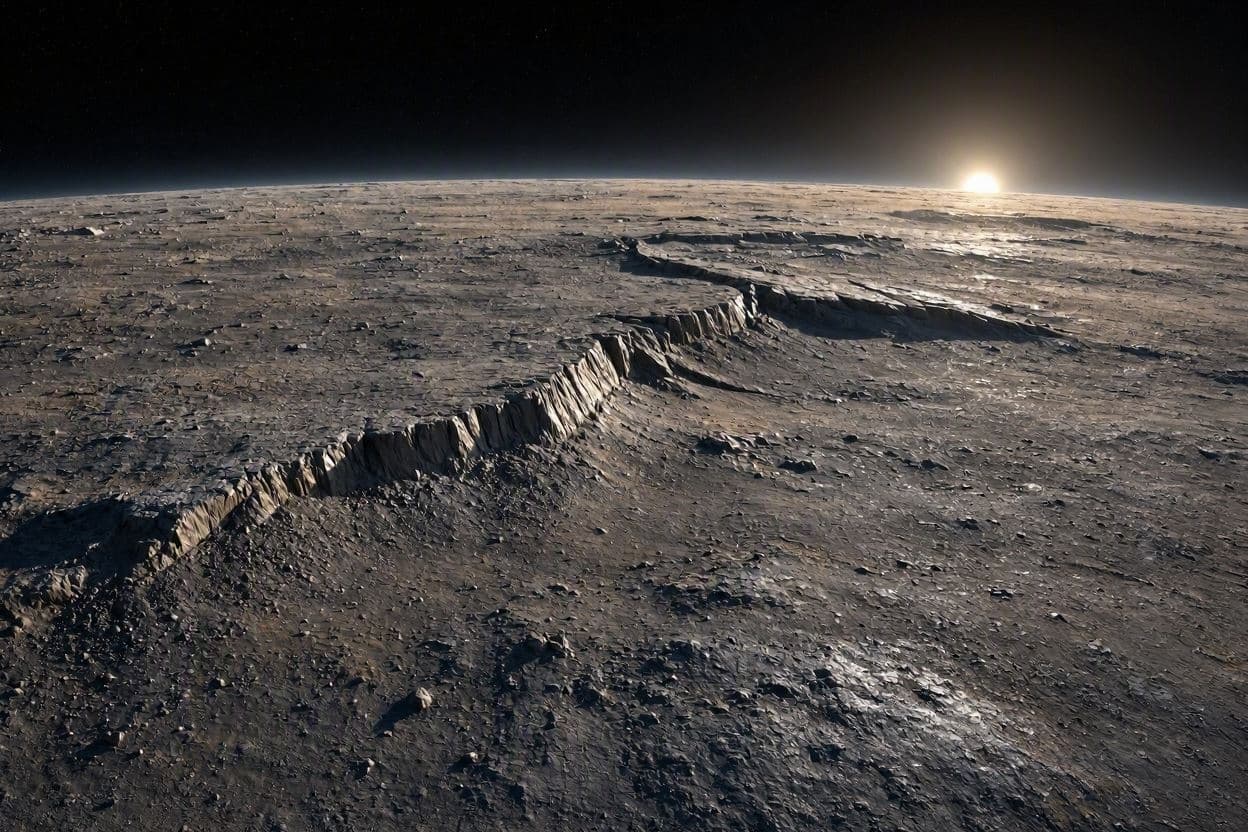
Mercury, the swift messenger of the gods, has long been a subject of fascination for astronomers. Closest to the sun, it endures extreme temperatures and a barren landscape that speaks of ancient violence. Recent studies suggest that this small world is undergoing a slow, internal contraction, a process more pronounced than previously estimated. This geological sigh, so to speak, reveals a planet that is still actively shaping its surface, reminding us that even seemingly dead worlds retain a dynamic history.
The contraction of Mercury is driven by its cooling interior. As the planet loses heat over billions of years, its volume decreases, causing the crust to wrinkle and fault. This process is analogous to an apple shrinking as it dries out, creating wrinkles on its skin. However, the scale and intensity of this contraction on Mercury are significant. New data from spacecraft missions indicate that the planet has shrunk by several kilometers in radius since its formation, a substantial change for a body of its size.
What makes this finding particularly striking is the realization that the rate of contraction may have been underestimated. Earlier models suggested a gradual settling, but recent observations of lobate scarps—cliff-like features formed by thrust faults—indicate more recent and vigorous tectonic activity. These features suggest that the planet is still adjusting to its internal cooling, with stresses building up and releasing in ways that reshape the surface.
This ongoing geological activity challenges the notion that small planets cool and become inert quickly. Mercury’s large iron core, which makes up a significant portion of its mass, plays a crucial role in this process. The core’s cooling dynamics drive the contraction, influencing the mantle and crust above. Understanding this relationship helps scientists refine models of planetary evolution, not just for Mercury but for other rocky bodies in the solar system.
The implications extend beyond mere geological curiosity. The stress caused by contraction can trigger moonquakes, or in this case, Mercurian quakes. These seismic events, though likely small, contribute to the weathering of the surface and the redistribution of regolith. They are a reminder that the planet is not static but is engaged in a slow, continuous dialogue between its interior and exterior.
For researchers, this discovery underscores the importance of detailed surface mapping. The ability to identify and date these tectonic features allows for a more accurate reconstruction of Mercury’s thermal history. It provides a window into the past, revealing how the planet has responded to the loss of heat over eons. This knowledge is invaluable for comparative planetology, helping us understand why Earth remained active while Mercury began its long decline.
Yet, there is a certain poignancy in this process. Mercury is slowly turning in on itself, a solitary dance of contraction in the harsh glare of the sun. It is a natural lifecycle, one that all terrestrial planets will eventually undergo. Observing it now, in real-time through our instruments, offers a rare glimpse into the future of our own world, albeit on a vastly different timescale.
As we continue to study Mercury, we gain a deeper appreciation for the complex life cycles of planets. Its slow collapse is not a sign of failure but a testament to the physical laws that govern all matter. It invites us to look at our neighboring worlds with renewed interest, recognizing that they too have stories to tell, written in the language of rock and time.
AI Image Disclaimer: Visuals associated with this article are AI-generated interpretations intended for illustrative purposes and do not represent actual photographic evidence.
Sources: NASA Johns Hopkins University Applied Physics Laboratory Geophysical Research Letters Planetary Science Journal
Published by Banx Network. This article is part of the Banx decentralized media programme, powered by the BXE token on the XRP Ledger.