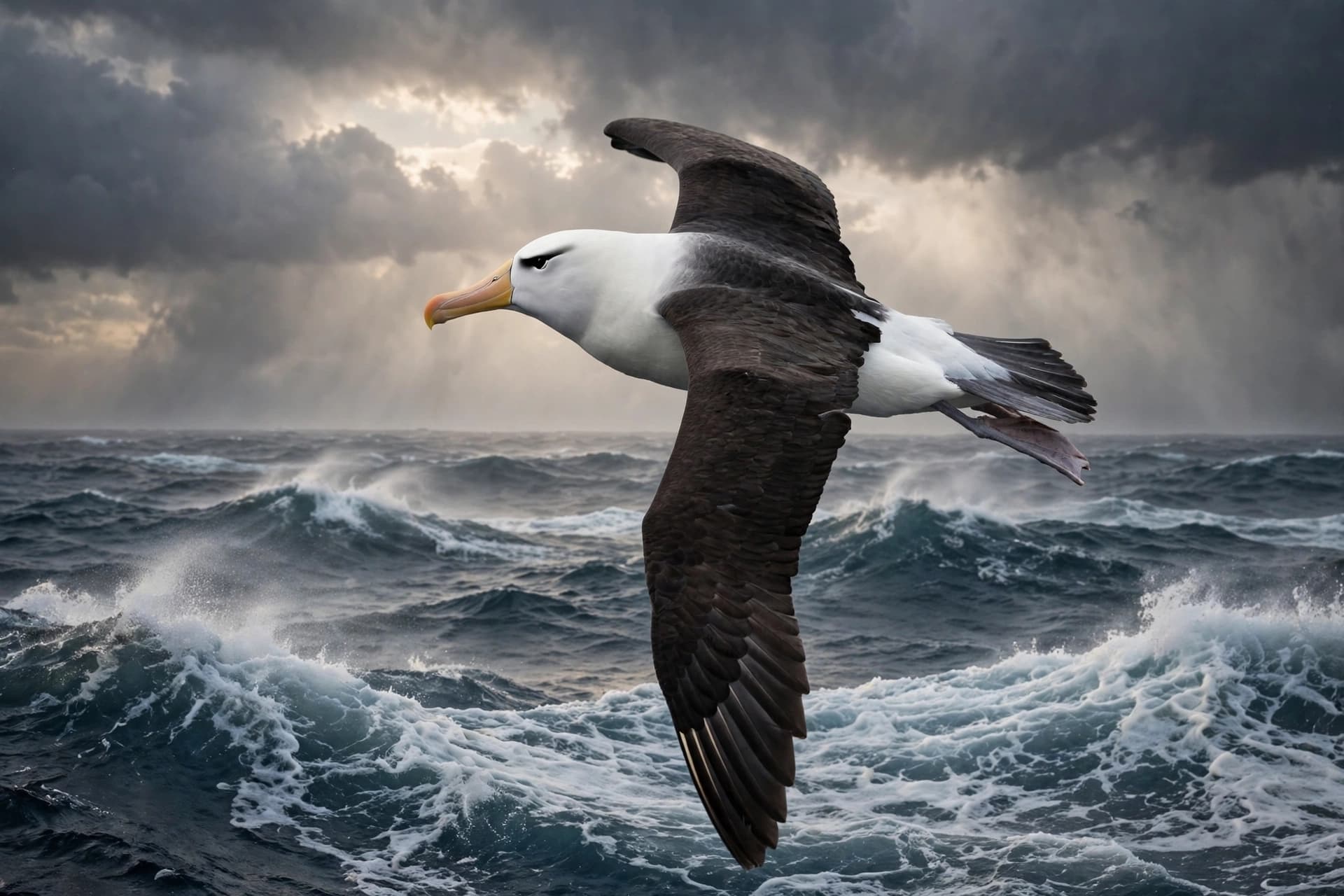
In the vast, windswept expanses of the Southern Ocean, the black-browed albatross soars with a grace that belies the precariousness of its existence. These majestic seabirds have long been symbols of endurance, navigating storms and vast distances with an instinct honed over millennia. Yet, as the climate warms and ocean dynamics shift, their ability to adapt is being tested in unprecedented ways. A recent study led by the Woods Hole Oceanographic Institution (WHOI) offers a sobering yet hopeful insight: while evolution plays a role, it is human action in mitigating climate change that holds the greatest promise for their survival.
The research, published in Proceedings of the National Academy of Sciences, combines over thirty years of demographic data with advanced eco-evolutionary modeling. By tracking individual birds and monitoring population trends, scientists sought to understand whether natural selection could help albatrosses adjust to rapidly changing environmental conditions. The findings suggest that while evolutionary adaptations can offer some resilience, they are insufficient to counteract the speed and scale of modern climate change. The pace of warming simply outstrips the biological capacity for adjustment.
Central to the study is the concept of "evolutionary rescue," where genetic changes allow a population to survive in a deteriorating environment. For the black-browed albatross, traits such as breeding timing and foraging efficiency are under selection pressure. However, the model indicates that even with favorable genetic shifts, the population would continue to decline under high-emission scenarios. This highlights a critical limitation: biology has its limits, and those limits are being reached faster than anticipated.
The alternative path, however, is one of mitigation. The study demonstrates that reducing greenhouse gas emissions significantly improves the outlook for albatross populations. Under low-emission scenarios, the pressure on these birds decreases, allowing existing adaptations to suffice and stabilizing their numbers. This finding underscores the profound impact of human policy on natural systems. It is a clear message that our choices today directly shape the viability of species tomorrow.
For conservationists, this research provides a strategic direction. While protecting breeding grounds and reducing bycatch remain essential, the overarching priority must be global climate action. The albatross serves as a sentinel species, reflecting the health of the marine ecosystem. Its struggle is not isolated but indicative of broader ecological disruptions. Saving the albatross, therefore, requires saving the ocean itself from the effects of unchecked warming.
The emotional weight of this discovery is significant. It challenges the notion that nature will always find a way, regardless of human interference. Instead, it places responsibility squarely on our shoulders. The albatross cannot evolve fast enough to outrun a warming planet, but we can slow the warming through concerted effort. This shift in perspective transforms conservation from a passive observation into an active mandate.
Moreover, the study highlights the importance of long-term data collection. The thirty-year dataset used in the analysis was crucial for distinguishing between short-term fluctuations and long-term trends. Such longitudinal studies are rare but invaluable, providing the depth of understanding needed to make accurate predictions. They remind us that patience and persistence in science yield insights that immediate snapshots cannot.
The WHOI study offers a clear directive: climate mitigation is the most effective tool for ensuring the survival of the black-browed albatross. While evolution provides a buffer, it is not a substitute for urgent environmental action. As we look to the future, the fate of these soaring giants depends largely on our willingness to address the root causes of climate change.
AI Image Disclaimer: The visuals accompanying this article are AI-generated illustrations depicting albatrosses in flight and oceanic environments, not actual photographs from the WHOI study.
Sources: Woods Hole Oceanographic Institution (WHOI) Proceedings of the National Academy of Sciences (PNAS) Earth.com
Published by Banx Network. This article is part of the Banx decentralized media programme, powered by the BXE token on the XRP Ledger.