Cities often carry memories in their stones. In Beirut, squares and streets have long served as stages for history—moments of celebration, protest, grief, and resilience. On ordinary days, Martyrs’ Square stands open beneath the Mediterranean sky, a space where footsteps echo lightly through the city’s center. But in times of uncertainty, even familiar places take on new meanings.
In recent days, that open space has begun to hold a different kind of gathering.
Families from the southern suburbs of Beirut—many leaving their homes after warnings and renewed airstrikes—have made their way toward the city’s heart. Some arrived carrying small bags, others pushing strollers or guiding children through crowded sidewalks. Their destination was not planned in advance. Like water seeking the nearest basin, people simply moved toward the wide openness of Martyrs’ Square.
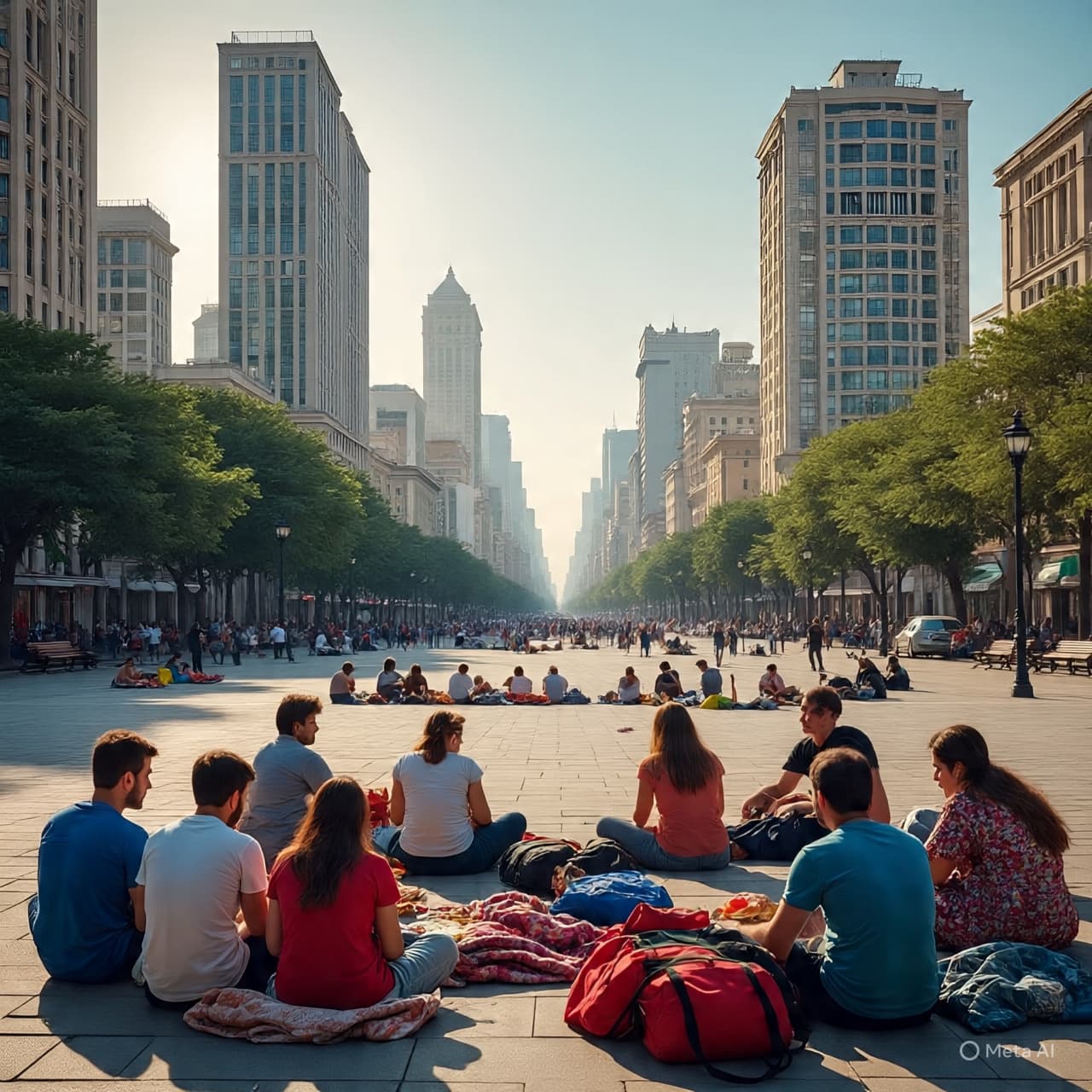
The square, usually defined by monuments and passing traffic, has gradually become a temporary resting point for those displaced by the escalating conflict. People sit on curbs, gather under trees, or rest beside parked vehicles. The open plaza offers visibility, space, and a sense—however fragile—of safety in the middle of the city.
The displacement follows a series of evacuation warnings and intensified military activity linked to the broader confrontation between Israel and Hezbollah. Entire neighborhoods in Beirut’s southern suburbs were urged to leave, prompting thousands of residents to move quickly, sometimes within minutes of the announcement. Roads out of the districts filled rapidly as families searched for safer ground.
Humanitarian agencies estimate that tens of thousands of people have already been displaced across Lebanon in the latest escalation, with some shelters filling quickly as the flow of evacuees continues. The United Nations has described the situation as a growing humanitarian emergency, noting that displacement numbers may continue to rise.
In the absence of available housing or organized shelter, many displaced people have found themselves in public spaces—squares, parking lots, and roadside areas that can accommodate large numbers at once. Martyrs’ Square, with its wide expanse and central location, has naturally become one of those gathering points.
Among those resting there are families who fled with little notice. Some wait for relatives to arrive from other neighborhoods; others scroll through phones searching for information about available shelters or safe routes. Children sit close to their parents, while volunteers and passersby occasionally bring water or food.
The square itself does not speak, yet it quietly absorbs these moments. Where crowds once assembled for civic demonstrations or national commemorations, there are now blankets laid across the pavement and conversations carried in low voices.
Beirut has known displacement before. The city’s memory holds many such chapters, when ordinary places temporarily became lifelines during uncertain times. In those moments, squares and streets transform into something beyond architecture—they become pauses in the journey between leaving and returning.
For now, Martyrs’ Square continues to hold that pause.
Authorities and humanitarian groups are working to expand shelter capacity and coordinate assistance as the displacement grows. Yet the movement of people through the city reflects a deeper uncertainty, one that cannot be measured solely in numbers.
In the quiet corners of the square, families sit beneath the open sky, waiting for news, for direction, for the moment when the road home might appear again.
AI Image Disclaimer
Illustrations were produced with AI and serve as conceptual depictions.
Source Check
Credible coverage does exist for this event. Mainstream and regional outlets reporting on displacement in Beirut and people gathering in Martyrs’ Square include:
1. Reuters
2. The Guardian
3. The National
4. Al-Monitor
5. L’Orient Today
Published by Banx Network. This article is part of the Banx decentralized media programme, powered by the BXE token on the XRP Ledger.