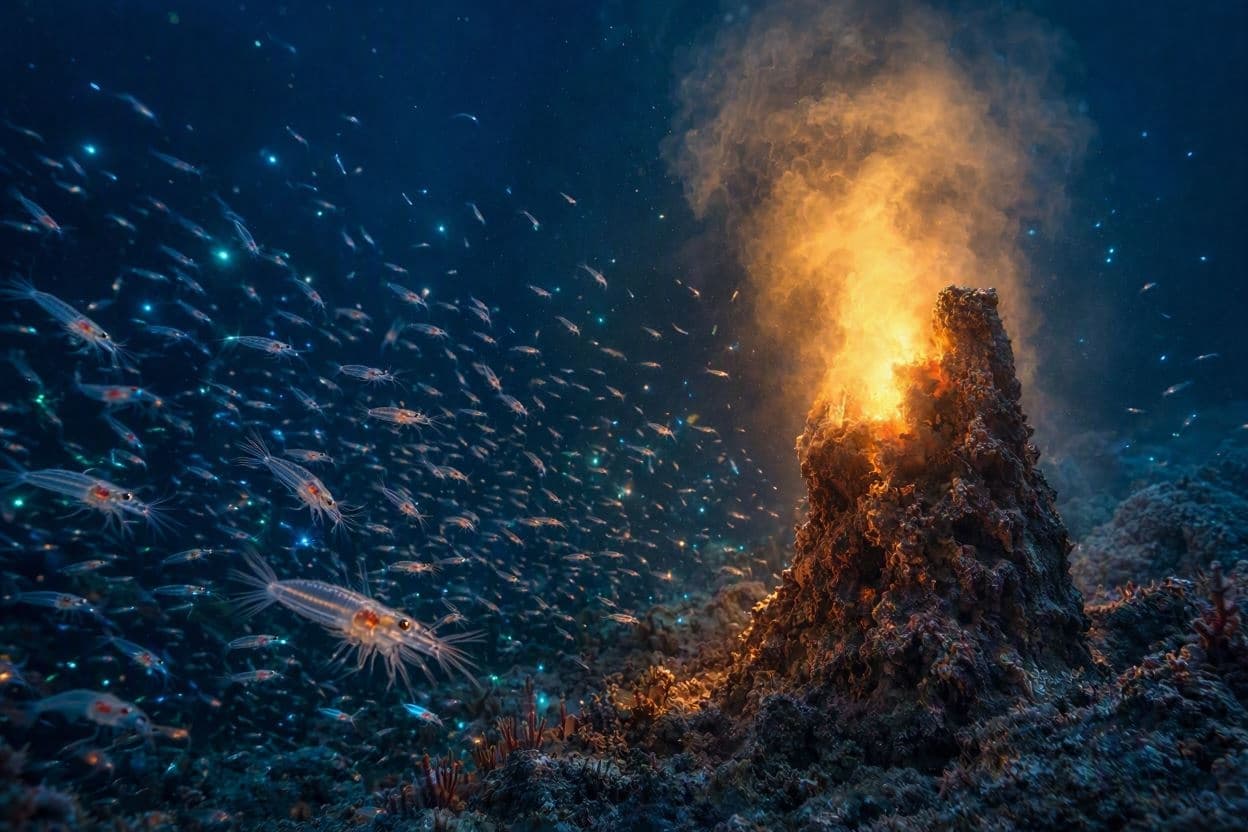
In the crushing darkness of the ocean’s depths, where sunlight never penetrates and pressure is immense, life finds a way to thrive in the most unexpected places. Hydrothermal vents, often described as underwater chimneys spewing superheated, mineral-rich water, are oases of biological activity. Yet, recent discoveries have added a puzzling piece to this ecosystem: tiny krill, creatures typically associated with the sunlit surface waters, are appearing in these extreme environments. Their presence challenges our understanding of marine migration and adaptation, prompting scientists to ask how and why these small crustaceans have ventured so far from home.
Krill are fundamental to the marine food web, serving as a primary food source for whales, seals, and penguins in polar regions. They are generally found in the upper layers of the ocean, feeding on phytoplankton. Finding them in the abyssal zones near hydrothermal vents is akin to discovering a desert cactus growing in a rainforest. The contrast between their typical habitat and the toxic, high-temperature environment of the vents is stark, raising questions about whether this is a case of accidental drift or intentional adaptation.
Researchers using deep-sea submersibles and remotely operated vehicles have documented these krill in significant numbers around vent fields in the Pacific Ocean. The animals appear healthy and active, suggesting they are not merely dying tourists but potentially resident populations. This observation has sparked intense interest among marine biologists, who are now investigating the physiological mechanisms that allow these creatures to withstand the harsh chemical conditions of the vent plumes.
One hypothesis suggests that the krill are attracted to the dense clouds of bacteria that thrive on the minerals emitted by the vents. These bacteria could serve as an alternative food source, replacing the phytoplankton unavailable in the deep. If true, this would represent a remarkable dietary shift, demonstrating the flexibility of krill biology. It also implies that the energy flow in deep-sea ecosystems may be more interconnected with surface processes than previously thought.
Another possibility is that the krill are using the vents as a refuge from predators or changing surface conditions. As climate change alters ocean temperatures and acidity, species may be forced to explore new niches. The stable, albeit extreme, environment of the hydrothermal vents might offer a sanctuary, provided the organisms can tolerate the heat and toxicity. This behavioral adaptation would highlight the resilience of marine life in the face of global environmental shifts.
Studying these deep-sea krill requires sophisticated technology and careful sampling. Scientists must collect specimens without damaging them, preserving their genetic material for analysis. Comparative studies between surface and deep-sea populations will help determine if there are genetic differences that confer tolerance to vent conditions. Such research could reveal new insights into evolutionary processes and the limits of biological endurance.
The discovery also has implications for conservation. Hydrothermal vents are unique habitats that support diverse and specialized communities. If krill are indeed establishing themselves in these areas, it could alter the dynamics of the vent ecosystem, affecting other species that rely on the same resources. Understanding these interactions is crucial for managing deep-sea protected areas and ensuring the preservation of these fragile environments.
As exploration of the deep ocean continues, each finding reminds us of how much remains unknown. The presence of krill in hydrothermal vents is a testament to the adaptability of life and the complexity of marine ecosystems. It invites us to look deeper, both literally and metaphorically, to understand the connections that sustain life on our planet.
AI Image Disclaimer: The visual representations included here are AI-generated illustrations designed to depict deep-sea environments and are not actual photographs from submersible missions.
Sources: Oceanography Journal National Geographic Smithsonian Magazine
Published by Banx Network. This article is part of the Banx decentralized media programme, powered by the BXE token on the XRP Ledger.

.jpg&w=3840&q=75 "New Wild Cat Species Identified for First Time in 100 Years, Researchers Say")