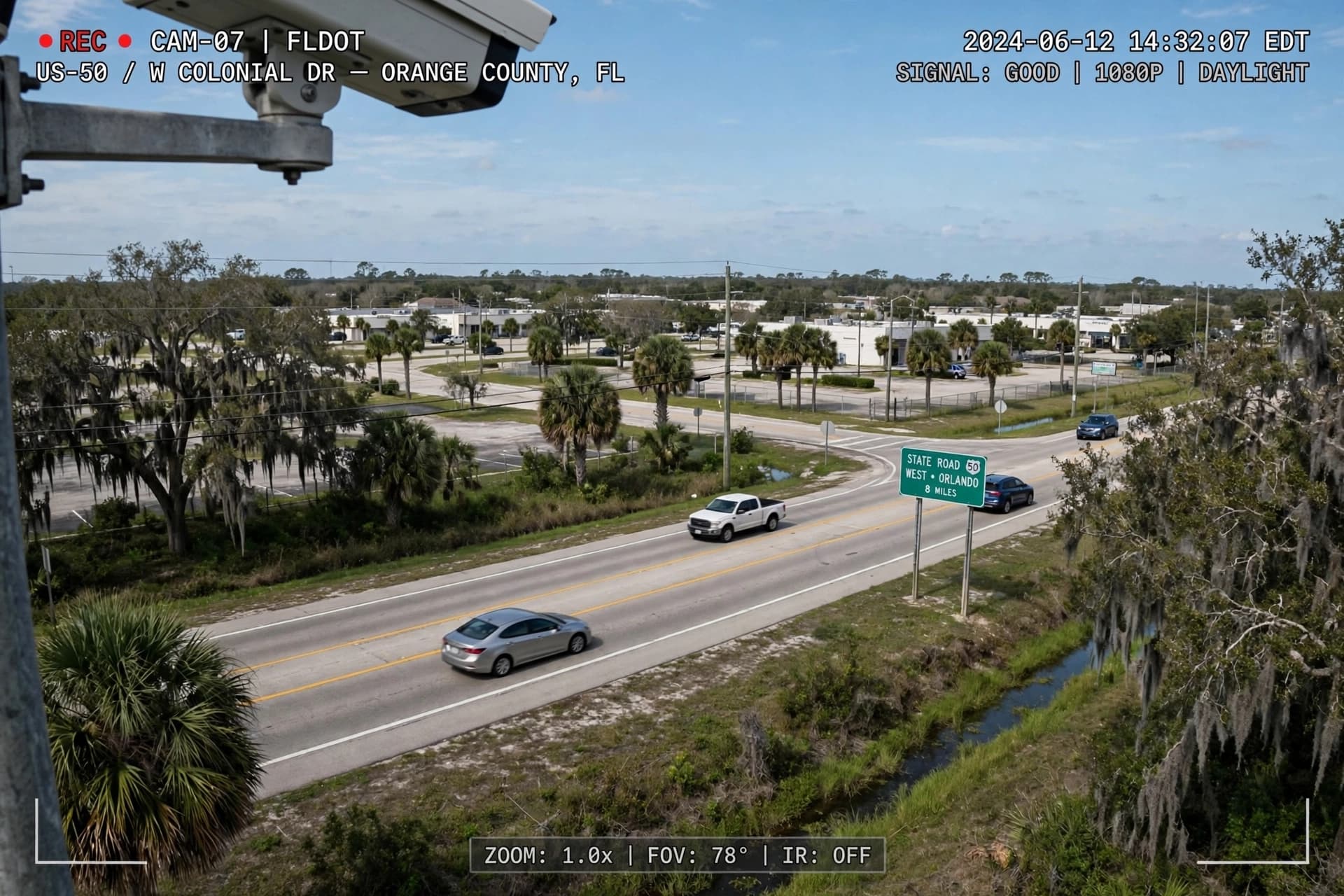
Like many modern roads, the streets of St. Lucie County, Florida, have quietly become places where technology watches the movement of everyday life. Yet when county officials recently began preparing to remove known Flock automated license-plate readers, they encountered something they had not expected: 14 additional cameras that were not part of the county's known inventory. The discovery has left officials trying to answer a simple but important question—who put them there, and who could access the information they collected?
The county had understood that 52 Flock cameras were operating across its roads, devices used to capture passing vehicles' license plates along with information such as the time and location of a sighting. But while preparing to remove those cameras, officials found 14 more devices that had not been permitted by the county. Three were subsequently identified as belonging to the St. Lucie County Sheriff's Office, while 11 remained without an obvious owner.
The uncertainty matters because automated license-plate readers are designed to collect information about vehicles that pass within their field of view. Law-enforcement agencies can use the technology to search vehicle data during investigations, while private organizations can also purchase Flock cameras. That combination of public infrastructure and privately operated technology makes clear ownership and access especially important when cameras are installed on public roads.
Flock Safety, the company that manufactures the cameras, said its permitting practices vary depending on local requirements. A company spokesperson told The Washington Post that Flock generally handles permitting and installation but said permits are not required in every jurisdiction. The company also said it had contacted St. Lucie County and was willing to work with officials to examine the cameras in question and resolve discrepancies.
For county officials, however, the immediate issue is not simply whether the cameras are technologically legitimate. It is whether their presence was properly authorized and whether there is a clear chain of responsibility for the information being gathered. St. Lucie County requires permitting through its Planning and Development department, according to The Washington Post, adding another layer to questions about how the unpermitted devices came to be operating.
The discovery comes during a broader period of scrutiny for Flock technology in Florida. In August, the Florida Department of Transportation revoked general-use permits previously granted to local law-enforcement agencies for license-plate readers on state-road rights-of-way. Agencies were given 30 days to remove affected devices, with the state citing concerns involving rapid deployment, data privacy and surveillance.
Across the country, the debate surrounding Flock cameras has increasingly focused on the difference between their intended purpose and the safeguards surrounding their use. Supporters describe automated license-plate readers as investigative tools that can help identify vehicles connected with crimes. Critics, meanwhile, have raised questions about privacy, data retention, access and the possibility of tracking people who are not suspected of wrongdoing. Those competing concerns have made transparency an increasingly central part of the conversation.
In St. Lucie County, officials have given notice for the unidentified cameras to be removed. Until then, county staff planned to cover the devices with plastic bags, according to The Washington Post. The temporary measure reflects the unusual nature of the discovery: technology intended to make vehicle movements more visible has itself become the subject of an investigation into who is watching and under what authority.
The episode leaves a broader question hanging over the roads of St. Lucie County: as surveillance technology becomes easier to install, can communities maintain equally clear systems for knowing who operates it and who has access to what it records? For now, officials are still working to identify the owners of 11 cameras, while the county's effort to remove its known Flock devices continues.
AI Image Disclaimer: The accompanying illustration is AI-generated and is intended for editorial visualization only; it does not depict the actual cameras or locations.
Sources: The Washington Post Ars Technica Miami Herald WKMG ClickOrlando
Published by Banx Network. This article is part of the Banx decentralized media programme, powered by the BXE token on the XRP Ledger.