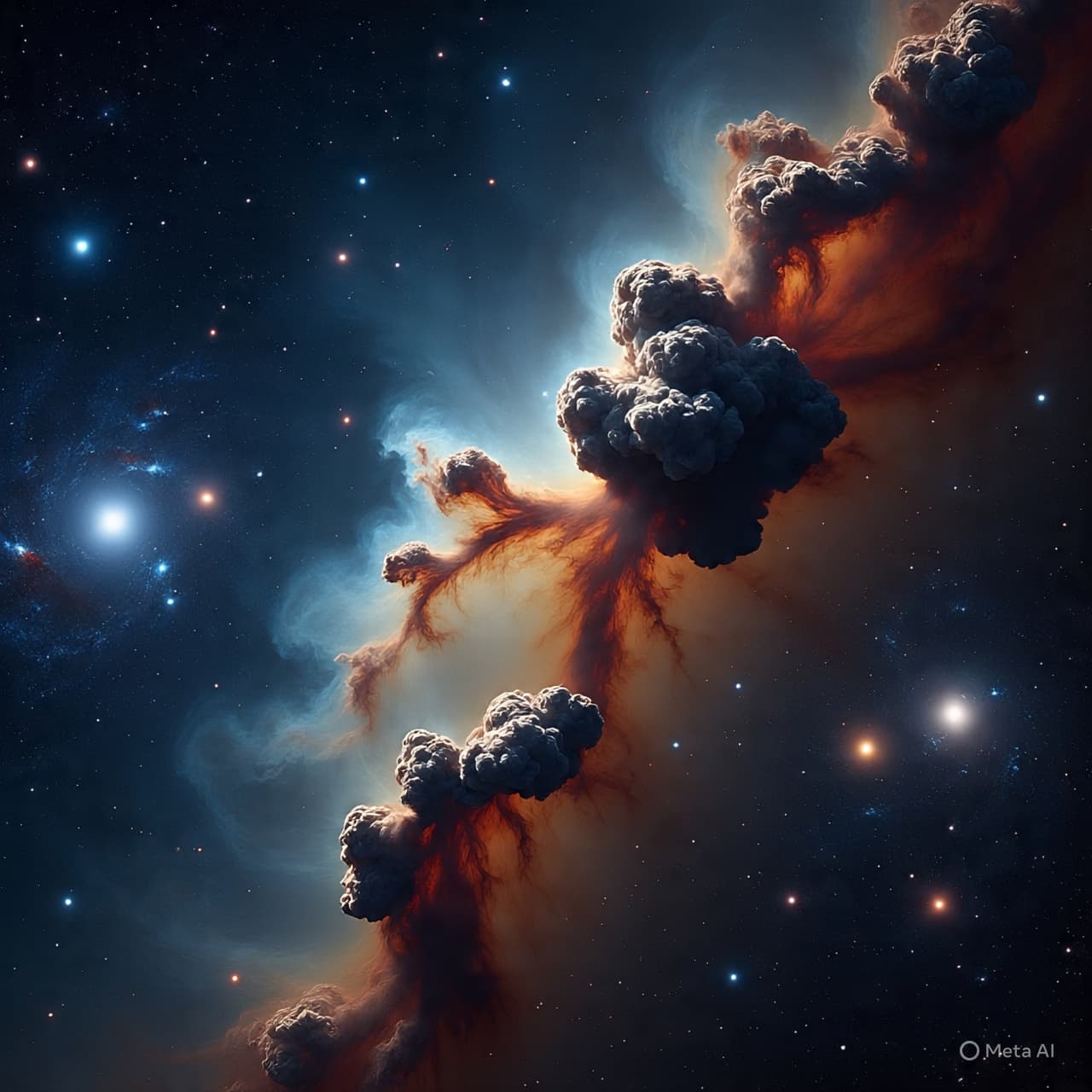
Under the veil of cosmic dust, a distant galaxy hums with hidden life. It glows not with the fierce fire of stars alone, but with the subtle signatures of chemistry that whisper across light-years. In the quiet of the infrared spectrum, the James Webb Space Telescope has pierced the opaque clouds of this ultra-luminous galaxy, revealing an unexpected richness—complex organic molecules that seem to write a story in the starlight.
These molecules, the building blocks of life as we know it, float amid clouds of gas and dust, weaving intricate patterns in the interstellar medium. They are both ephemeral and eternal, drifting through a galaxy where stars are born and die in a ceaseless rhythm. JWST’s instruments have captured their spectral fingerprints, showing that even in the most extreme galactic environments, chemistry can flourish, quietly shaping the raw ingredients that might one day seed new worlds.
The discovery challenges assumptions about where organic chemistry can thrive. Ultra-luminous infrared galaxies, or ULIRGs, are turbulent realms, where intense star formation and energetic phenomena would seem hostile to delicate molecules. Yet here, in this cosmic furnace, the molecules endure. Their resilience invites reflection: if chemistry can persist in such extremes, perhaps the universe’s capacity for life is broader than we imagined.
For astronomers, the finding opens a new chapter in the study of galactic ecosystems. JWST’s unprecedented sensitivity allows us to map chemical diversity across entire galaxies, revealing not only the presence of organics but hints at their complexity and distribution. Each spectrum, a line of cosmic poetry, tells us that the story of life’s ingredients is written across space in patterns both predictable and mysterious.
As we gaze into the infrared glow of this distant ULIRG, we are reminded that discovery is often quiet, unfolding in subtle signals rather than explosive events. In the dance of molecules amid stellar nurseries, there is both beauty and significance—a reflection of the cosmos’s endless capacity to surprise.
AI Image Disclaimer
Visuals are AI-generated and serve as conceptual representations.
Sources
NASA European Space Agency (ESA) Space Telescope Science Institute Astrophysical Journal Nature Astronomy
Published by Banx Network. This article is part of the Banx decentralized media programme, powered by the BXE token on the XRP Ledger.