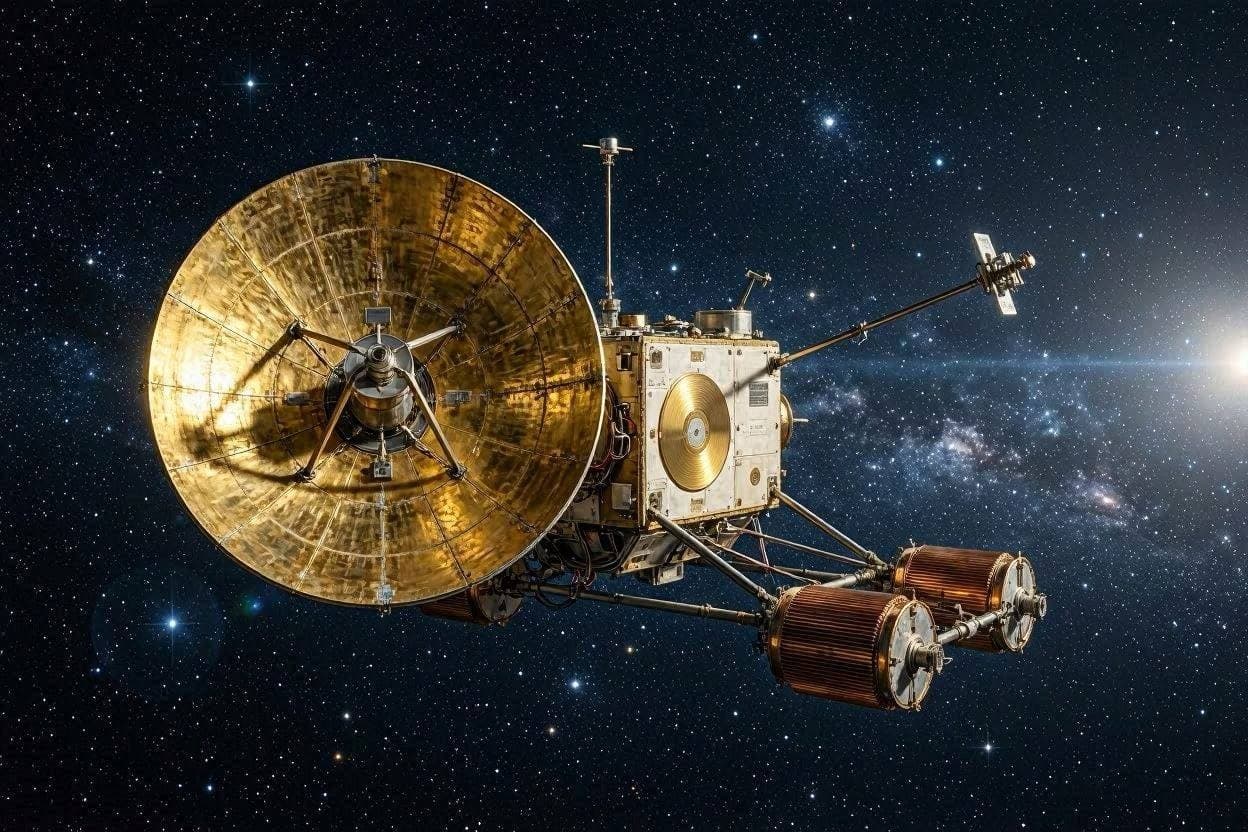
There are stories of endurance that transcend time, tales of resilience that inspire awe. The Voyager missions are such a story. Launched in 1977 with a planned lifespan of just five years, Voyager 1 and 2 have surpassed all expectations, venturing into the uncharted realm of interstellar space. They remain the only human-made objects to have crossed this boundary, still transmitting data back to Earth after nearly half a century. This achievement is a testament to human ingenuity, perseverance, and the enduring spirit of exploration.
Body: The Voyager probes were designed to explore the outer planets—Jupiter, Saturn, Uranus, and Neptune. Their grand tour provided unprecedented images and data, revolutionizing our understanding of the solar system. But their journey did not end there. Powered by radioisotope thermoelectric generators, they continued outward, crossing the heliopause—the boundary where the sun’s influence wanes—and entering the interstellar medium. Here, they encounter plasma and magnetic fields from other stars, offering a unique perspective on our galactic neighborhood.
The longevity of the Voyagers is largely due to the dedication of a small team of engineers and scientists at NASA’s Jet Propulsion Laboratory. Many of these individuals have worked on the mission for decades, some since its inception. Their expertise and passion have kept the aging spacecraft operational, troubleshooting issues and optimizing power usage to extend their lives. This continuity of knowledge is rare in modern engineering, where turnover is common, and it highlights the value of institutional memory.
Communication with the Voyagers is a challenge. Signals take over 20 hours to travel one way, requiring precise targeting and sensitive antennas on Earth. The Deep Space Network, a global array of radio dishes, listens for their faint whispers. Each byte of data received is a victory, a confirmation that these tiny ambassadors of humanity are still alive and well. The data they send back helps scientists understand the structure of the interstellar medium and the nature of cosmic rays.
Funding for the mission has been a continuous effort, relying on the support of NASA and the scientific community. Despite budget constraints and shifting priorities, the Voyagers have remained a priority due to their unique scientific value. They provide data that cannot be obtained any other way, making them indispensable tools for astrophysics. The commitment to keeping them alive reflects a broader appreciation for long-term scientific investment.
The cultural impact of the Voyagers is also significant. Carrying the Golden Record, a message to potential extraterrestrial life, they represent humanity’s desire to connect with the universe. Images of Earth, music, and greetings in multiple languages are etched onto the discs, serving as a time capsule of our civilization. As they drift further away, they carry our story into the cosmos, a poetic gesture of hope and curiosity.
As power levels decline, the team faces difficult decisions about which instruments to keep running. Some systems have already been turned off to conserve energy, but the core science instruments remain active. The end of the mission is inevitable, but it is still years away. Until then, the Voyagers continue to explore, pushing the boundaries of what is possible and inspiring new generations of scientists and engineers.
Closing: The Voyager missions stand as a monument to human curiosity and technical excellence. Their journey into interstellar space is not just a scientific achievement but a symbolic one, representing our reach beyond our home world. As they continue to transmit, they remind us that exploration is a never-ending quest, driven by the desire to know and understand.
AI Image Disclaimer: Please note that the images accompanying this article are AI-generated and intended for illustrative purposes only.
Sources: NASA Jet Propulsion Laboratory BBC Future Scientific American
Published by Banx Network. This article is part of the Banx decentralized media programme, powered by the BXE token on the XRP Ledger.