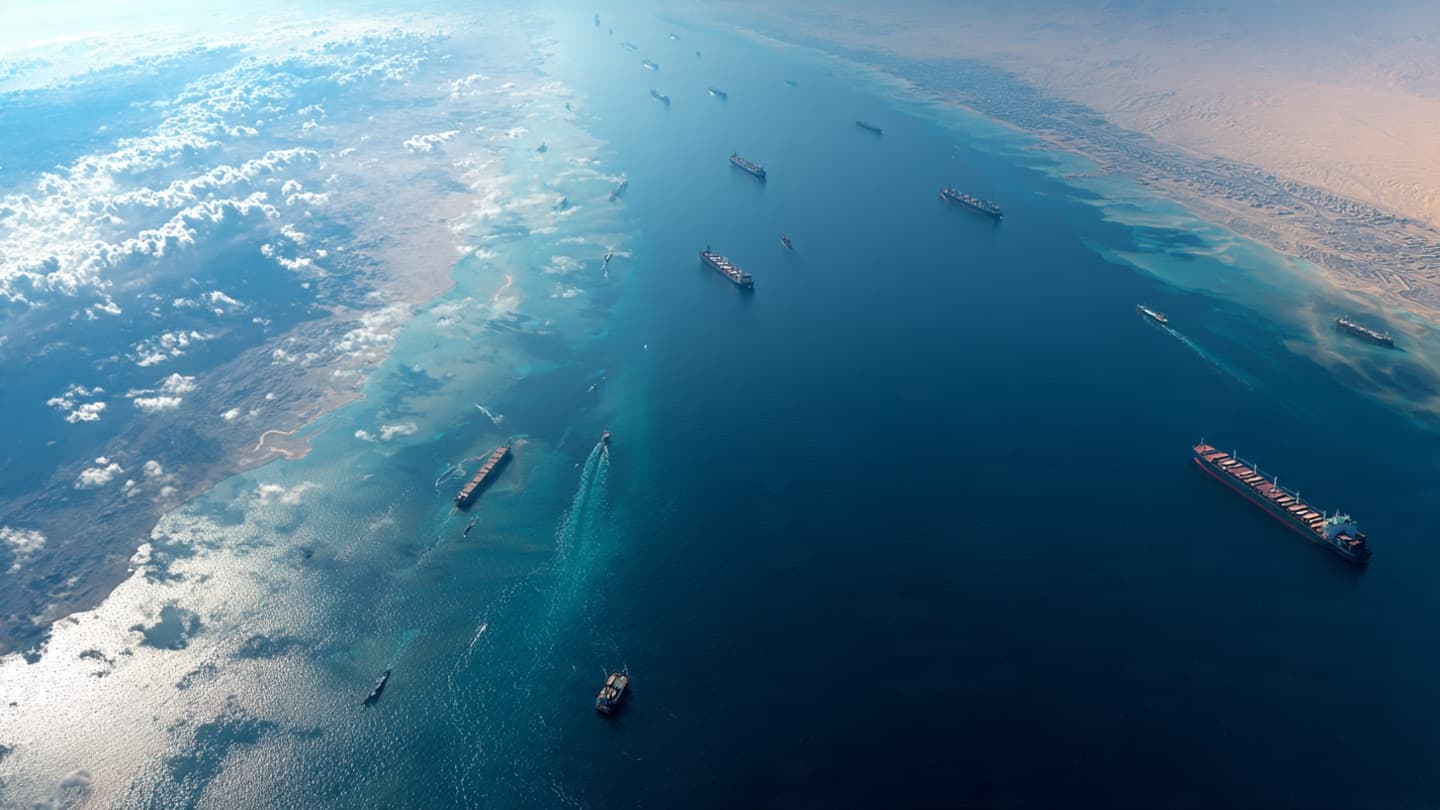
At the southern edge of the Red Sea, where the waters narrow before opening toward distant oceans, ships have long passed like silent travelers between continents. Day and night, tankers, cargo vessels, and merchant fleets move through these channels, carrying the rhythms of global commerce across seas that connect Africa, the Middle East, Asia, and Europe. The horizon often appears calm, yet history has repeatedly shown how quickly these strategic waters can become focal points of wider events.
That fragile balance has come under renewed strain as Yemen's Iran-backed Houthi movement announces a maritime blockade targeting Saudi shipping, expanding the reach of a conflict already stretching across the Gulf. The move places additional pressure on one of the world's most important maritime corridors and introduces a new dimension to the ongoing confrontation involving Iran and the United States.
The announcement centers on the Bab el-Mandeb Strait, a narrow gateway linking the Red Sea to the Gulf of Aden. Though modest in width compared with the vast oceans it connects, its importance is immense. A significant share of global trade and energy shipments travels through these waters, making any disruption a matter of international concern. Analysts have warned that uncertainty alone can alter shipping patterns, insurance costs, and commercial planning.
Houthi officials describe the blockade as a response to actions they attribute to Saudi Arabia and its regional partners. The group has stated that Saudi-linked maritime traffic could face restrictions, creating fears that commercial vessels may need to reroute or operate under heightened security conditions. While details regarding implementation remain limited, the declaration has drawn immediate attention from governments and shipping companies around the world.
The development arrives at a moment when tensions are already elevated across the Middle East. American military operations targeting Iranian-linked assets have continued, while Iran and its regional allies remain engaged in a broader contest that now extends from the Gulf to the Red Sea. What once appeared as separate regional flashpoints increasingly resembles a network of interconnected pressures influencing one another across vast distances.
For global energy markets, geography has become a central character in the unfolding story. The Strait of Hormuz and the Bab el-Mandeb Strait form two critical gateways for oil and commercial goods. Concerns that disruptions could affect both routes simultaneously have heightened anxiety among traders and policymakers alike. Energy prices have responded with volatility as markets attempt to measure risks that remain difficult to predict.
Beyond statistics and shipping maps lies the human dimension of maritime trade. Every vessel crossing these waters carries crews, cargo, and schedules tied to communities thousands of miles away. Delays at sea can ripple outward to ports, factories, retailers, and households. The movement of ships often appears distant from everyday life, yet it quietly influences the flow of goods that support economies across continents.
Diplomatic efforts continue alongside military preparations. Regional governments, international organizations, and global powers are seeking ways to prevent further escalation while preserving freedom of navigation. Such efforts often unfold away from public view, progressing through negotiations and communications that receive far less attention than declarations of conflict. Yet they remain among the most significant tools available for reducing tension.
As evening settles across the Red Sea, ships continue to move beneath open skies, their lights tracing paths through waters that have linked civilizations for centuries. The newly announced blockade does not alter the geography of the region, but it changes how that geography is viewed. What was once a familiar maritime route now stands at the center of a widening conflict, carrying questions about trade, security, and stability far beyond the shores it touches. For now, the currents continue their course, while the world watches to see whether diplomacy or confrontation will shape the next chapter.
AI Image Disclaimer These visuals were generated with AI and are intended to illustrate the topic conceptually rather than document actual events.
Sources Reuters Associated Press Council on Foreign Relations The Guardian BBC News
Published by Banx Network. This article is part of the Banx decentralized media programme, powered by the BXE token on the XRP Ledger.