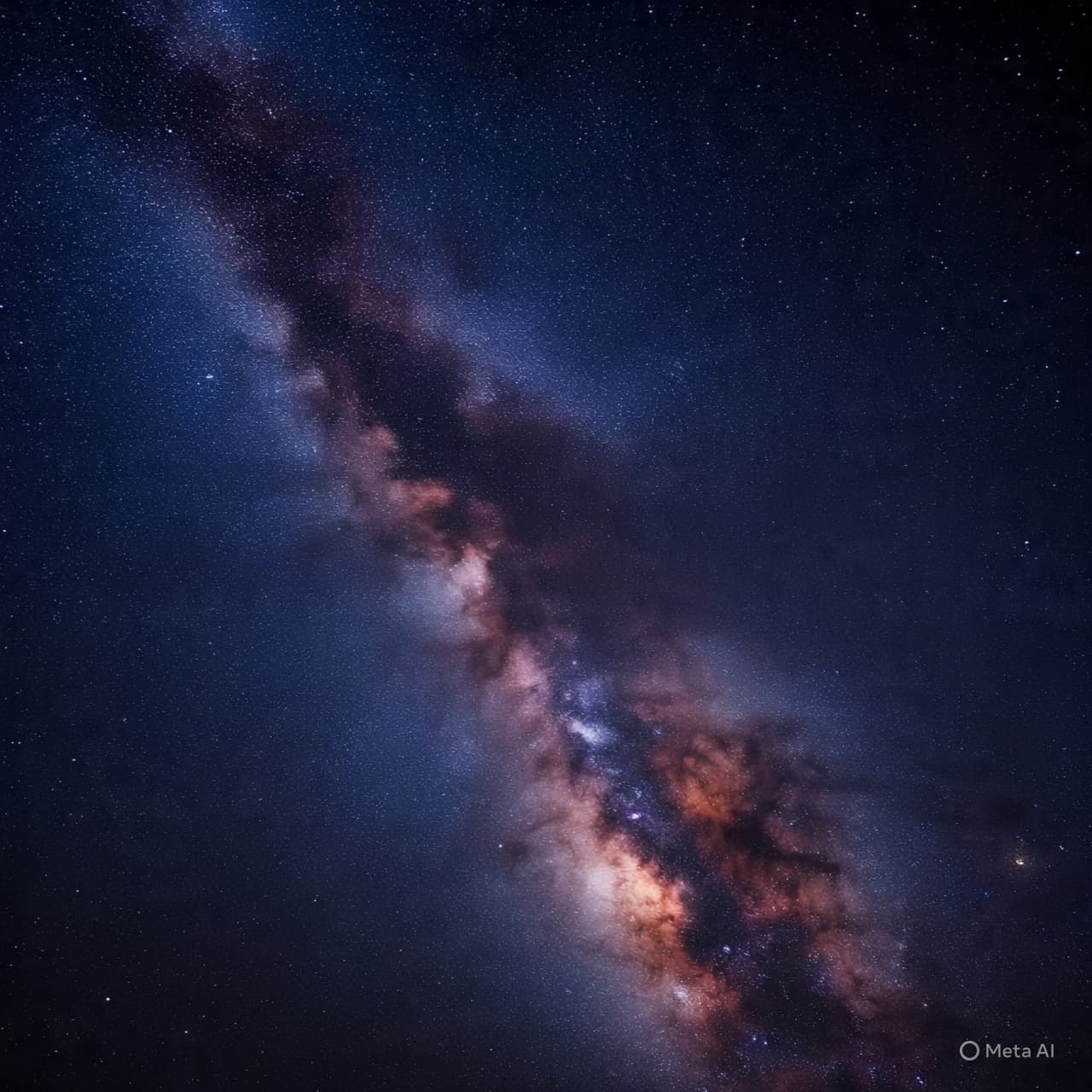
At the center of the Milky Way, light struggles to travel cleanly. Dust thickens the view, stars overlap in crowded layers, and gravity bends space into restless motion. It is a region defined less by clarity than by accumulation — of mass, of energy, of unanswered questions. Somewhere within this turbulence, researchers believe they may have detected something small, precise, and rhythmic: a possible pulsar.
Pulsars are the remnants of massive stars that collapsed long ago, compressed into neutron stars so dense that a teaspoon of their material would outweigh a mountain. As they spin, they emit beams of radiation that sweep through space like lighthouse signals. When those beams cross Earth, they appear as steady pulses, some ticking with astonishing regularity. Finding one is often a matter of patience. Finding one near the galaxy’s center is something else entirely.
The Milky Way’s core is among the most challenging regions to study. Radio signals scatter as they pass through dense clouds of charged particles, smearing and distorting the clean pulses astronomers rely on. For years, scientists have suspected that many pulsars should exist there, born from generations of massive stars, yet only a few candidates have ever surfaced. The environment hides its clocks well.
The newly reported signal stands out not because it is loud, but because it repeats. Detected in radio observations aimed toward the galactic center, the source shows characteristics consistent with a pulsar — periodic emission and a compact origin — though confirmation will require further study. Researchers remain careful in their language, calling it a candidate rather than a discovery, aware of how easily noise can imitate order in such a crowded field.
If confirmed, the pulsar would carry significance beyond its own existence. Pulsars near the galactic center are valuable tools, natural probes that respond to gravity and spacetime with exquisite sensitivity. Their signals could help scientists test theories about the supermassive black hole at the heart of the Milky Way, measure the distribution of matter nearby, and refine models of how stars live and die in extreme environments.
There is also something quietly human in the search itself. Amid the brightest stars and the strongest gravitational forces, researchers are listening for a faint, regular beat — evidence that even in the galaxy’s most chaotic region, order can persist. A pulsar does not dominate its surroundings. It simply turns, again and again, marking time in radiation and silence.
For now, the signal remains tentative, its identity not yet sealed. Follow-up observations will determine whether the pulses hold steady or dissolve under closer scrutiny. But the possibility alone reshapes the picture slightly. In the Milky Way’s crowded heart, where signals overlap and certainty is rare, a small star may be keeping time, waiting to be clearly heard.
AI Image Disclaimer
Visuals are AI-generated and serve as conceptual representations.
Sources
National Radio Astronomy Observatory NASA European Southern Observatory
Published by Banx Network. This article is part of the Banx decentralized media programme, powered by the BXE token on the XRP Ledger.