There is a particular kind of resilience that does not announce itself with monuments or declarations, but with the quiet movement of people who refuse to disappear. Seven thousand three hundred years ago, a volcano beneath the sea south of Japan erupted with a force that should have ended everything in its path. Pyroclastic flows raced across the water and onto land. Tsunamis scoured the coast. Ash fell until the sky was a memory. And yet, when archaeologists look closely at what came after, they do not find an ending. They find a redistribution.
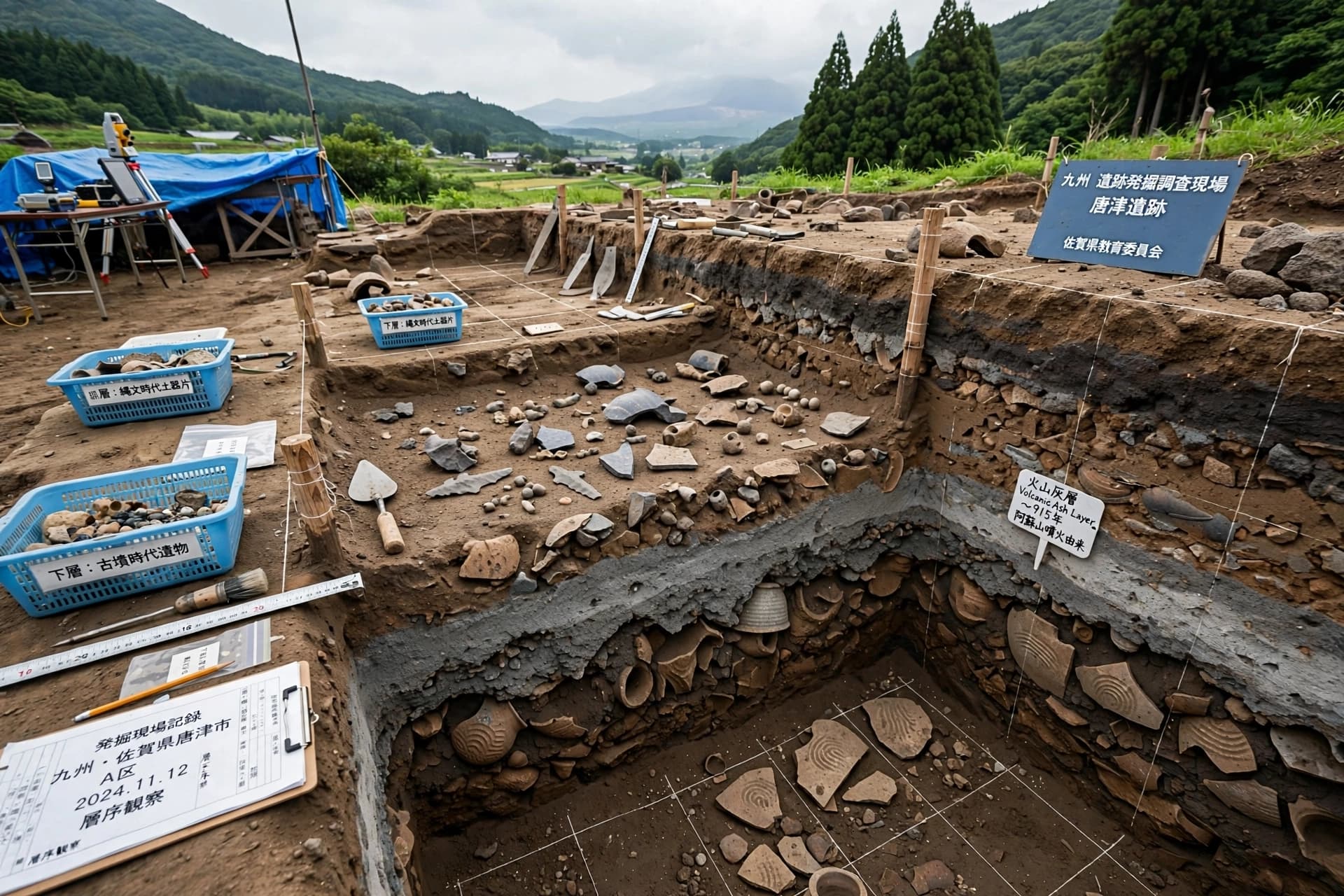
The Kikai-Akahoya eruption, as it is known, was one of the largest volcanic events of the Holocene. The Kikai caldera, roughly thirty kilometers south of Kyushu, collapsed in a series of explosive phases that sent superheated gas and rock surging across the sea and into the coastal and inland topography of southern Japan . The ash layer from that eruption remains visible across Kyushu, a persistent geological marker that archaeologists encounter at every excavation . For decades, the prevailing view was one of abrupt cultural collapse: the Jōmon hunter-gatherers of southern Kyushu, among the most advanced foraging communities of their era, were thought to have been annihilated or displaced entirely.
A new study published in Science Advances, led by researchers at the University of Cambridge, has complicated that narrative in a way that feels both surprising and deeply human. By analyzing 540 radiocarbon dates from archaeological sites across 61 regions of Japan, the team reconstructed population trends for 750 years before and after the eruption . What emerged was not a single story of catastrophe but a map of divergence. Southern and central Kyushu suffered severe depopulation, with some areas showing no evidence of human presence for centuries. But northern and northwestern Kyushu did not collapse. In some places, population growth continued, and possibly accelerated, in the aftermath .
The evidence for human movement is subtle but compelling. Stone earrings, which appear in southern Kyushu before the eruption, begin to show up further north immediately afterward, where they proliferate in number . Stone harpoons, tools for maritime hunting, appear across northern Kyushu and its nearby islands shortly after the disaster, suggesting that survivors who fled the devastated south turned to the sea for sustenance . A new pottery tradition, known as Sobata, emerged in the north as displaced populations mingled with existing communities and forged new social networks.
The coastal advantage may explain much of this. Marine ecosystems, while battered by tsunamis, could recover within months to a few years, flushed by ocean currents and fertilized by volcanic ash . Inland ecosystems took far longer. Soils buried under thick ash needed decades or centuries to reform, and the forests that had supported game and foraging were replaced by barren volcanic wastelands . Survivors who moved toward the coast found a resource base that was damaged but not destroyed, and the archaeological record shows them adapting quickly, intensifying maritime hunting and developing new toolkits.
What the study challenges is the word "apocalypse" itself. The eruption was undoubtedly catastrophic for those in its direct path. Entire communities were lost. The site of Numerikawa, where abundant pottery lies beneath a layer of volcanic debris and nothing above it, is a silent testament to that loss . But apocalypse implies finality, and the Jōmon people of Kyushu did not end. They moved, adapted, and in some places thrived. The disaster reshaped the island's demography and culture, but it did not erase them.
The findings also carry a quieter relevance. In a world increasingly attentive to how communities respond to climate extremes and natural hazards, the Kikai-Akahoya story offers something more nuanced than either resilience or collapse. It suggests that survival is rarely a matter of standing one's ground. Sometimes it means knowing when to leave, where to go, and what to carry with you—and that the communities that endure are often those willing to become something new.
AI Image Disclaimer: The visuals accompanying this article were created using artificial intelligence for illustrative purposes only.
Sources: Science Advances, IFLScience, Scinexx, Cambridge University Press & Assessment
Published by Banx Network. This article is part of the Banx decentralized media programme, powered by the BXE token on the XRP Ledger.