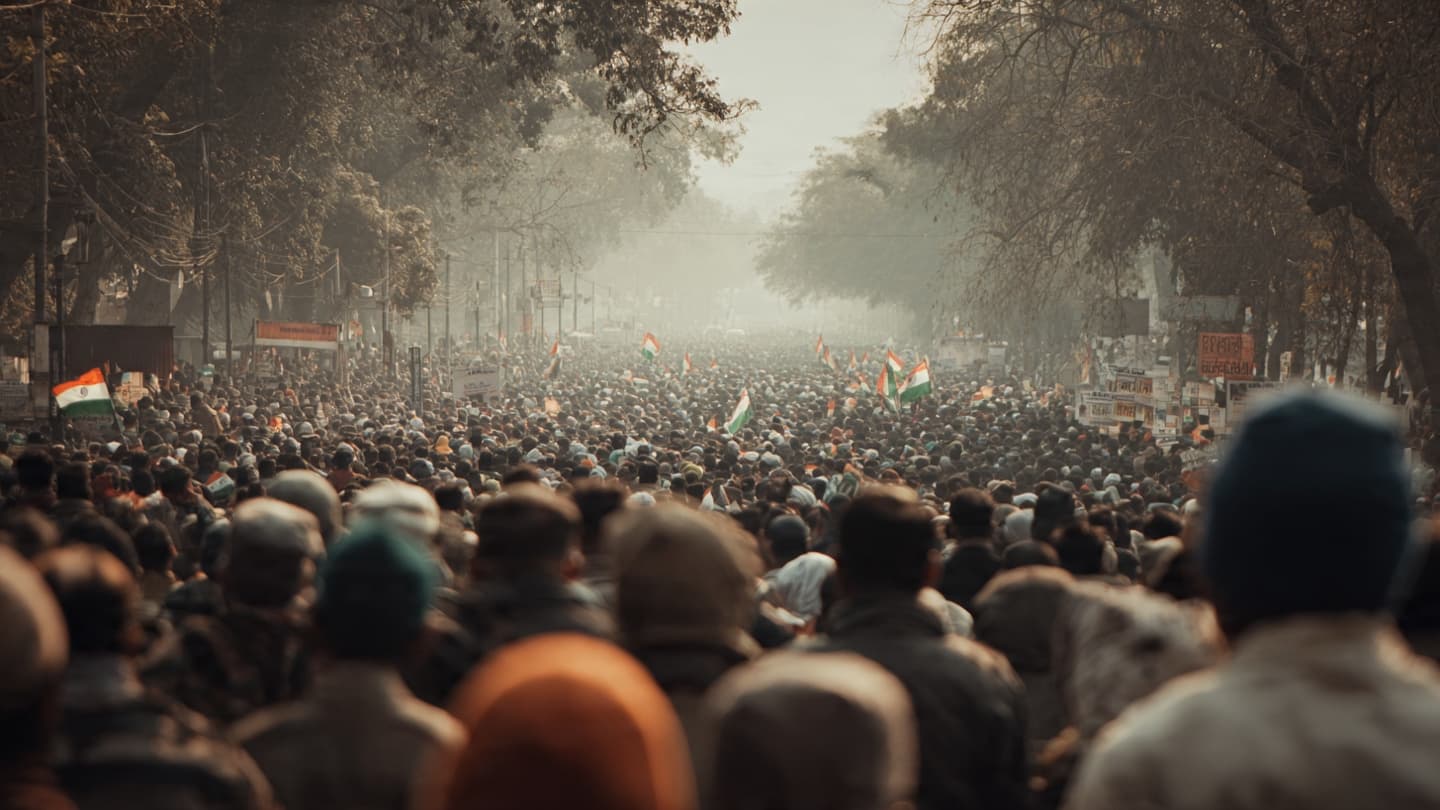
The morning air in New Delhi often carries the familiar rhythm of a city awakening. Vendors arrange their stalls, commuters weave through crowded intersections, and the broad avenues leading toward Parliament gradually fill with movement. Yet on some days, those same streets become places where ordinary routines give way to public voices, where the movement of people reflects not commerce alone but the desire to be heard.
That atmosphere unfolded as thousands of supporters of India's youth-led "Cockroach" movement gathered near Jantar Mantar and attempted to march toward Parliament despite authorities denying permission for the demonstration. Police responded by deploying tear gas and using batons after protesters sought to move through security barricades surrounding the parliamentary district. Many participants later continued their march in smaller groups despite the crackdown.
The movement began earlier this year following repeated examination paper leak scandals that affected millions of students competing for university admissions and government employment. Its unusual name emerged after a remark comparing unemployed young people to "cockroaches," a label that organizers reclaimed as a symbol of resilience and collective protest. Since then, the campaign has evolved into one of the country's largest youth-led civic movements, drawing widespread support online and in cities across India.
The immediate demonstration was also shaped by concern over education activist Sonam Wangchuk, who had been on a prolonged hunger strike before being taken to a hospital by police. His removal intensified public attention and encouraged larger numbers of supporters to travel to New Delhi for the opening day of Parliament's monsoon session. Protesters continued calling for the resignation of Education Minister Dharmendra Pradhan, comprehensive examination reforms, and greater accountability within the education system.
Around the heavily secured government district, police maintained that restrictions were necessary to preserve public order while Parliament was in session. Protest organizers, meanwhile, described their march as peaceful and argued that citizens should be able to express concerns about issues affecting students and young job seekers. The differing perspectives reflected the delicate balance between public security and the right to peaceful assembly that often accompanies large demonstrations.
For many participants, the march represented more than a single policy dispute. Students, recent graduates, professionals, and families gathered with the hope that their experiences would be acknowledged. In conversations throughout the crowd, concerns about educational fairness, employment opportunities, and confidence in public institutions became intertwined, illustrating how individual frustrations can gradually become a broader civic movement.
Observers note that education has become an increasingly significant public issue in India, where competitive examinations influence the futures of millions of young people each year. Repeated reports of examination irregularities have contributed to wider discussions about transparency, institutional trust, and equal opportunity. The protests therefore reflect not only immediate grievances but also longer-term questions about public confidence in national systems.
Government representatives have indicated a willingness to continue discussions with movement leaders, marking an initial step toward dialogue even as tensions remain high. Whether those conversations develop into meaningful policy changes remains uncertain, but both public demonstrations and official responses suggest that education has become a central topic in India's national conversation.
As evening settles over New Delhi, the avenues leading away from Parliament gradually return to their familiar rhythm. Barricades may eventually be removed, and the sounds of protest may fade into the city's larger chorus, yet the questions carried through those streets often remain. Democracies are shaped not only inside legislative chambers but also in the spaces where citizens gather to express hope, concern, and the enduring belief that their voices may still find a place within the nation's future.
AI Image Disclaimer The illustrations accompanying this article were generated using AI and are intended as conceptual representations rather than actual photographs of the events.
Sources Reuters Associated Press The Wall Street Journal The Guardian Al Jazeera
Published by Banx Network. This article is part of the Banx decentralized media programme, powered by the BXE token on the XRP Ledger.