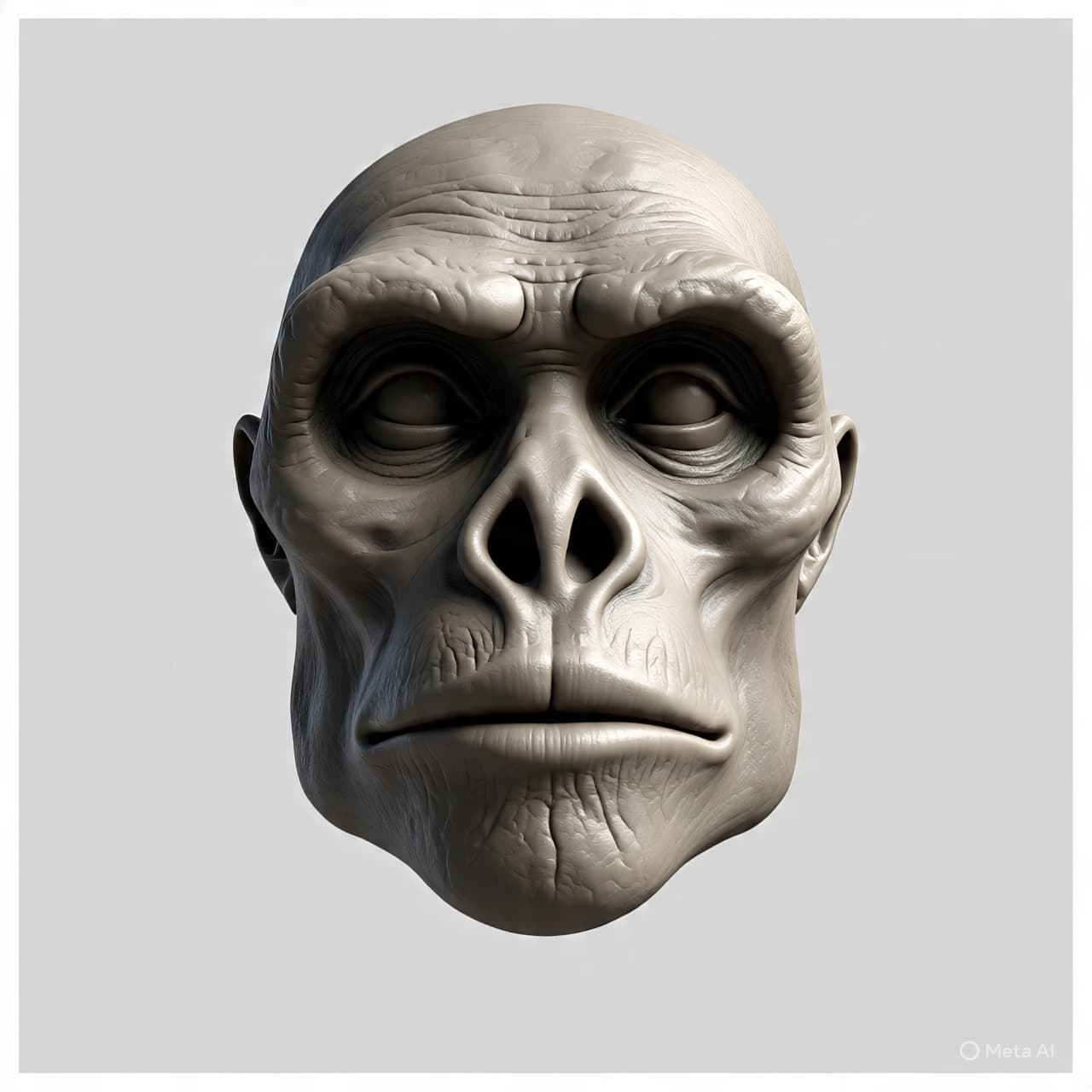
In a quiet gallery of stone and memory, where the echoes of ancient life linger in fossils long since rested in rock, there lies a figure whose silent presence has stirred wonder for generations. Known to researchers as Little Foot, this nearly four‑million‑year‑old ancestor — a member of the genus Australopithecus — bears the traces of a world long vanished. For decades, her nearly complete skeleton has offered fragments of a story too old for words, and until now, the missing piece was her face, crushed and distorted by the immense pressures of time and sediment.
In the rugged expanse of South Africa’s Sterkfontein Caves, part of the famed Cradle of Humankind, Little Foot’s bones were unearthed — first in tiny fragments, then as a remarkable 90 percent‑intact skeleton that has become one of the most informative fossils of early hominins ever found. But the skull, pushed and warped over millions of years, resisted attempts at a physical reconstruction. The face hidden beneath was like a silhouette behind cracked glass, its lines uncertain and obscured by the passage of deep time.
Now, leveraging cutting‑edge digital tools, scientists have breathed new life into that ancient visage. Using high‑resolution synchrotron scans that pierce rock and fossil alike with intensely bright X‑rays, researchers captured thousands of cross‑sectional images of Little Foot’s skull. Those images — terabytes of intricate data — were fed into advanced 3D modelling systems, allowing scientists to programmatically reposition and realign bones to their original anatomical places. In effect, a silent face long hidden beneath crushed bone has been coaxed back into view on a computer screen.
The reconstructed face reveals proportions that fall in a space between familiar great apes and later hominins. The size of the facial bones and the wide eye sockets draw comparisons with East African fossils, despite Little Foot having been discovered far to the south. These features, researchers note, offer a fresh perspective on how early hominin populations across Africa might have been more interconnected than once imagined — migrating and adapting in response to ecological pressures across vast landscapes, rather than evolving in isolated pockets.
There is a poetic symmetry in the methods now used to restore ancient life. In ages past, fossil hunters relied on pick and brush to gently coax remnants from rock. Today, it is global collaborations and computational reconstructions that allow us to see the face behind the fossil, bridging the gulf between physical fragility and technological resilience. This union of old bones and new technology has given form to features involved in vision, breathing and feeding — essential facets of life that now, for the first time, can be studied with clarity in a specimen so ancient.
In the calm light of reflection, Little Foot’s reconstructed face seems to speak not only of anatomy, but of connection — to other hominins, to environments shaped by wind and water, to the biological forces that shaped the long journey toward modern humans. Though the contours traced by pixels and algorithms are still open to interpretation and further study, they offer a rare glimpse of a distant ancestor whose story has waited in stone for millions of years.
As scientists continue to refine these digital portraits and to extend their work to other parts of Little Foot’s skull, such as the braincase, we may come ever closer to understanding not just how our ancestors looked, but how they lived, saw the world and adapted to it. In the gentle transition from bones encrusted by time to a face reborn in data, we find a profound reminder: that even in the quietest relics of the deep past, there is a life waiting to be seen again.
AI Image Disclaimer
Illustrations are AI-generated and serve as conceptual representations.
Sources (News Outlets Only)
CNN Scientific American Discover Magazine Wits University Nature
Published by Banx Network. This article is part of the Banx decentralized media programme, powered by the BXE token on the XRP Ledger.