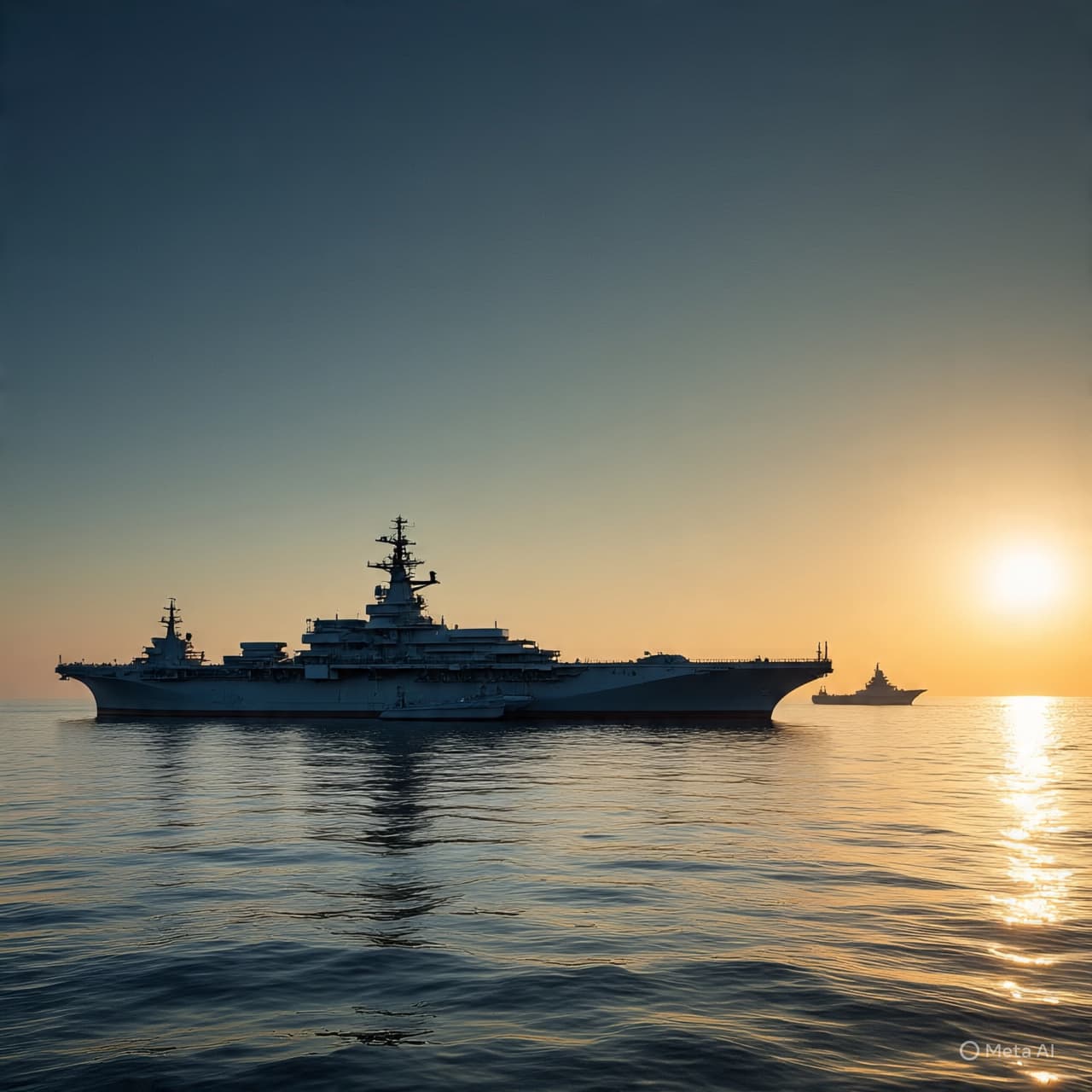
The early light on an open sea carries with it a sense of expectancy, as if the horizon itself holds its breath before the sun peeks above an unseen line. Sailors know this hour well, when night’s final shadows still cling to the water’s surface and the vessels that cleave through it seem suspended between dusk and dawn. In that quiet hour, naval traditions feel most palpable — routines practiced and repeated, formations that once felt immovable now drift gently in the balance between memory and reinvention.
For decades, the image of a carrier strike group — a mighty aircraft carrier flanked by cruisers, destroyers, and support ships — has been more than a formation of steel and sailors. It has been a symbol of maritime presence and strategic weight, the slow, confident cadence of American naval power projected across distant seas. Yet even this venerable structure, forged in years of steady deployment and anchored in long years of service, now finds itself amid a period of reflection and adjustment.
In conversations among naval leaders and strategists, a new theme has emerged: the idea that the traditional carrier strike group, with its rigid three‑year cycle of maintenance, training, and deployment, may no longer fit the fluid demands of a world in motion. Lessons drawn from extended deployments, whether in the Mediterranean or the Red Sea, have shown that rigid rhythms can strain crews and vessels alike, especially when circumstances call for more nimble responses to shifting priorities. The image of standing watch off distant chokepoints — its silhouettes etched against an endless skyline — now shares space with the reality of a more varied and unpredictable strategic landscape.
From this reflection has arisen a vision that might be called “tailored forces” — formations assembled not by a single template, but by the needs of the moment. In this emerging conception, destroyers and other combatants might join or leave a carrier’s orbit with greater ease, forming a mosaic of capabilities suited to specific missions without dragging an entire constellation of assets along for tasks that demand only a fraction of that strength. The emphasis shifts from uniformity to adaptability, from a singular “one size fits all” formation to a more flexible ensemble attuned to the particular demands of a crisis or campaign.
This approach draws on hard‑earned experience. On occasion, destroyers have already joined distant carrier groups well after their departure from port — a practice that, in quieter moments, showed the promise of a formation that might bend without breaking. Such movement, once an improvised response, offers a glimpse of what might become a more habitual pattern: forces that can be reshaped like clay in the hands of a potter, molded to meet the contours of a commander’s precise need.
Beneath these changes lies a subtle shift in the understanding of presence itself. The sea does not pause for tradition, and neither do the challenges that ripple across distant waters. Minefields in narrow straits, surveillance in vast expanses, or anti‑submarine warfare in deep waters — each of these tasks demands a particular set of tools, and if a carrier strike group’s entirety is not necessary for them, tailored forces may be. In this sense, the old and the new are not so much in opposition as in conversation: the weight of a carrier’s deck still carries profound meaning, even as the ships that accompany it learn new steps in a complex choreography.
In quieter moments aboard any ship, one sailor might remark on the subtle shift in how the fleet moves and interlocks, like dancers in a formation learning a new rhythm. Tradition carries through still — the ceremonial horn salute as dawn breaks, the measured cadence of boots on deck — but there is also a sense of lightness, an awareness that adaptability may itself be a form of strength. In the interplay between hull and tide, between the known and the possible, a new pattern begins to take shape: less rigid, perhaps, but more attuned to the ebb and flow of a world in motion.
In straight news language, the U.S. Navy is advancing plans to reshape the traditional aircraft carrier strike group model by developing more flexible and tailored force packages that can be adapted to specific mission needs. Chief of Naval Operations Adm. Daryl Caudle has introduced new guidance emphasizing scalable and customizable formations, allowing destroyers and other vessels to join or depart carrier groups as needed, rather than deploying as a fixed unit. These concepts build on recent operational experiences and aim to better support warfighters and global naval requirements.
AI Image Disclaimer
Illustrations were created using AI tools and serve as conceptual representations.
Sources (Media Names Only)
Breaking Defense Associated Press USNI News
Published by Banx Network. This article is part of the Banx decentralized media programme, powered by the BXE token on the XRP Ledger.