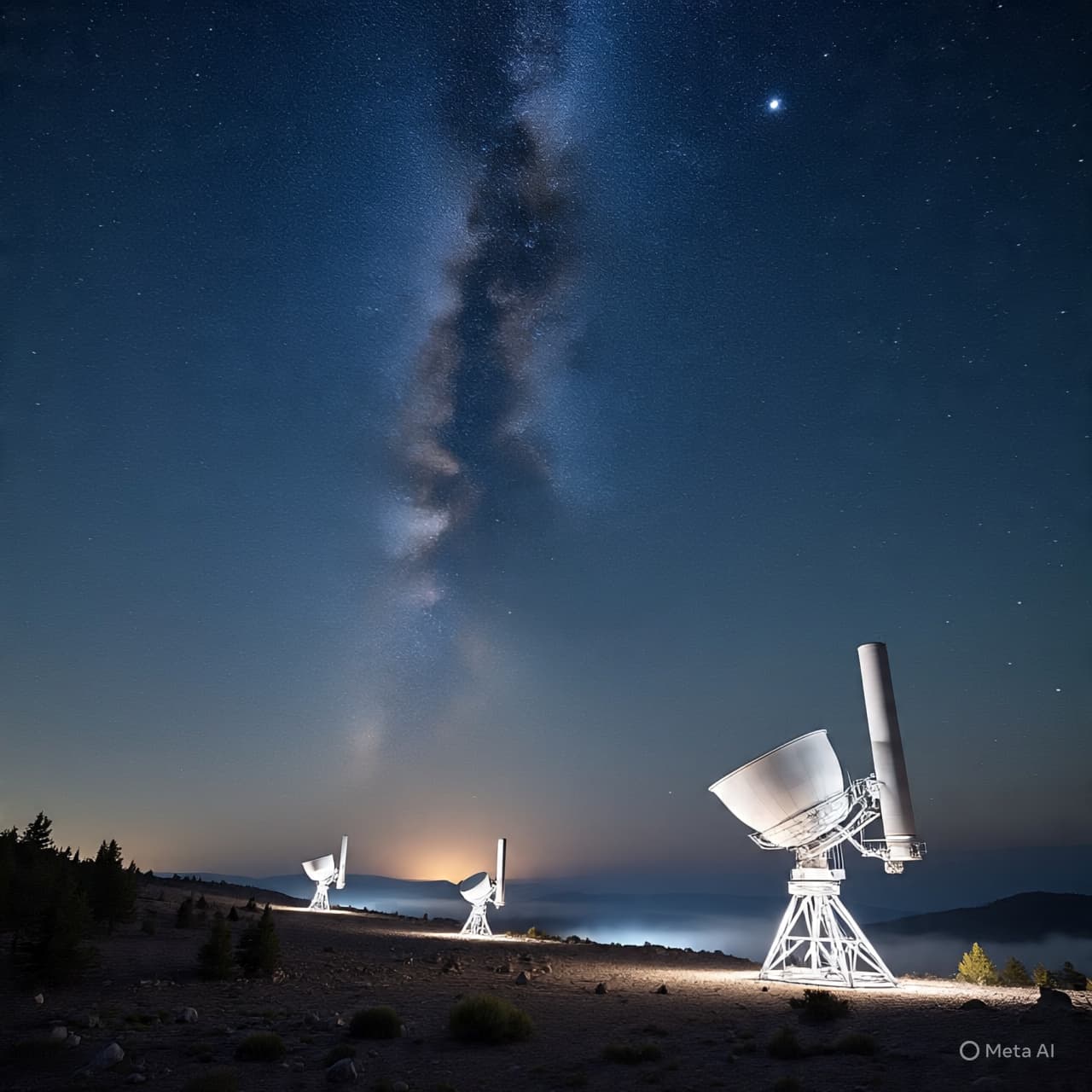
There are places in the night sky that feel like secret gardens — vast, quiet, and pulsing just beyond the reach of ordinary sight. The heart of the Milky Way galaxy has long been one of those places: cloaked in clouds of gas and dust, it hid its beauty from our eyes, like dew‑laden petals waiting for dawn. This week, astronomers offered us that dawn, revealing an image so rich with structure and motion that it seems almost alive. Using a network of telescopes high in Chile’s Atacama Desert, scientists have captured the swirling beauty of our galaxy’s core, unveiling patterns of gas and dust once hidden from view.
The new picture focuses on a region known as the Central Molecular Zone, a cold expanse more than 650 light‑years across wrapped around the galaxy’s supermassive black hole. This zone — made of intricate filaments of molecular material — is where stars are born, and in this latest glimpse, its rich tapestry of gases emerges in vivid detail. Scientists mapped different molecules in the gas clouds, assigning them colors that reveal the unseen chemistry shaping the Milky Way’s bustling core.
This largest‑ever mosaic from the Atacama Large Millimeter/submillimeter Array (ALMA) is more than a beautiful picture; it’s a window into processes both delicate and immense. The filaments of cold gas stretch across the frame, weaving through space like threads in a cosmic loom, hinting at the forces that sculpt galaxies and nurture stars. Researchers say this detailed view helps them better understand how matter coalesces, how stars emerge from chaos, and how our own galaxy evolved over billions of years.
Astronomers describe the Central Molecular Zone as “a place of extremes” — dense, turbulent, and dynamic — where gravity, motion, and chemistry dance in a complex waltz. Seeing this region with such clarity is a reminder that even in the vast darkness, the universe holds beauty that becomes visible only through patience, ingenuity, and tools that extend our senses.
For all its scientific promise, the image also resonates in a more poetic way: it invites us to reflect on our place in the vast cosmic tapestry. From our vantage point far from the galactic center, we look toward these glowing clouds and see, in their whorls and hues, a story of creation. Even as telescopes keep revealing more of the hidden universe, this new portrait of the Milky Way’s heart reminds us that there is always more to discover — and more beauty waiting to be revealed.
AI Image Disclaimer (rotated wording) Graphics are AI‑generated and intended for representation, not reality.
Credible sources found:
Associated Press (AP News) European Southern Observatory press release Live Science FineDayRadio News EurekAlert! / ESO news release
Published by Banx Network. This article is part of the Banx decentralized media programme, powered by the BXE token on the XRP Ledger.