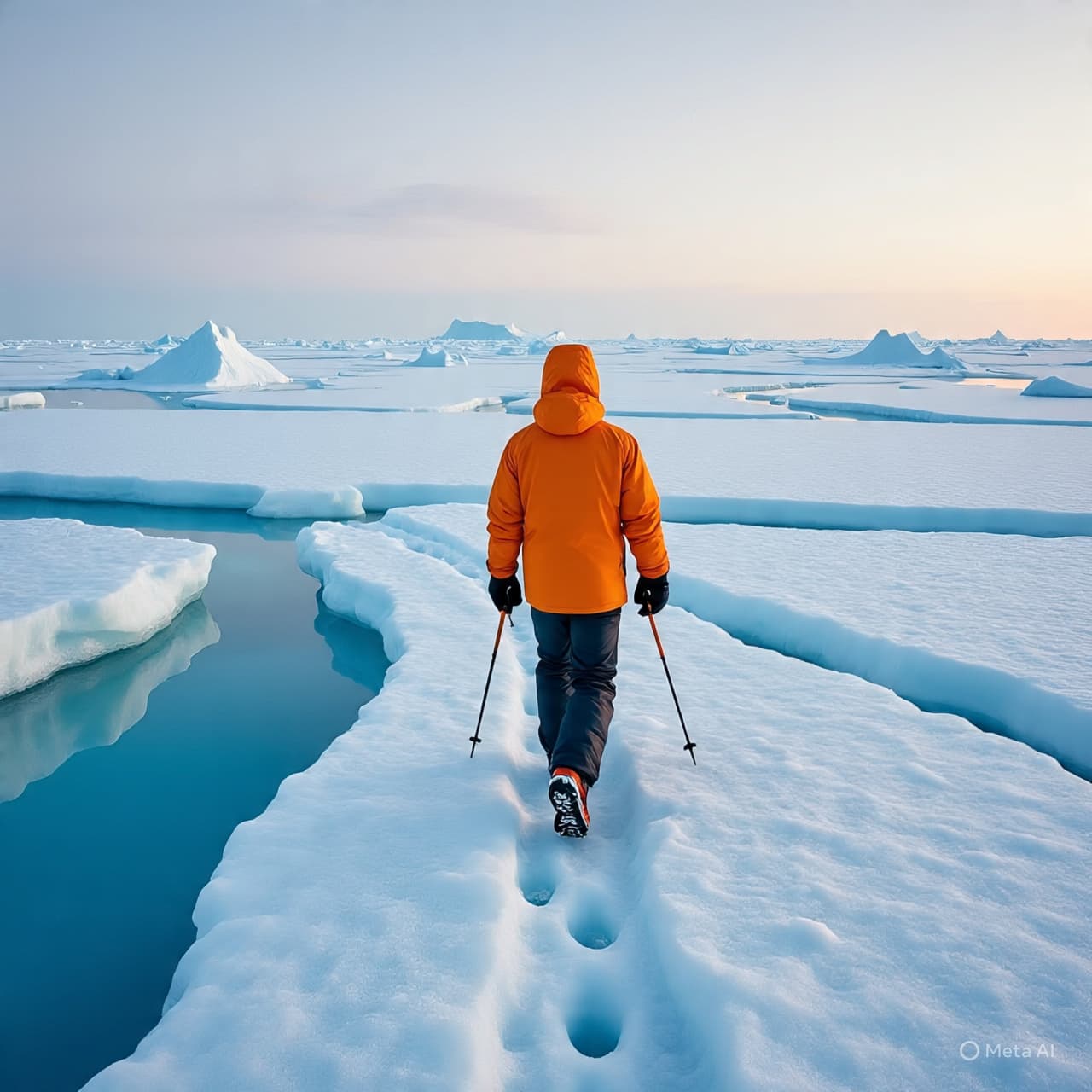
There are places on Earth where the horizon seems to dissolve into a single shade, where every breath feels like a shared secret between snow and sky. Antarctica’s sea ice is one of those realms, a landscape of pristine white that unfolds in all directions like an unbroken dream. To walk upon this frozen sea is to step into a universe shaped by wind and cold, where each footprint becomes a gentle punctuation in a vast quiet dialogue.
Far from the bustle of human life, the southernmost continent invites those few who journey there to experience extremes that defy common experience. Four hours from southern Australia, planes descend onto runways carved into glaciers, and visitors step into conditions that can feel like stepping onto another planet where the wind sometimes whispers harshly and temperatures plunge deep below what most have ever known.
Walking on Antarctic sea ice is not simply a matter of placing one foot in front of another. The ice itself is alive with subtle textures: rippled by winter winds, cracked in places by slow forces unseen, and bathed in a light that seems to stretch time itself. Travelers describe the sensation as entering a landscape that feels both timeless and deeply present, where colors are muted and contrasts are sharp, but where the mind settles into an open space.
This frozen sea ice that forms and recedes with the seasons is shaped by cycles of cold and light. In summer, explorers may walk on thick sea ice fringed by icebergs and watched over by seabirds and seals. In winter, the ice spreads far out into the Southern Ocean, an enormous white lattice that supports microscopic life beneath its surface, where algae and other tiny organisms play their roles in a complex web of ecology unseen from above.
Yet the sea ice that feels so perennial and unchanging is also part of a dynamic world. Scientists have observed record low extents in recent years, a sign that the rhythms of freeze and thaw are adjusting under the influence of a warming climate an influence that ripples through ecosystems, ocean circulation, and even the patterns of winds that shape the ice itself.
To stand on Antarctic sea ice is to feel the delicate balance of this environment: breathtaking in its beauty, quiet in its immensity, and fragile in its shifting forms. The whiteness that greets the eye is more than a color; it is an expression of Earth’s coldest reaches, a reminder of the forces that shape our planet’s edges.
And when explorers return from that vast white universe whether scientists studying climate, artists capturing its memory, or travelers recounting their journey they carry with them a story of stark contrasts: the softness of silence and the sharpness of cold; the purity of snow underfoot and the complexity of a changing world. Their steps on the ice become part of a broader narrative, one that gently unfolds between the immense and the intimate.
AI Image Disclaimer
Illustrations were produced with AI and serve as conceptual depictions.
Sources
ABC News; Afar; Australian Antarctic Division; News24 Climate Service / Copernicus; University of Washington News.
Published by Banx Network. This article is part of the Banx decentralized media programme, powered by the BXE token on the XRP Ledger.