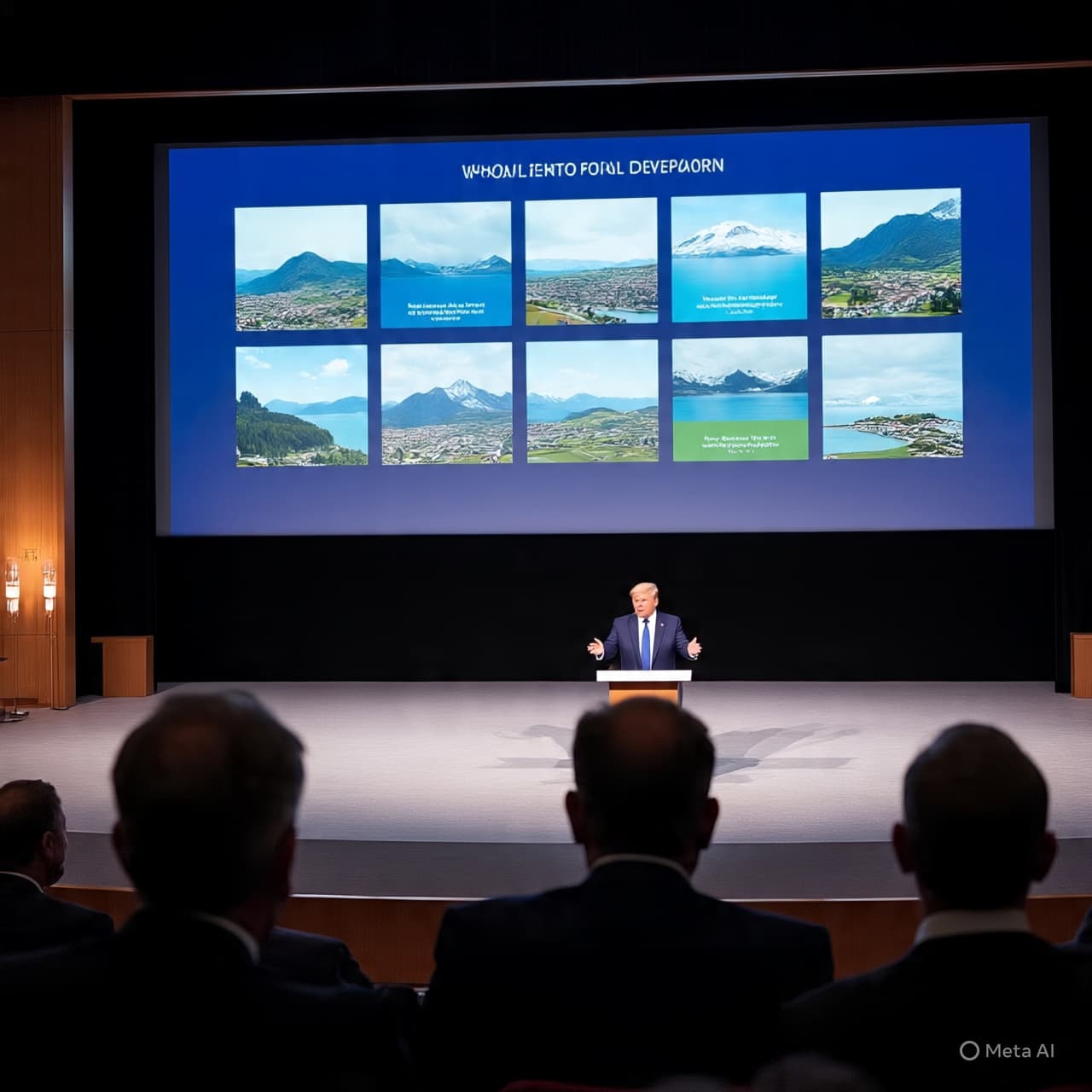
In the hush of a winter morning in the Swiss Alps, where ideas flow like rivers merging at a delta, a gathering of world leaders listened as visions of peace were drawn not just in words, but in pictures of what might lie ahead. In this reflective space at the World Economic Forum, U.S. President Donald Trump offered remarks about Gaza that blended his long-held identity as a builder with the solemn hopes of peace. “I’m a real estate person at heart,” he said, gently gesturing toward the Mediterranean coastline, “and I said, look at this location on the sea, look at this beautiful piece of property, what it could be for so many people.”
For those gathered, the imagery evoked places of glistening promenades and tree-lined enclaves — more tapestry of possibility than cartography of conflict. In Trump’s words, Gaza was not only a strip of land scarred by years of war but also, in his reflections, a site where transformation could be imagined: a space where economic renewal and peaceful development might eventually take root. The phrase “beautiful piece of property” carried the softness of a gardener speaking of fertile soil, yet it also sparked the sharper contours of global debate about what peace and reconstruction truly mean for the people who live there.
At the same event, Trump formally launched the first charter of the so-called Board of Peace, positioning it as a forum for conflict resolution beginning with Gaza. The initiative brings together leaders from a range of countries, though notable Western European presence was modest. Trump’s remarks intertwined aspirations for demilitarization, governance, and reconstruction with energetic plans for economic opportunity, placing emphasis on the territory’s potential for prosperity once peace takes hold.
Alongside Trump, his son-in-law Jared Kushner presented what he described as a “master plan” for a “New Gaza,” portraying images of apartment towers and vibrant commercial avenues rising from the coastal plain. These visuals spoke to a Mediterranean utopia shaped by private investment and modern infrastructure — a future that, in this telling, could unfold over a few short years if resources and cooperation align.
Yet beneath these reflections on potential, the lived reality for millions in Gaza remains marked by the deep echoes of conflict. Much of the enclave’s infrastructure was damaged or destroyed in recent fighting, and humanitarian needs continue to be profound. In this light, the elegant words about beauty and redevelopment floated alongside urgent questions about how peace, aid, governance, and everyday life will be woven back together.
It is the interplay of hope and hardship, of imagery and experience, that lends this moment its soft cadence — the way a river shaped by both sun and storm finds its way to the sea. For leaders and citizens alike, imagining Gaza’s future involves balancing the poetry of potential with the practical details of recovery and reconciliation.
In straight news terms, President Trump used the Board of Peace event at Davos to outline this vision for Gaza’s reconstruction and to stress his personal connection with the idea of development based on the territory’s Mediterranean geography. He emphasized plans for economic growth and infrastructure rebuilding as part of long-term peace efforts, accompanied by proposals from his envoys for significant investment and planning
AI Image Disclaimer
“Visuals are created with AI tools and are not real photographs.”
---
Sources
Times of India The Straits Times Arab News AFP / RTL Today The New Indian Express
Published by Banx Network. This article is part of the Banx decentralized media programme, powered by the BXE token on the XRP Ledger.