
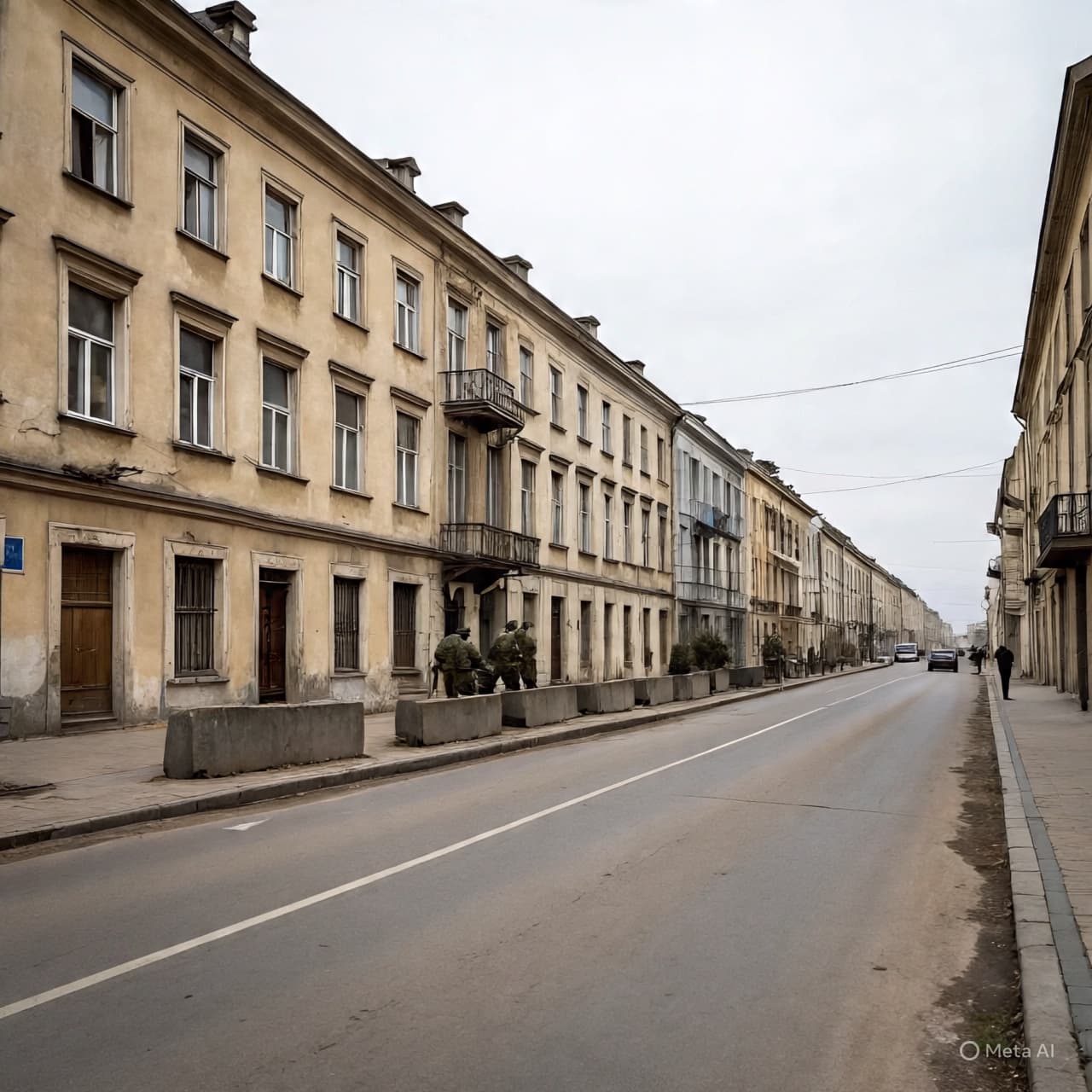
In towns where church domes once caught the sun without interruption, the light now falls differently. It settles against new checkpoints, unfamiliar insignia, and billboards bearing slogans that speak in another register. The streets are not empty, but they move with caution. Doors open briefly; conversations lower their tone. In parts of eastern and southern Ukraine under Russian control, daily life unfolds with a carefulness that former residents and activists describe as both ordinary and fraught.
Since Russia’s full-scale invasion in 2022, vast swaths of territory—including areas of Donetsk, Luhansk, Zaporizhzhia, and Kherson—have come under Moscow’s administration. The Kremlin has declared these regions annexed following referendums widely rejected by Kyiv and Western governments as illegitimate. On the ground, the changes have been practical as well as symbolic: Russian curricula introduced in schools, passports distributed, the ruble circulating in markets where the hryvnia once dominated.
Activists working with displaced Ukrainians say the transformation reaches beyond paperwork. They describe a climate in which public dissent is risky and independent media scarce. Residents who remain often measure their words, aware that criticism of authorities can carry consequences. Human rights groups have documented allegations of arbitrary detentions, enforced disappearances, and pressure on community leaders to cooperate with occupying administrations. Moscow has denied systematic abuses, insisting it is restoring order and services in areas it considers its own.
For many who left, departure was not a single decision but a sequence of calculations—when shelling intensified, when a neighbor was questioned, when a son faced conscription into local forces aligned with Russia. Those now living in cities like Kyiv, Odesa, or abroad in Poland and Germany recount a mixture of relief and dislocation. They follow news from their hometowns through encrypted messages and fleeting phone calls, piecing together a portrait of streets they can no longer walk.
Utilities and infrastructure tell another part of the story. Power supplies have been disrupted by fighting and repair efforts complicated by front-line proximity. In some areas, activists say, residents rely on irregular deliveries of water and fuel. Local authorities installed by Moscow report efforts to rebuild roads, hospitals, and housing damaged in combat. Yet the pace and visibility of reconstruction vary widely, shaped by security conditions and resources.
Education has become a quiet battleground of identity. Teachers in occupied territories have faced pressure to adopt Russian-approved textbooks and narratives of history. Some have left rather than comply; others remain, navigating new expectations while trying to preserve continuity for their students. Parents weigh choices that feel larger than a school year—whether to keep children in place, move them across front lines, or send them abroad.
Economic life, too, has shifted. Businesses that once traded freely across Ukraine’s regions now operate within a narrower corridor. Sanctions, disrupted supply chains, and the uncertainty of legal status complicate investment and employment. Former residents speak of salaries paid in rubles, of banking systems reoriented, of property records transferred into Russian registries. Each administrative change redraws daily routines in subtle lines.
Yet even within this altered landscape, life persists in gestures both small and stubborn. Markets open in the morning. Elderly neighbors exchange bread and news. Gardens are tended behind fences. Activists say resilience is visible not only in protest—which is rare and risky—but in endurance: in the determination to maintain family ties, language, and memory.
International observers continue to monitor conditions through satellite imagery, refugee interviews, and limited access visits. Kyiv insists the territories remain Ukrainian and has pledged eventual restoration of control. Moscow maintains that the regions have chosen their alignment. Between these competing narratives are civilians who describe a reality defined less by geopolitics than by immediate concerns—safety, food, schooling, the next winter’s heating.
As the war grinds on, front lines shift by kilometers rather than sweeping arcs. For those inside Russian-held areas, time is measured not only in months of occupation but in routines recalibrated to new authorities. The harshness activists describe is not always visible from afar; it resides in the constant awareness of constraint.
In the fading light over fields that stretch toward contested horizons, the land itself appears unchanged. Wheat still bends in the wind. Rivers continue their course. Yet the human landscape has been rearranged—by fear, by adaptation, by choices made under pressure. Whether these territories remain divided or return to Kyiv’s administration is a question for diplomats and soldiers. For now, the stories carried by those who left and those who stay sketch a portrait of life lived carefully, in places where the map has shifted but the need for ordinary days endures.
AI Image Disclaimer Visuals are AI-generated and serve as conceptual representations.
Sources Reuters BBC News Human Rights Watch The Guardian United Nations Office of the High Commissioner for Human Rights
Published by Banx Network. This article is part of the Banx decentralized media programme, powered by the BXE token on the XRP Ledger.


