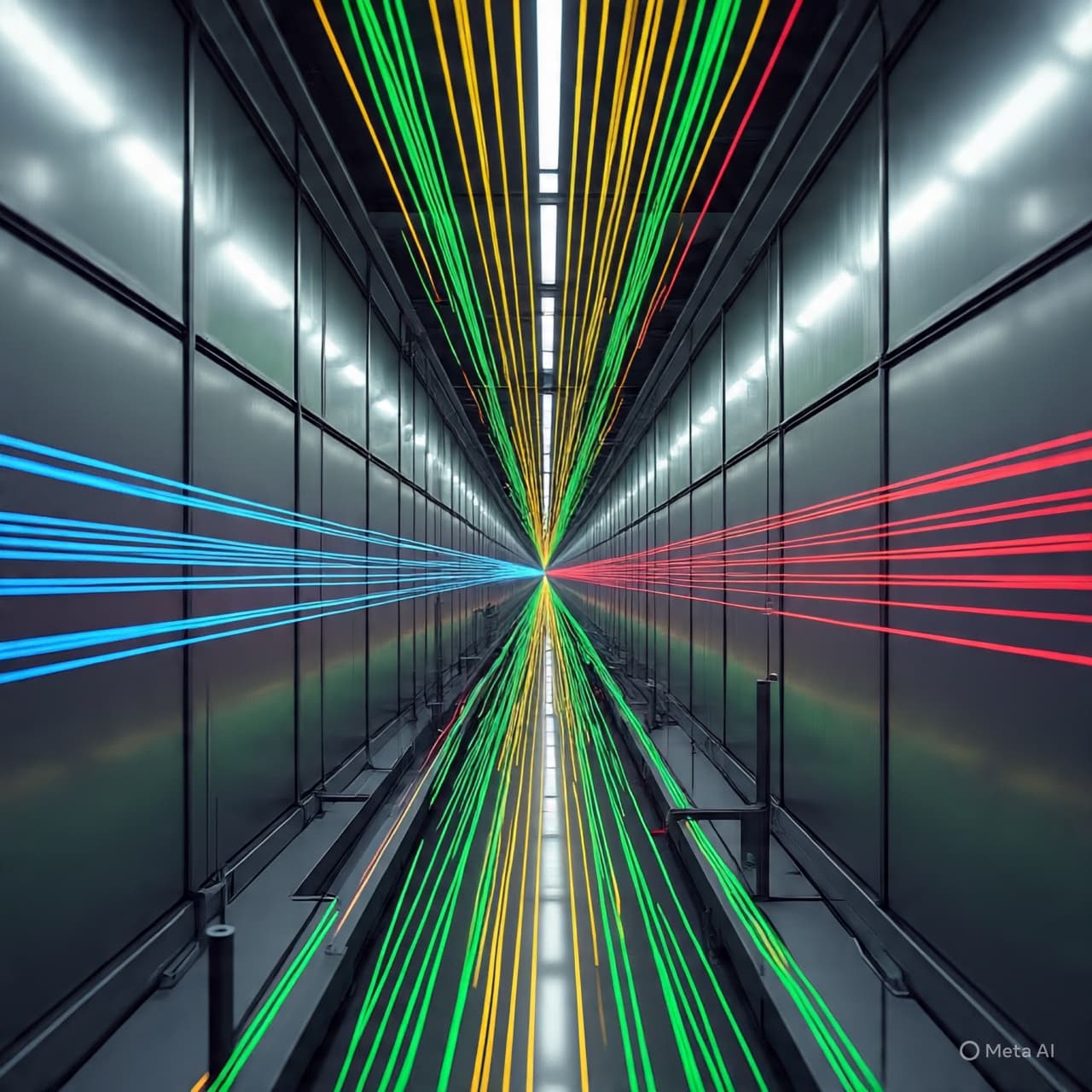
There are moments in the natural world that teach us to look not only at what happens, but at what almost happens—the near-brush, the near-touch, the almost-collision that nonetheless carries meaning. In the grand halls of particle physics, where beams of matter circle at near light-speed and instruments listen for the faintest whispers of creation, scientists have begun to pay attention to such near-misses: the occasions when particles do not collide head-on, but skirt past one another in a dance of forces and fields.
In the depths beneath Geneva, Switzerland, the Large Hadron Collider—an immense ring of magnets and circuitry—has long been a place of dramatic encounters. Protons, accelerated to staggering energies, crash together to reveal fragments of nature’s most fundamental tapestry. These collisions have yielded discoveries that reshaped our understanding of matter. But recent research, led by a team including physicists from the Massachusetts Institute of Technology, has taken a different tack. Instead of focusing solely on the spectacular crashes, the scientists examined those moments when particles narrowly miss one another.
When particles approach at such speeds, each carries with it an electromagnetic field flattened by its motion. In a near-miss, these fields interact in ways that produce intense flashes of high-energy photons—packets of light that, though fleeting, can be detected and studied. In this way, the accelerator becomes less a machine of collision and more a kind of microscope, revealing subtle behaviors in the forces that bind matter together. It is a reminder that even in the absence of impact, there is information—patterns of motion and energy that speak to the deep structure of reality.
There is something quietly poetic about this shift in perspective. Rather than seeking only the moment of greatest force, scientists are learning to listen to the space between. The near-miss, once perhaps regarded as background noise in the data, emerges as a signal in its own right—a testament to the richness of interactions that occur at the smallest scales. These interactions, governed by the laws of quantum field theory and the Standard Model of particle physics, are subtle yet rich with clues to phenomena that may lie beyond our current theories.
The study appears in the journal Physical Review Letters, and it underscores how high-precision measurements at facilities like the LHC can reveal new behavior in the fundamental forces. By turning attention to near-miss events, researchers have identified patterns that challenge and enrich existing models, suggesting pathways to uncover physics that remains hidden in plain sight.
As we contemplate these almost-touches, it is worth remembering that nature often speaks in nuance. The space between events—the near-collisions, the fleeting interactions, the near-misses—can carry as much meaning as the events themselves. In particle physics, as in life, what almost happens can illuminate what truly matters.
An MIT-led team used data from the Large Hadron Collider to study instances where particles narrowly missed colliding, finding that these near-miss interactions can reveal new properties of matter and the forces that govern it.
Illustrations were created using AI tools and are not real photographs.
Sources
MIT News (MIT)
Published by Banx Network. This article is part of the Banx decentralized media programme, powered by the BXE token on the XRP Ledger.