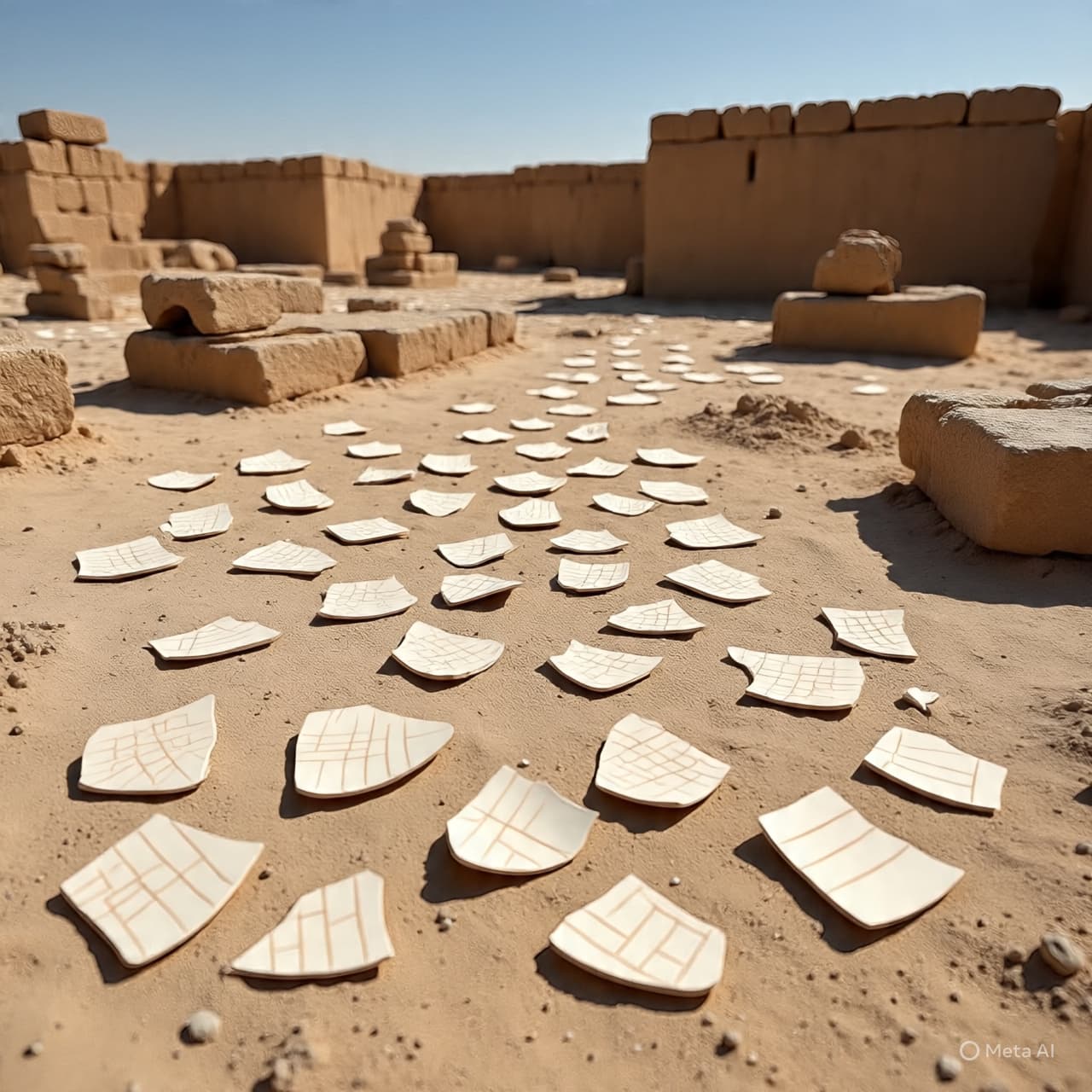
In the pale light that filters through dust and time, an ostrich egg is no longer just a vessel. It is a fragile echo of wind‑scoured plains, of people whose eyes first turned from survival to pattern and meaning. At sites scattered across southern Africa — from Diepkloof in South Africa to Apollo 11 in Namibia — etched fragments of eggshell speak in quiet grids, parallel bands, and angled crossings that reach back more than sixty millennia. These are not the aimless scratches of chance but deliberate instantiations of spatial order on curved surfaces.
For decades, archaeologists have treated such objects as functional containers for water, turned light by prehistoric hands in landscapes both harsh and plentiful. Yet within these shells lies another story — one of abstraction and reason. The engraved lines are arranged with regularity that goes beyond simple doodling: parallelisms, near‑right angles, and repeated sequences mark a planning mind at work. Researchers find that over eighty percent of the examined patterns demonstrate a coherence not of happenstance but of intention, a form of visual construction that implies abstraction rather than mere ornamentation.
These engraved markings, recovered from more than a hundred fragmentary pieces, are spread across layers of the Howiesons Poort cultural horizon — a phase of the Middle Stone Age associated with advanced toolmaking and nascent symbolic behavior. Here, long before the dawn of agriculture or writing, people engaged with surface and space, carrying geometric logic into their everyday objects. These patterns were rendered with repeated strokes that suggest a “grammar” of marking: operators of rotation, translation, and embedding used again and again to organise form.
It is tempting to view these marks simply as art or ornamentation; yet their consistency nudges us toward a subtler conclusion. They reflect not only a capacity for spatial reasoning but also a shared set of visual habits potentially spread across groups and locales. In the quiet repetition of a grid or a hatch, one hears the slow turning of human thought toward abstraction, a step in the evolving relationship between mind and the marks it leaves upon the world — a precursor to the shapes that centuries later would grace walls, bones, and eventually paper.
The implications of these geometrics ripple outward. They weave into broader debates about the cognitive and cultural capacities of early Homo sapiens, suggesting that the roots of structured thought may stretch back deeper than we once believed. These engraved shells stand as one of the earliest material manifestations of organized graphic representation — a reminder that the leap from survival to contemplation may have been written first in the gentle geometry of tireless hands.
In calm factual terms, this recent research identifies finely engraved patterns on ostrich eggshell fragments dating to roughly 60,000 years ago. The engravings show statistical regularities — parallel lines, orthogonal crossings, and repeated motifs — that indicate controlled patterning rather than random activity. Archaeologists interpret these markings as evidence that early modern humans engaged in consistent geometric operations long before the emergence of formal writing systems or complex urban architecture.
AI Image Disclaimer
Illustrations were created using AI tools and are not real photographs.
Sources
The Jerusalem Post ScienceAlert Archaeology Magazine Phys.org
Published by Banx Network. This article is part of the Banx decentralized media programme, powered by the BXE token on the XRP Ledger.