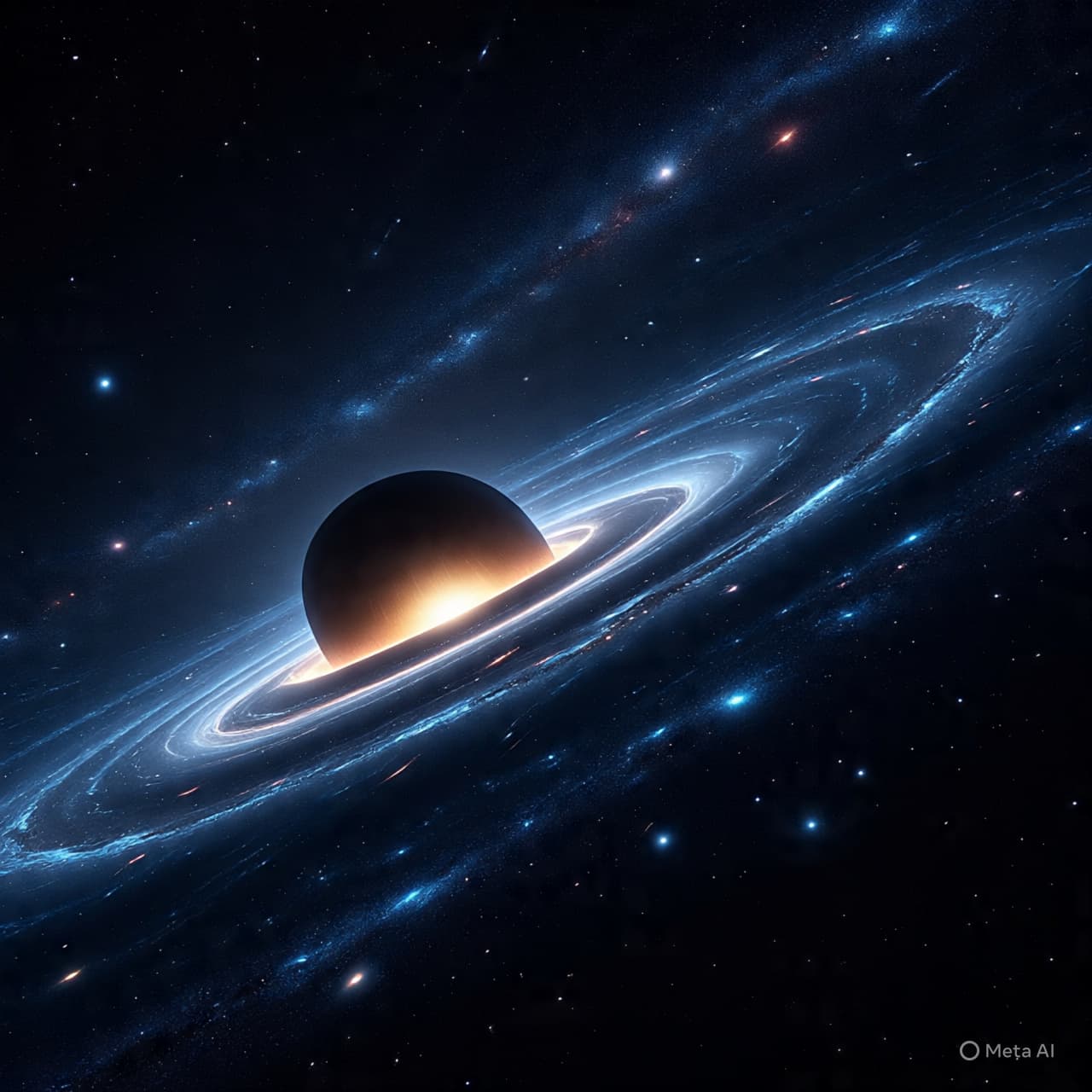
In the vast darkness between the stars, faint signals carry stories of cosmic giants spiraling together — like distant beacons in a night sea, guiding the gaze of astronomers toward some of the universe’s most profound forces. Recently, scientists announced they have named two such systems of merging supermassive black holes after landmarks from The Lord of the Rings, capturing both the poetic imagination and the cutting edge of astrophysics. In a discipline that often deals in stark numbers and distant abstractions, choosing names like Rohan and Gondor evokes images of towering watchfires and epic journeys — metaphors that resonate with our own search for understanding.
These cosmic titans — unimaginably massive black holes at the centers of distant galaxies — are locked in a slow dance, orbiting ever closer as they prepare to collide. Such mergers are among the universe’s most powerful events, releasing vast amounts of energy and the faint but enduring ripples in spacetime known as gravitational waves. Yet unlike the dramatic signals detected from smaller black hole collisions, these supermassive spirals emit waves so low in frequency that new detection methods are required. Enter the North American Nanohertz Observatory for Gravitational Waves (NANOGrav), a research collaboration that has pioneered a novel approach, combining gravitational wave background measurements with observations of exceptionally bright galactic nuclei called quasars.
In this new framework, quasars — luminous beacons powered by matter falling into supermassive black holes — serve as signposts. When one of these beacons also emits continuous gravitational waves, it suggests that two black holes are in orbit and nearing merger. In their survey of 114 such active galactic nuclei, researchers identified two promising candidates: SDSS J1536+0411, dubbed Rohan, and SDSS J0729+4008, named Gondor. The name Rohan honors a Yale student first to analyze the system, while Gondor was chosen playfully because “the beacons were lit,” echoing J.R.R. Tolkien’s tale of call and response across the lands.
Though no direct gravitational wave signal from these systems has yet been isolated, the significance lies not merely in their names but in what they represent: the first concrete steps toward mapping where supermassive black hole mergers occur. Creating such a map — a cosmic atlas of merging giants — could illuminate how galaxies grow and evolve, how black holes interact over billions of years, and how the universe’s largest structures change with time. As they refine their detection protocols and continue exploratory searches, scientists hope that these beacons will light the way toward a deeper understanding of gravity and cosmic history.
In the interplay of fiction and discovery, Rohan and Gondor serve as reminders that human curiosity — whether inspired by stories or star charts — drives us to see beyond the visible, to the rhythms that govern the cosmic dance of creation and change.
AI Image Disclaimer “Visuals are created with AI tools and are not real photographs.”
Sources Latest reporting on the identification and naming of merging supermassive black holes using gravitational waves and quasar data.
Published by Banx Network. This article is part of the Banx decentralized media programme, powered by the BXE token on the XRP Ledger.