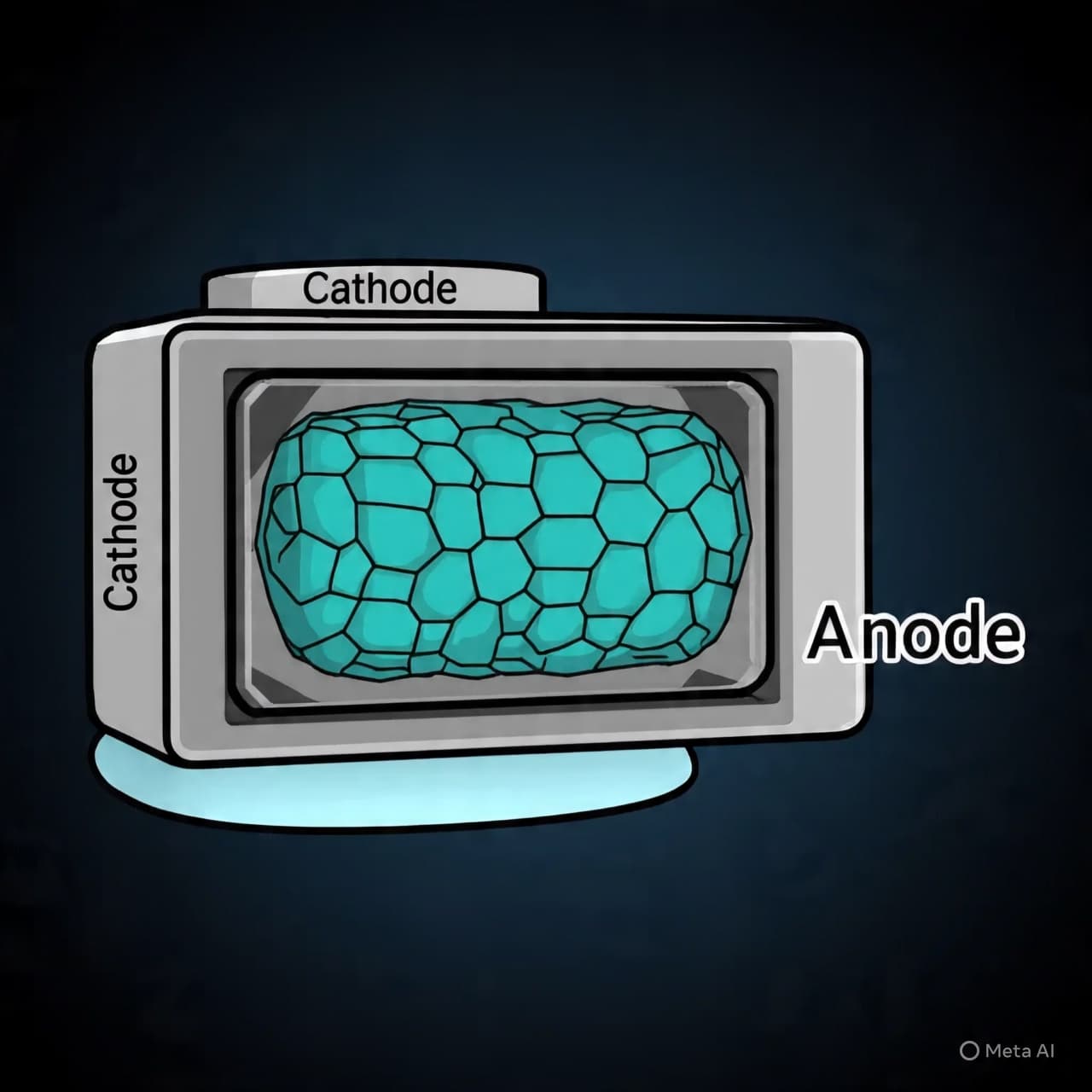
Some discoveries arrive like lightning — sudden, bright, and attention‑grabbing. Others creep in quietly, like the tide, hinting at change long before it fully shows. In the evolving world of energy storage, a new twist on an old idea now suggests that the future might trickle in much the same way: by letting something we usually push out — water — stay within.
At the University of Surrey, researchers have taken a familiar material from the realm of sodium‑ion batteries and asked a simple question with profound consequence: what if instead of removing the natural water from the compound, we left it in? The answer was surprising. Stocks of nanostructured sodium vanadate hydrate in its so‑called “wet” form were found to store nearly twice as much electrical charge as their dry counterparts — a dramatic leap that brings sodium‑ion batteries closer to performance levels long dominated by lithium‑ion technology.
This isn’t merely about capacity, but about perspective. Sodium, abundant in Earth’s crust and seawater alike, offers a promise of energy storage less constrained by the limited metals that underpin current battery markets. By preserving the water inside the cathode material, scientists observed faster charging, notable stability across hundreds of cycles, and performance ranks among the best reported for sodium systems to date.
Yet perhaps the most poetic aspect of this work is the way it reframes seawater itself. In tests, the hydrated material didn’t simply tolerate salt water — it worked within it, pulling sodium ions from solution as part of its electrochemical activity. When paired with an electrode that removed chloride ions, the entire assembly acted as an electrochemical desalination system. In other words, a device that stores energy might also reduce the salt in water, edging toward fresh water production as part of its operation.
For decades, lithium‑ion batteries have powered portable electronics, electric vehicles, and grid storage alike, their dominance built on high energy density and reliable performance. But their reliance on scarcer resources has long spurred the search for alternatives. Sodium‑ion systems, by contrast, draw on materials that are plentiful and less environmentally fraught. Even so, matching lithium’s capabilities has been challenging. This new approach — preserving water rather than expelling it — challenges a long‑standing assumption in battery chemistry and opens a pathway toward higher performance with simpler methods.
While this research remains at the material‑science and laboratory stage, its implications reach wider. A battery that can reliably store energy and play a role in water purification touches two of the twenty‑first century’s most pressing needs: sustainable power and safe water. In coastal regions where seawater abounds but fresh water is scarce, hybrid systems that combine energy storage with desalination could one day bring both light and drinkable water to communities that need them most.
These possibilities do not unfold overnight. Yet the work at Surrey stands as a reminder that innovation often comes from seeing what has always been there — water in a compound, salt in the sea — in a new way.
AI Image Disclaimer “Visuals are created with AI tools and are not real photographs.”
Sources University of Surrey research (via ScienceDaily) Applied sciences reporting (TechnologyNetworks) Sustainable energy coverage (Phys.org) Battery performance discussion (SciTechDaily) Applied sciences digest (TechBriefs)
Published by Banx Network. This article is part of the Banx decentralized media programme, powered by the BXE token on the XRP Ledger.