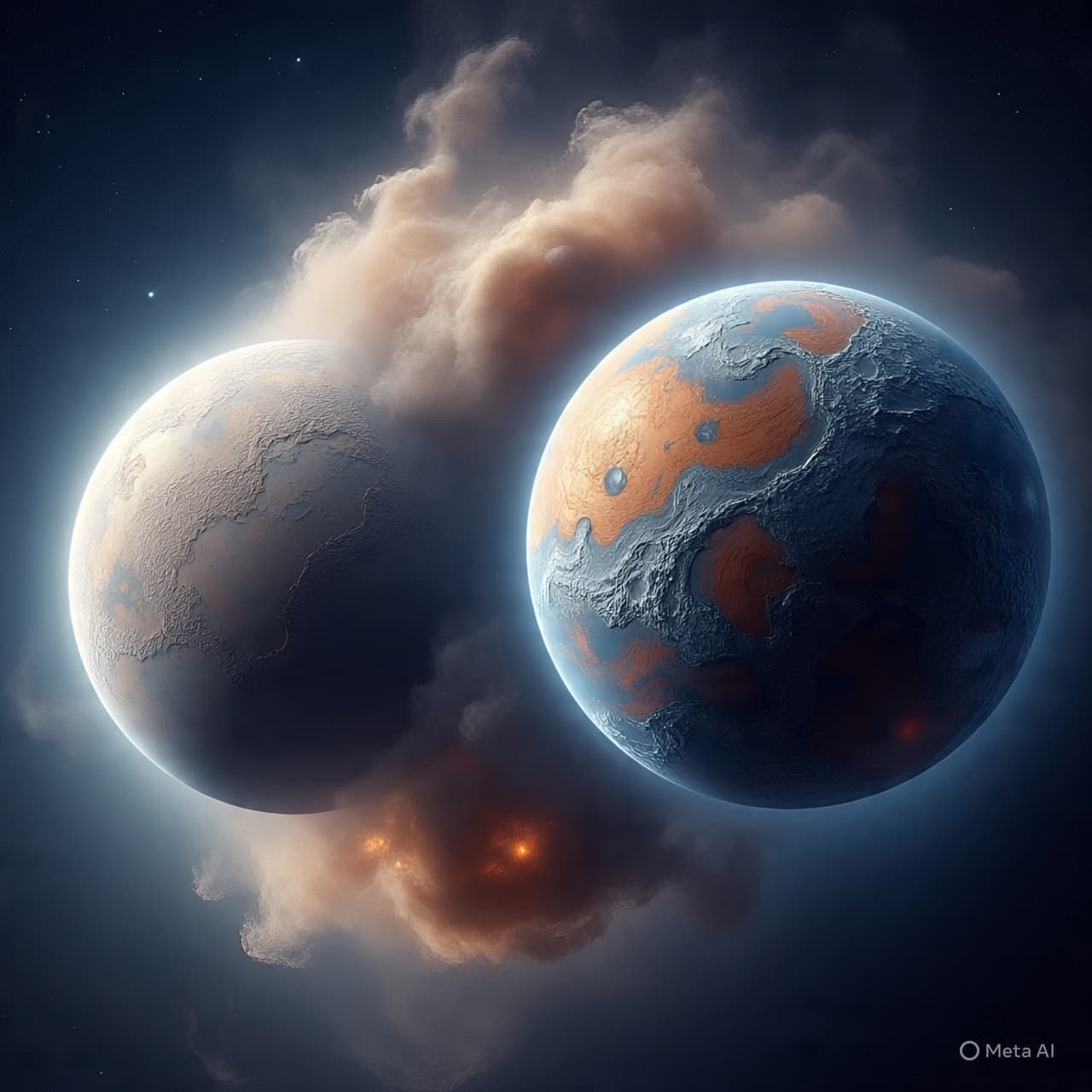
In the young Solar System, long before continents formed or oceans settled into their basins, Earth was not alone. New research suggests that Theia — the long-theorized planetary body believed to have collided with Earth and created the Moon — may not have been a wandering intruder after all. Instead, it may have been our cosmic neighbor, orbiting in a position so close and so stable that their fates were intertwined from the very beginning.
The early Solar System was a crowded arena, filled with growing worlds that drifted, collided, and scattered like ancient stones in a slow-motion dance. Traditionally, Theia has been seen as a rogue planetesimal that crossed Earth’s orbit at the wrong moment. But new geochemical models, supported by comparative mantle analyses and orbital reconstructions, point toward a gentler, more intimate origin story: Theia and Earth may have formed near the same region of the Sun, sharing similar material and evolving in near-parallel arcs.
That possibility reshapes the narrative. If Theia grew in Earth’s neighborhood, their compositions would naturally align — providing a cleaner explanation for why lunar samples match Earth so closely. The Moon’s chemistry has long puzzled scientists; a violent impact with an unrelated body should have left more distinct fingerprints. But siblings formed from the same primordial dust offer a more harmonious solution.
This updated perspective also softens the emotional tone of the giant-impact hypothesis. Instead of a random cosmic strike, it becomes the final chapter of two worlds long drifting beside each other — a slow gravitational inevitability rather than a sudden catastrophe. In that collision, Theia’s material contributed not only to the Moon but to Earth itself, adding depth to our planet’s mantle and shaping the world we now inhabit.
The idea is still developing, supported by simulations and isotope studies but requiring further refinement. The early Solar System leaves few clear traces; its history is read in mineral ratios and orbital clues rather than preserved records. Yet each discovery adds a stroke to a broader picture — one where planetary formation is not a series of chaotic accidents but a gradual choreography shaped by proximity, timing, and shared origins.
If Theia and Earth were truly neighbors, then the Moon is more than a relic of violence — it is a reminder of an ancient kinship between worlds. A fragment of a lost planet that once circled near us, close enough that its destiny became our own.
Published by Banx Network. This article is part of the Banx decentralized media programme, powered by the BXE token on the XRP Ledger.