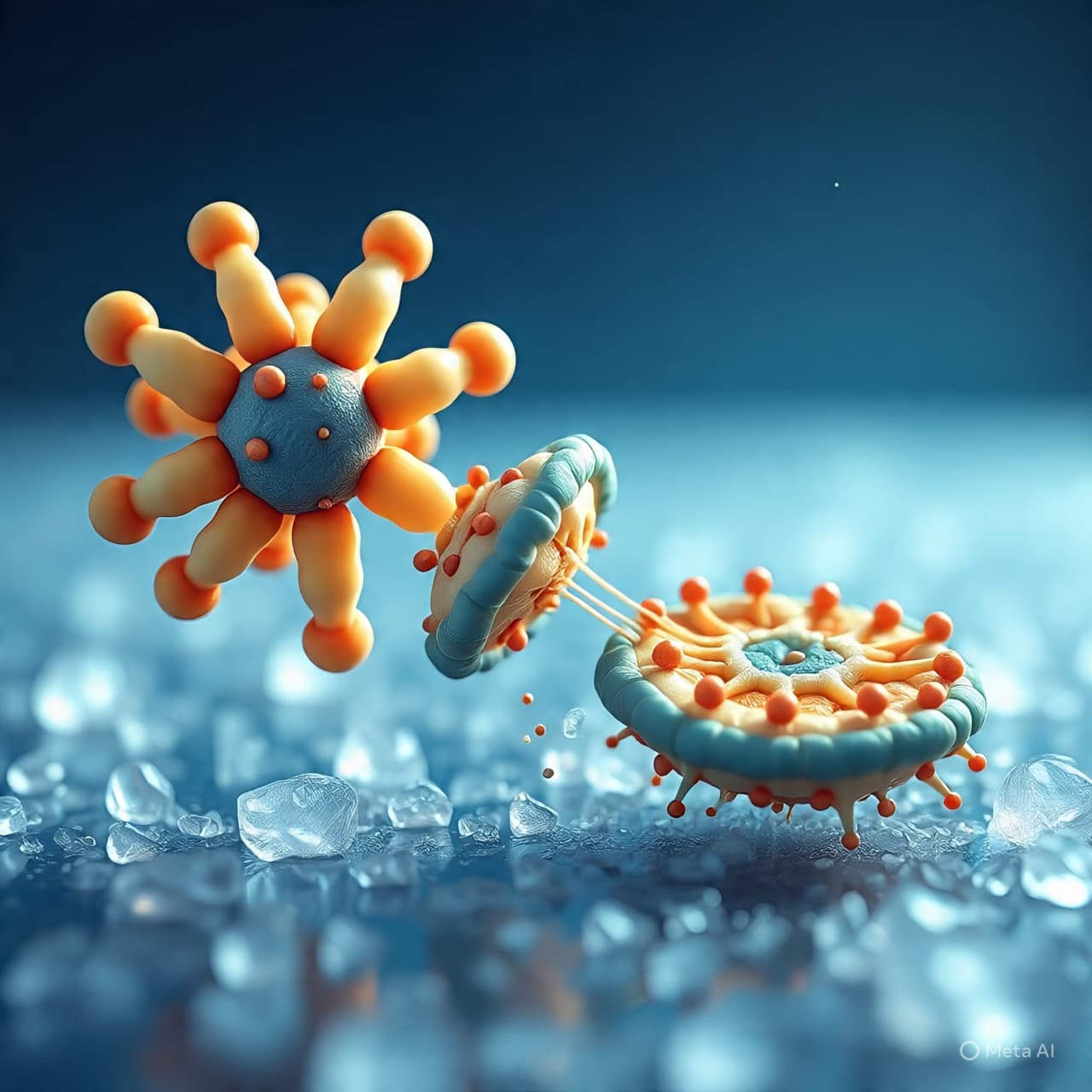
In the intimate dance between microscopic life and the viruses that prey upon it, there are hidden moves that both astonish and inspire. Among these is a newly revealed mechanism by which certain viruses — bacteriophages — wield tiny proteins that bring bacterial defenses to a standstill. Like a clever key fitting into a complex lock, these phage‑encoded “single‑gene lysis” proteins slip into a bacterial transporter and jam it, halting a vital process that keeps the cell wall assembled and intact. The result is bacterial collapse — and in that collapse lies a whisper of promise for new antibiotics.
At the heart of this story is MurJ, an essential protein in Gram‑negative bacteria that functions as a flippase — a molecular machine that translocates lipid II, a building block of peptidoglycan, from the inside to the outside of the cell membrane. This flipping action is a linchpin of bacterial cell wall biosynthesis, akin to a shuttle that ferries bricks across a border for construction. Without this transport, construction stalls, and the cell wall weakens and fails.
Researchers led by molecular biologists have uncovered a striking phenomenon: three distinct phage lysis proteins — each from unrelated viruses and bearing no sequence similarity — independently evolved to target MurJ. Through high‑resolution cryo‑electron microscopy, scientists captured how these proteins dock onto the flippase and lock it in an outward‑facing conformation, effectively freezing its normal conformational cycle and stalling lipid II movement. It is as though the phage proteins have found the Achilles’ heel in MurJ’s mechanism and used it to wedge the transporter into a nonproductive pose.
One of these phage proteins — known as Sglᴹ — was studied in detail and shown to interact with grooves between specific transmembrane helices of MurJ, stabilizing an outward‑facing state that blocks the flippase’s ability to reset for another cycle. In biochemical terms, this amounts to a conformational blockade: MurJ cannot flip lipid II and, just like a worker barred from leaving a factory floor, the process grinds to a halt.
What makes this finding especially compelling is the convergence: independent viral lineages have each hit upon a remarkably similar strategy — targeting the same protein and the same functional interface to achieve lysis. This convergent evolution suggests that MurJ represents a particularly accessible and vulnerable point in the bacterial cell wall synthesis pathway. It’s a vulnerability that phages exploit repeatedly and elegantly, and that antibiotic researchers now see as a potential opportunity.
In a world facing rising antimicrobial resistance, these insights are more than molecular curiosities; they offer a fresh perspective on how to design drugs that mimic nature’s most efficient bacterial killers. By understanding how tiny phage proteins jam MurJ, scientists hope to craft novel antimicrobial agents that could disrupt bacterial survival with precision and potency.
AI Image Disclaimer (rotated wording) “Graphics are AI‑generated and intended for representation, not reality.”
Source Check Here are credible sources confirming the research before I write the article:
Sources:
Nature — Convergent MurJ flippase inhibition by phage lysis proteins (structure and mechanism) Phys.org / Caltech press — summary of mechanisms and implications for antibiotic targeting Science Advances / PubMed — phage lysis protein Lys⁽M⁾ mechanism blocking MurJ conformational change Sciety / preprint discussion — structure showing convergent inhibition by different lysis proteins PubMed / PMC — structural basis and biochemical details of Lys⁽M⁾ blocking MurJ activity
Published by Banx Network. This article is part of the Banx decentralized media programme, powered by the BXE token on the XRP Ledger.