
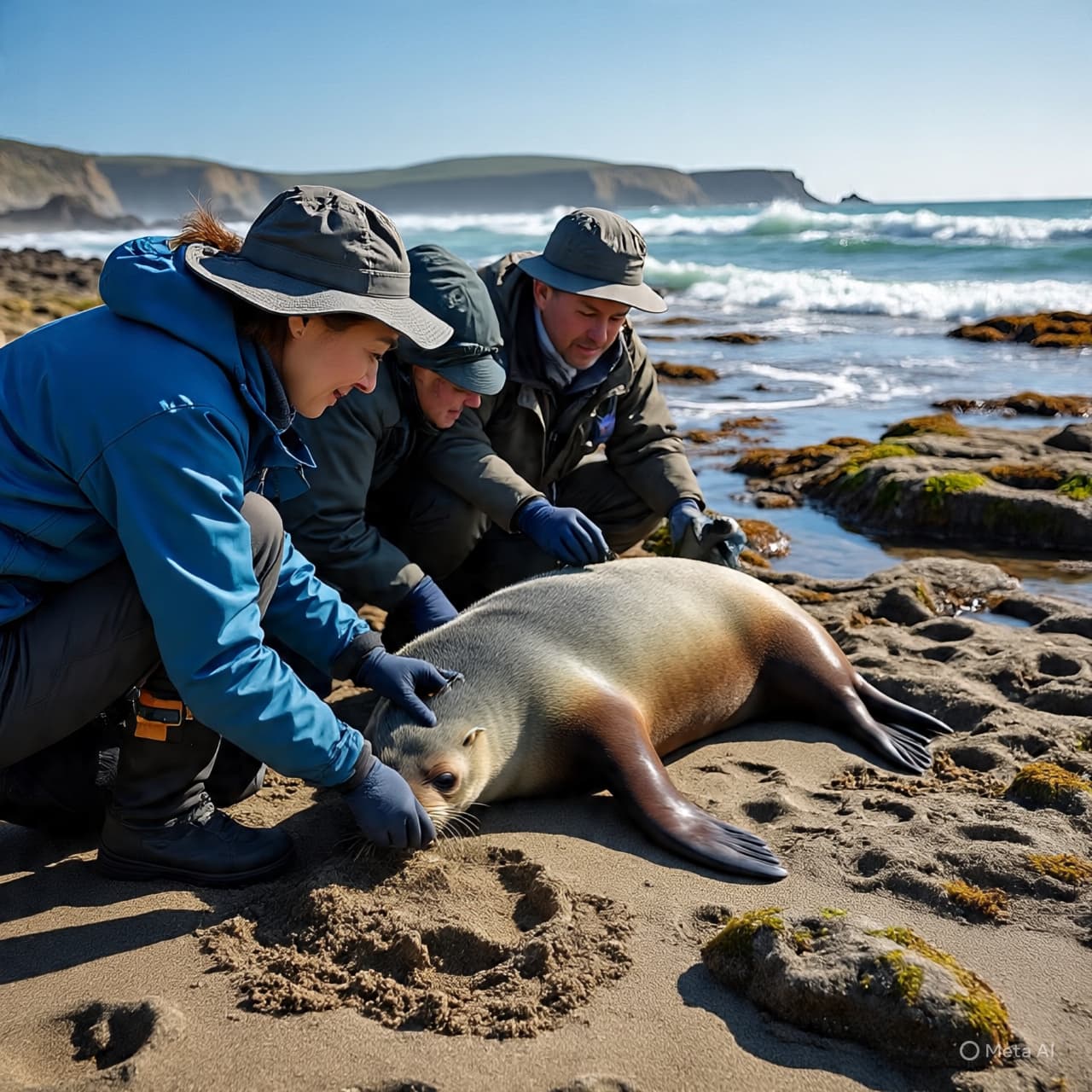
There are moments in nature that remind us how delicately woven the threads of life truly are — like the brief flicker of a candle in the evening breeze, capturing our gaze before reminding us of its vulnerability. In the vast expanse where ocean meets sand along the California coast, northern elephant seals gather each winter in a rhythm as reliable as the tides themselves, a spectacle of growth and struggle that has long enchanted scientists and visitors alike.
But recently, this rhythm has been disrupted by an unexpected visitor: a virus carried on the winds and wings of birds now found among marine mammals it once seldom touched. At Año Nuevo State Park, a beloved site for observing the annual elephant seal gathering, researchers have confirmed a small outbreak of highly pathogenic avian influenza — commonly known as bird flu — with a number of seal pups affected and deaths reported, capturing the concern of wildlife teams who have devoted decades to studying this colony.
This outbreak marks a poignant chapter in the story of wildlife disease ecology, as it is the first time the H5N1 strain has been confirmed in marine mammals in California. Seven recently weaned elephant seal pups have tested positive, part of a group of roughly 1,350 seals on the beach when signs emerged. Scientists first noticed unusual respiratory and neurological symptoms — weakness, tremors and lethargy — in some pups late last week, prompting immediate testing and surveillance.
The disease has been responsible for significant impacts in other regions; in Argentina, for example, a similar outbreak led to high mortality rates among southern elephant seals during their 2023 breeding season. Those historical echoes add weight to the careful attention now focused on the Año Nuevo colony. Yet, researchers remain cautiously optimistic that early detection and active monitoring may help limit the spread.
Bird flu, particularly the H5N1 strain, has travelled widely since its emergence in the 1990s, moving across continents via migratory birds and occasionally spilling into mammal populations. While its effects vary across species, elephant seals are particularly vulnerable when young and recently weaned, lacking the immunological defenses of adults. This vulnerability is reflected in the age profile of the cases observed so far.
Long‑term scientific monitoring at Año Nuevo — one of the most intensively studied elephant seal colonies in the world — has equipped researchers with invaluable baseline data. For more than 60 years, scientists from institutions such as the University of California, Santa Cruz, have tracked individual seals through flipper tags and systematic observations, making this moment all the more meaningful in the context of deep ecological knowledge.
The presence of avian influenza in marine mammals raises questions about the pathways of transmission and the interplay between ecosystems. Though the precise route by which these seals became infected remains uncertain, experts point to bird‑to‑mammal spillover as the most likely scenario. Continued surveillance of birds, mammals and environmental reservoirs will be central to understanding the dynamics of this outbreak.
In a gesture of caution rooted in both public safety and wildlife protection, park officials have canceled elephant seal tours through at least March and restricted access to seal‑viewing areas to minimize disturbance and reduce potential human‑linked spread. While the risk to people is considered low, officials advise that visitors maintain distance from marine mammals and follow guidance on interactions with wildlife.
This development offers a moment to reflect not only on the resilience of nature but on its fragility. The ebb and flow of animal populations, linked as they are to environments both near and far, reminds us that the web of life can be touched by forces that cross species and ecosystems. Discovering, with measured concern, that an age‑old virus has found a new host in this colony is a reminder of the continuing journey scientists and stewards of the natural world share.
In straightforward terms, officials and researchers have confirmed the first cases of highly pathogenic avian influenza in northern elephant seals at Año Nuevo State Park in California. Seven weaned pups tested positive for H5N1, and about 30 seals have died amid the detected outbreak. Park officials have closed public seal‑viewing areas and canceled tours as surveillance and testing continue in coordination with state and federal wildlife agencies.
AI Image Disclaimer Visuals are created with AI tools and are not real photographs.
Sources: The Guardian UC Davis News KQED Smithsonian Magazine NBC Bay Area
Published by Banx Network. This article is part of the Banx decentralized media programme, powered by the BXE token on the XRP Ledger.



.jpg&w=3840&q=75 "Qantas Grounds Plane After Passengers Report Bedbug Bites")