In the dappled light of our shared evolutionary history, we have long held the capacity for imagination as a uniquely human sanctuary—a private garden where we alone could build worlds out of nothing. We believed the ability to "pretend," to treat an empty vessel as if it brimmed with liquid, was the threshold that separated the waking world of the animal from the dreaming mind of the person. Yet, in the quiet observation rooms of recent scientific study, that threshold has begun to soften and blur. By inviting our closest relatives to a table set with the simple props of a tea party, researchers have glimpsed a startling mirror held up to the human soul. It appears that the great apes, our cousins in bone and blood, have been keeping their own invisible company all along.
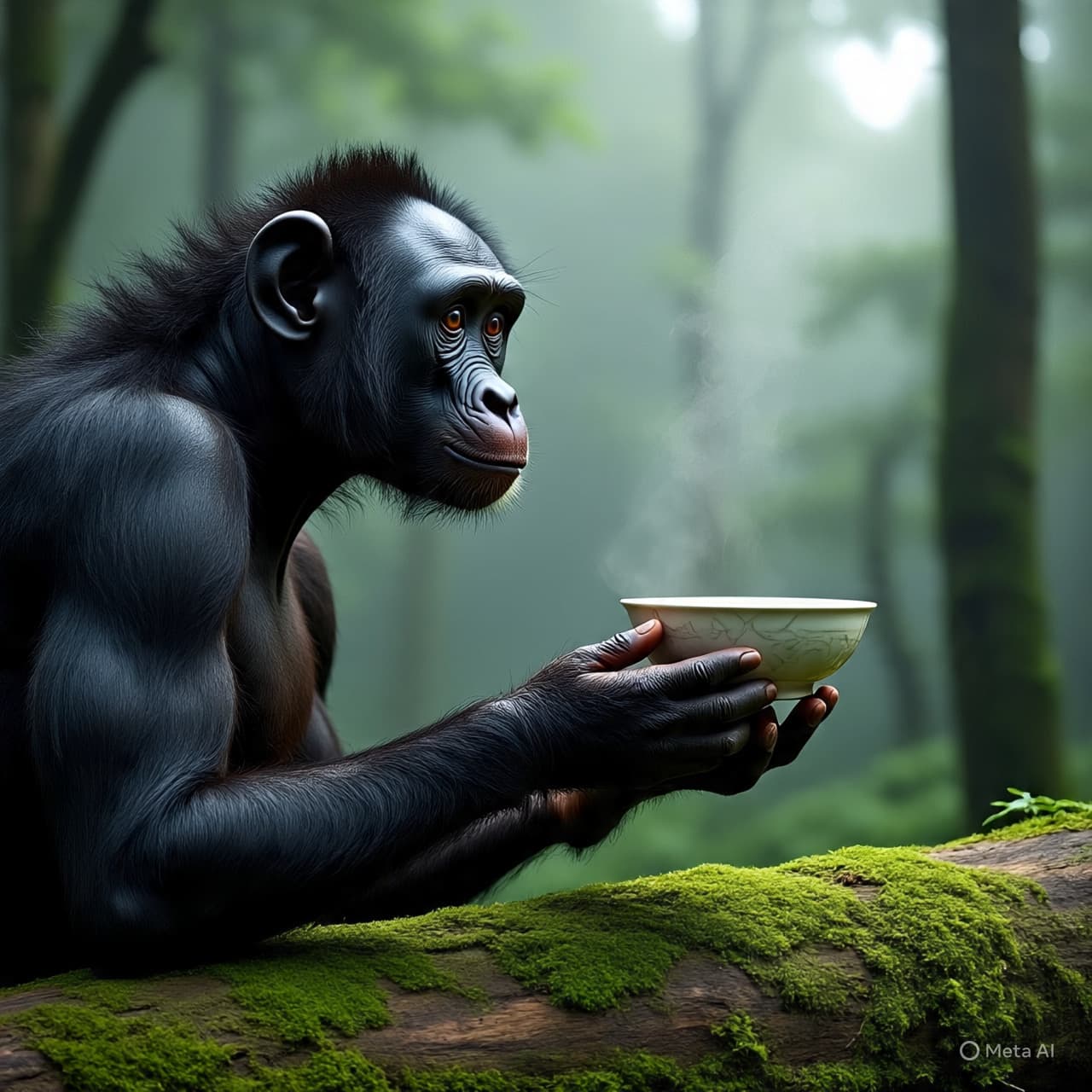
The experiments were deceptively simple, involving the presentation of empty cups and teapots to chimpanzees and bonobos, yet the results carried the weight of a profound revelation. These creatures did not merely stare at the hollow plastic; they engaged in the complex, rhythmic dance of the "as-if." They poured silence into cups and drank from the air with a deliberate grace that suggests a mind capable of holding two realities at once—the world that is, and the world that could be. This leap into the symbolic is no small feat of biology; it is the cornerstone of culture, the very spark that allows a species to move beyond the immediate demands of hunger and fear into the realm of narrative and shared meaning.
As we watch a chimpanzee carefully "sip" from an empty bowl, we are forced to reconsider the texture of their inner lives. The factual discovery that great apes possess the cognitive architecture for pretend play suggests that the roots of our own myths and stories are far deeper and older than we dared to imagine. It moves the conversation away from the cold metrics of tool-use and into the warmer, more elusive territory of the spirit. We find ourselves no longer alone in the theater of the mind, but rather sitting at a table that has been set for millions of years, waiting for us to recognize the invisible tea being poured by hands so very much like our own.
AI Image Disclaimer
Visuals are AI-generated and serve as conceptual representations of the scientific observations.
Sources
• Science Magazine
• Nature
• Royal Society Open Science
• National Geographic
• Smithsonian Magazine
Published by Banx Network. This article is part of the Banx decentralized media programme, powered by the BXE token on the XRP Ledger.