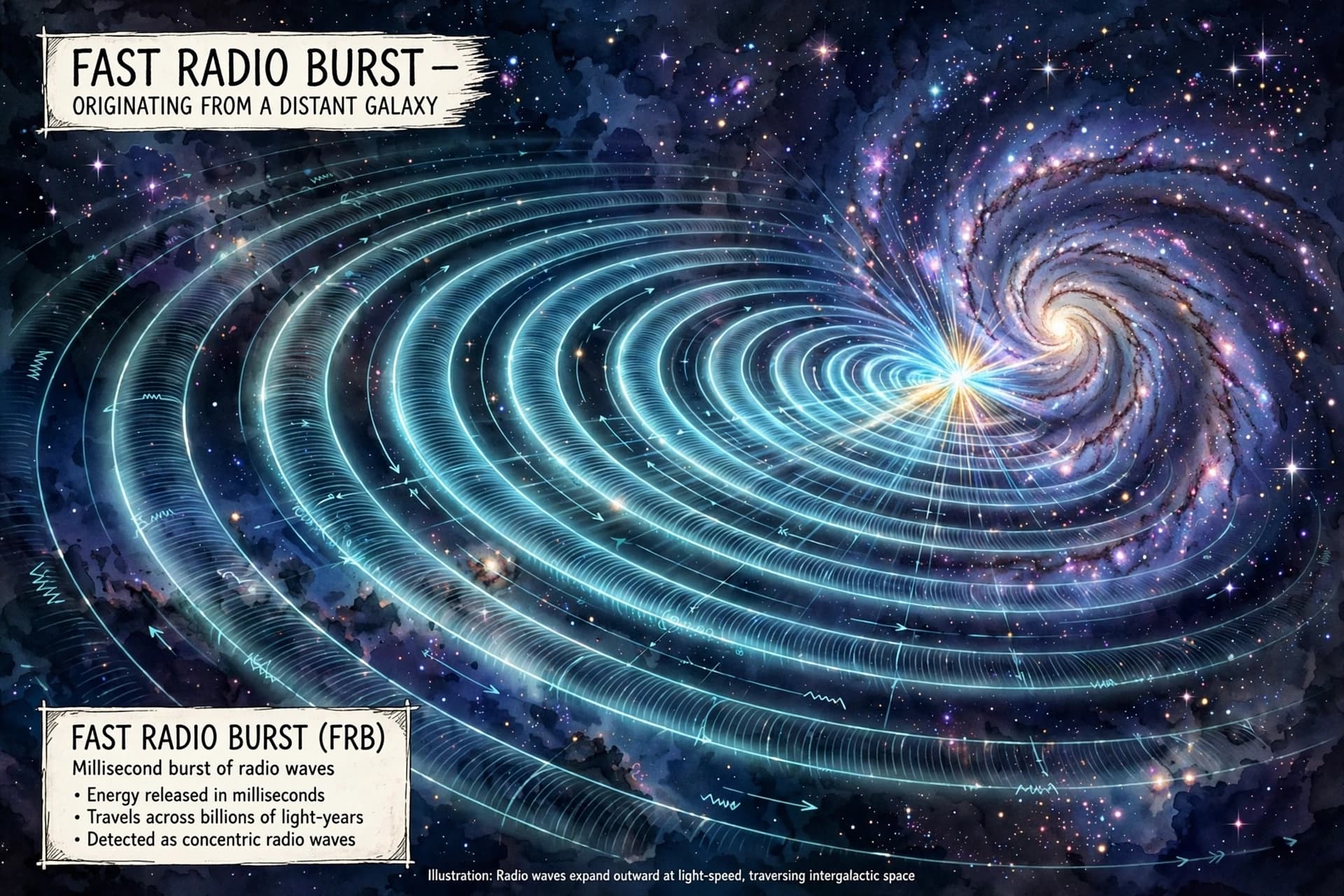
High above the atmosphere, where Earth thins into vacuum and time stretches under relativistic rules, something struck our planet with extraordinary force. It left no crater, no fireball visible to the naked eye — only a fleeting cascade of particles racing through detectors before vanishing again into silence. What mattered was not what was seen, but the energy it carried: more than 100,000 times greater than anything produced by the Large Hadron Collider.
For years, the particle was treated as an anomaly, an outlier too extreme to fit comfortably within known physics. Ultra-high-energy cosmic rays are rare but familiar, usually traced back to violent astrophysical environments such as supernova remnants or active galaxies. This event, however, arrived with such intensity that even those explanations strained under the weight of its numbers.
A new study offers a more unsettling possibility. The particle may have originated from the death of a black hole — not the massive kind that anchors galaxies, but a primordial black hole, formed shortly after the universe itself came into being. These ancient objects, if they exist, would be small by cosmic standards and unstable by nature, slowly losing mass over billions of years before ending in a sudden, energetic release.
According to the research, the final moments of such a black hole could produce bursts of particles at energies far beyond what conventional accelerators or astrophysical engines can achieve. In this interpretation, the particle that struck Earth was not a messenger from a distant star, but debris from an evaporation process predicted decades ago and never directly observed.
The idea reshapes the event’s meaning. Rather than breaking physics, the particle may be confirming it — offering indirect evidence of Hawking radiation and of black holes that predate stars, galaxies, and planets. If correct, it suggests the universe still carries remnants of its earliest moments, capable of announcing themselves in brief, violent whispers.
Detection remains difficult. These events are exceptionally rare, and their signals are easily confused with more familiar cosmic noise. Yet each confirmed instance would carry immense weight, connecting particle physics, cosmology, and gravity in a way no laboratory experiment can.
The particle itself is long gone, its energy spent in the atmosphere above us. What remains is the question it left behind. Somewhere in the vast dark between galaxies, something may have ended — not with light, but with a single, impossible impact that briefly touched Earth and expanded the boundaries of what we thought the universe could do.
AI Image Disclaimer Visuals are AI-generated and intended as conceptual representations.
Sources Physical Review Letters Astroparticle Physics European Organization for Nuclear Research
Published by Banx Network. This article is part of the Banx decentralized media programme, powered by the BXE token on the XRP Ledger.