Sleep is one of biology’s most intimate mysteries. We surrender to it nightly, yet even in our own species, its purpose remains only partly understood. For decades, the deep architecture of sleep—the cycling between quiet rest and the vivid, twitching theater of rapid eye movement—was assumed to belong to vertebrates, creatures with backbones and brains we recognized as complex.
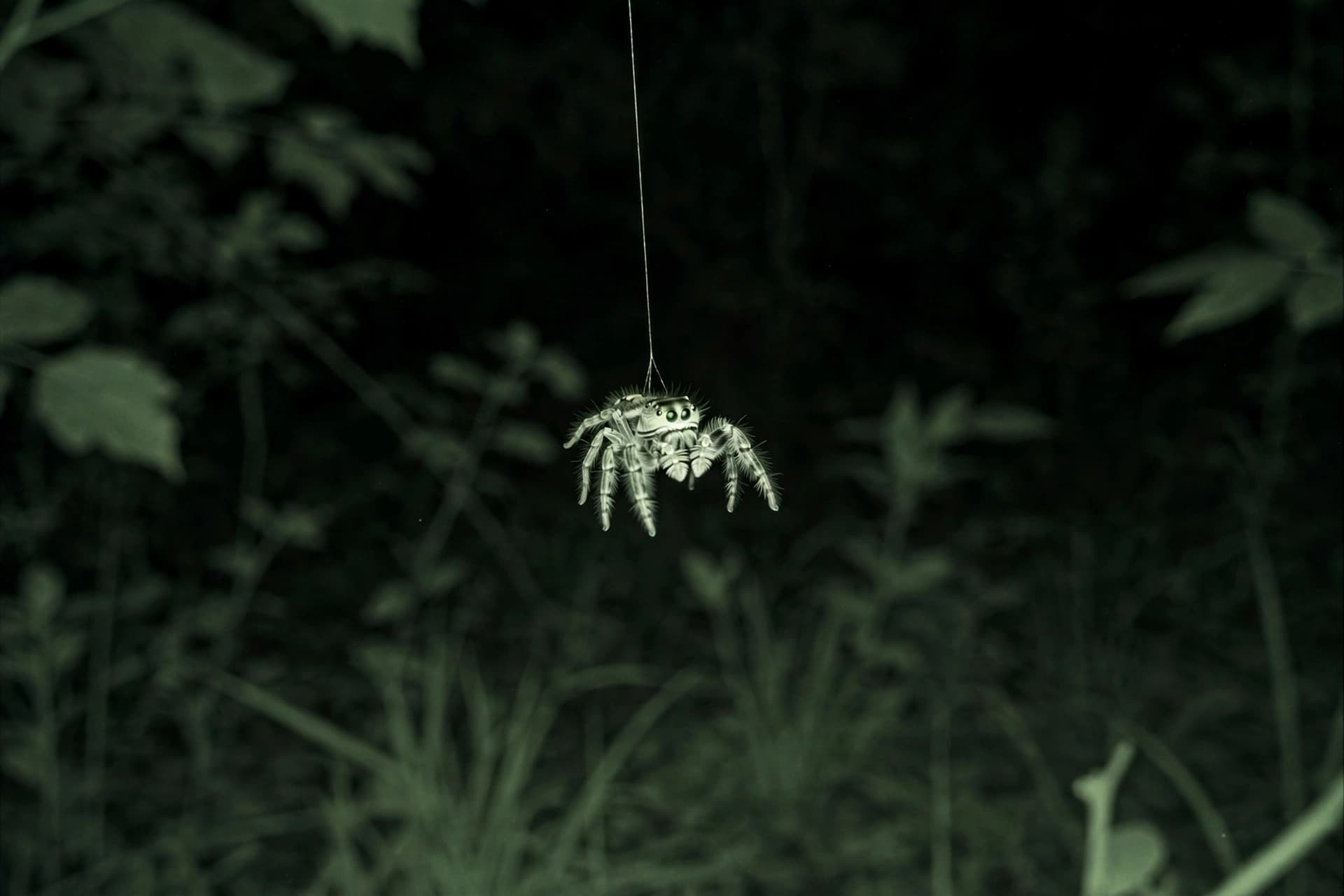
A small spider with large, curious eyes has gently challenged that assumption. Researchers at the University of Bonn, studying the Australian jumping spider Portia fimbriata, have documented what appears to be a two-stage sleep pattern, including a REM-like phase marked by retinal movements and leg twitches . The findings, published in the Proceedings of the National Academy of Sciences, offer the first comprehensive behavioral evidence of such sleep in a spider.
The study required patience and a willingness to look closely at a creature the size of a coin. Using infrared cameras to observe the spiders through the night, the researchers recorded periods of still, quiet rest interrupted by distinct episodes of activity. During these active phases, the spiders’ legs twitched, their spinnerets moved, and—because the spiderlings have translucent heads—their retinal tubes could be seen shifting back and forth .
To confirm that these were truly sleep states and not mere rest, the team tested arousal thresholds. Spiders in the active phase took longer to respond to acoustic stimuli than those in quiet rest or full wakefulness . When deprived of sleep, the spiders later spent more time in the active phase, a rebound effect that suggests the state serves a biological need.
What makes the finding remarkable is not just its novelty but its implications. The last common ancestor of vertebrates and arthropods lived more than 500 million years ago. If both lineages exhibit two-stage sleep, the phenomenon may be far older and more widespread than previously imagined—or it may have evolved independently, a solution to a problem shared across nervous systems of vastly different designs . The researchers are careful not to claim that spiders dream, only that their behavior mirrors the outward signatures of a state we associate with dreaming in ourselves.
There is a quiet philosophical weight to this. For centuries, humans have drawn lines between ourselves and the creatures we share the world with, often placing sleep and consciousness on the human side of those lines. A jumping spider, suspended from a silk thread in the dark, twitching its legs in a rhythm older than bones, invites us to reconsider where those lines belong.
The work also opens practical questions. How does sleep evolve in animals with miniature brains? What function does the REM-like state serve in a creature that hunts by sight and relies on intricate visual memory? The Bonn team plans to extend their studies across spider diversity, and to examine how artificial light at night and other human disruptions affect these ancient rhythms .
For now, the spider offers a small, humbling lesson. Sleep, it seems, is not a luxury of complexity. It may be one of the oldest conversations between an animal and the turning of the day.
Image note: This article’s visual is AI-generated and intended for illustrative purposes; it is not a photograph of the studied spiders.
Sources: Phys.org, Proceedings of the National Academy of Sciences, University of Bonn
Published by Banx Network. This article is part of the Banx decentralized media programme, powered by the BXE token on the XRP Ledger.