There is a particular kind of mystery that arrives in the form of something small and bright. The James Webb Space Telescope, in its first years of operation, revealed a population of compact red sources in the early universe—objects that appear at redshifts between about 4 and 10, when the cosmos was less than a billion years old. They are called "little red dots," and their nature has been a subject of quiet but intense debate.
The name is almost dismissive, but the objects themselves are not trivial. They are compact, luminous, and red, and multiple lines of evidence suggest they host accreting supermassive black holes . What has puzzled astronomers is the shape of their light. Standard models of black hole accretion predict a disk of hot plasma, but the little red dots do not quite fit that picture. Their variability, their colors, and their compactness have pointed toward something stranger.
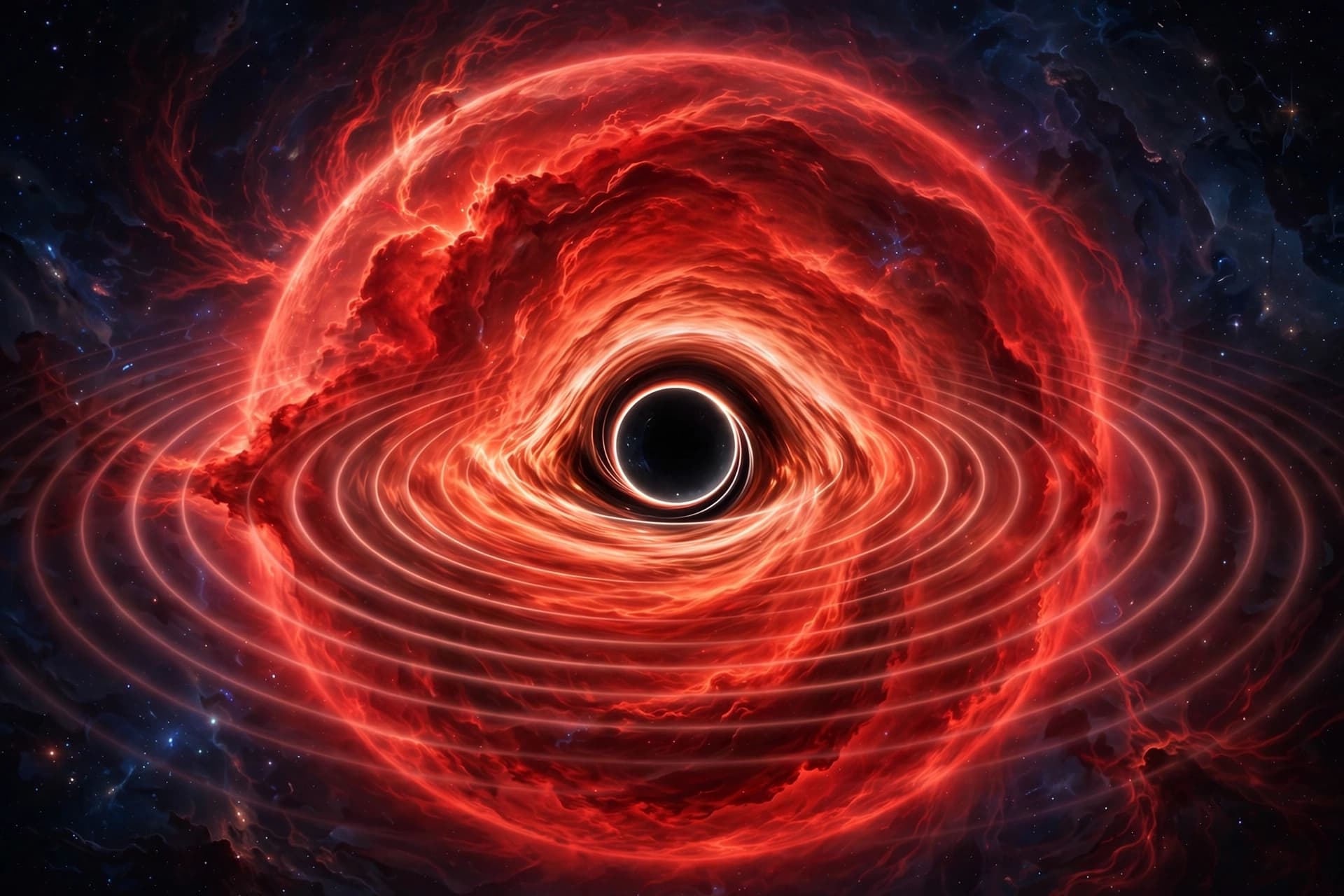
A new paper published in The Astrophysical Journal Letters offers a theoretical framework that may explain the observations. Led by Matteo Cantiello and colleagues, the study investigates the "quasi-star" hypothesis: the idea that a rapidly growing black hole seed could be embedded within a massive, radiation-pressure-supported envelope of gas . In this scenario, the optical light we see does not come from an accretion disk but from a pulsating, stellar-like photosphere surrounding the black hole.
The impetus for the study came from observations of a gravitationally lensed little red dot called R2211-RX1. This object shows century-scale photometric variability and a hysteresis loop in the luminosity-temperature plane—behavior that strongly suggests a pulsating photosphere rather than a stable accretion disk . Cantiello's team used stellar evolution and oscillation codes to model the stability of quasi-star envelopes, identifying a theoretical "instability strip" with a blue edge around 5,000 to 5,200 Kelvin. Models cooler than this threshold are unstable to radial pulsations driven by the kappa-mechanism in hydrogen and helium ionization zones, producing periods of 20 to 180 years for quasi-star masses in the range of 10,000 to 100,000 solar masses .
These pulsations match the timescale of variability observed in R2211-RX1. The researchers argue that such violent oscillations would drive enhanced mass loss, analogous to winds from super-asymptotic giant branch stars, which could regulate how long the quasi-star phase lasts and how massive the final black hole seed becomes . It is a picture in which the black hole's growth is not a simple, steady accumulation but a turbulent, pulsating process, with the envelope breathing and shedding material as the seed inside grows.
The work does not claim to solve the mystery of every little red dot. Some may be dust-reddened active galactic nuclei, others may be something else entirely. A separate study in the same journal found that the brightest little red dots are more likely than expected to have blue companions nearby, suggesting that their formation may be linked to synchronized events in dense environments . The picture is becoming richer, but not simpler.
What the quasi-star model offers is a way to connect the strange colors and variability of these early objects to known physics of stellar envelopes and pulsation. It is a bridge between the familiar and the bizarre, built with the tools of stellar astrophysics and tested against the peculiar behavior of a single lensed source. Whether it holds for the population as a whole remains to be seen.
For now, the little red dots remain what they were when they were first noticed: small, red, and stubbornly resistant to easy explanation. The universe, in its earliest chapters, seems to have found ways of making black holes grow that we are only beginning to imagine.
Image note: This article's visual is an AI-generated illustration and does not depict actual JWST data or observations.
Sources: The Astrophysical Journal Letters, Max Planck Institute for Astrophysics, Google Scholar
Published by Banx Network. This article is part of the Banx decentralized media programme, powered by the BXE token on the XRP Ledger.