In moments when history pauses, nations often find themselves walking along narrow bridges. One step still belongs to yesterday, while the next cautiously reaches for tomorrow. The passing of a leader, especially one whose presence shaped decades of governance, leaves not only a silence but also a question: who carries the torch until the path ahead becomes clear? Such a moment now unfolds in Iran. The country has entered a transitional phase after the reported death of its long-time Supreme Leader, Ayatollah Ali Khamenei, a figure who had stood at the center of Iran’s political and religious structure since 1989. In response, the state has activated a constitutional mechanism designed precisely for moments like this — a temporary leadership council tasked with guiding the nation until a permanent successor is chosen. According to Iran’s constitutional framework, when the position of Supreme Leader becomes vacant, the duties of that office do not simply disappear into uncertainty. Instead, they are temporarily carried by a council of three senior figures within the state. This arrangement is intended to ensure that the machinery of government continues to move, even as the nation reflects on the next chapter of its leadership. The current interim council is composed of three key officials: the sitting president, the head of the judiciary, and a senior cleric from the Guardian Council. Together, they assume the responsibilities that normally belong to the Supreme Leader. Their role is not to redefine the direction of the state but to maintain stability while the formal process of selecting a new leader begins. The body responsible for choosing the next Supreme Leader is the Assembly of Experts — a council of Islamic scholars and clerics elected to oversee the highest authority in the Islamic Republic. Under Article 111 of Iran’s constitution, this assembly must convene to deliberate and ultimately appoint the next figure who will hold the position. Until that moment arrives, the temporary council acts as a bridge between the old chapter and the one yet to be written. Observers note that the formation of such a council is not an improvisation but a built-in feature of Iran’s political system. The constitutional provision was designed precisely to prevent sudden power vacuums, ensuring that governance continues even during periods of uncertainty. In practice, this means that key state decisions, security responsibilities, and institutional functions remain under structured leadership. At the same time, the transition unfolds in a region already marked by geopolitical tension and rapid developments. Leadership transitions often attract international attention, not only because of their domestic implications but also because of the wider influence Iran holds across the Middle East. For many observers, the current moment is less about immediate change and more about careful continuity. Within Iran, official statements have emphasized stability and continuity with the ideological path established since the country’s Islamic Revolution in 1979. The interim leadership, according to government figures, is expected to maintain the existing state framework while the Assembly of Experts carries out its constitutional duty of selecting a successor. Transitions of power, especially those following long tenures, rarely unfold overnight. They tend to move at the rhythm of institutions — sometimes slow, sometimes cautious, often deliberate. For now, Iran stands in that quiet interval where governance continues, yet the horizon of leadership is still forming. History often remembers such moments not for the pause itself, but for what comes next. For the moment, Iran’s temporary council holds the reins of authority, guiding the state through a delicate interlude until the country formally names its next Supreme Leader.
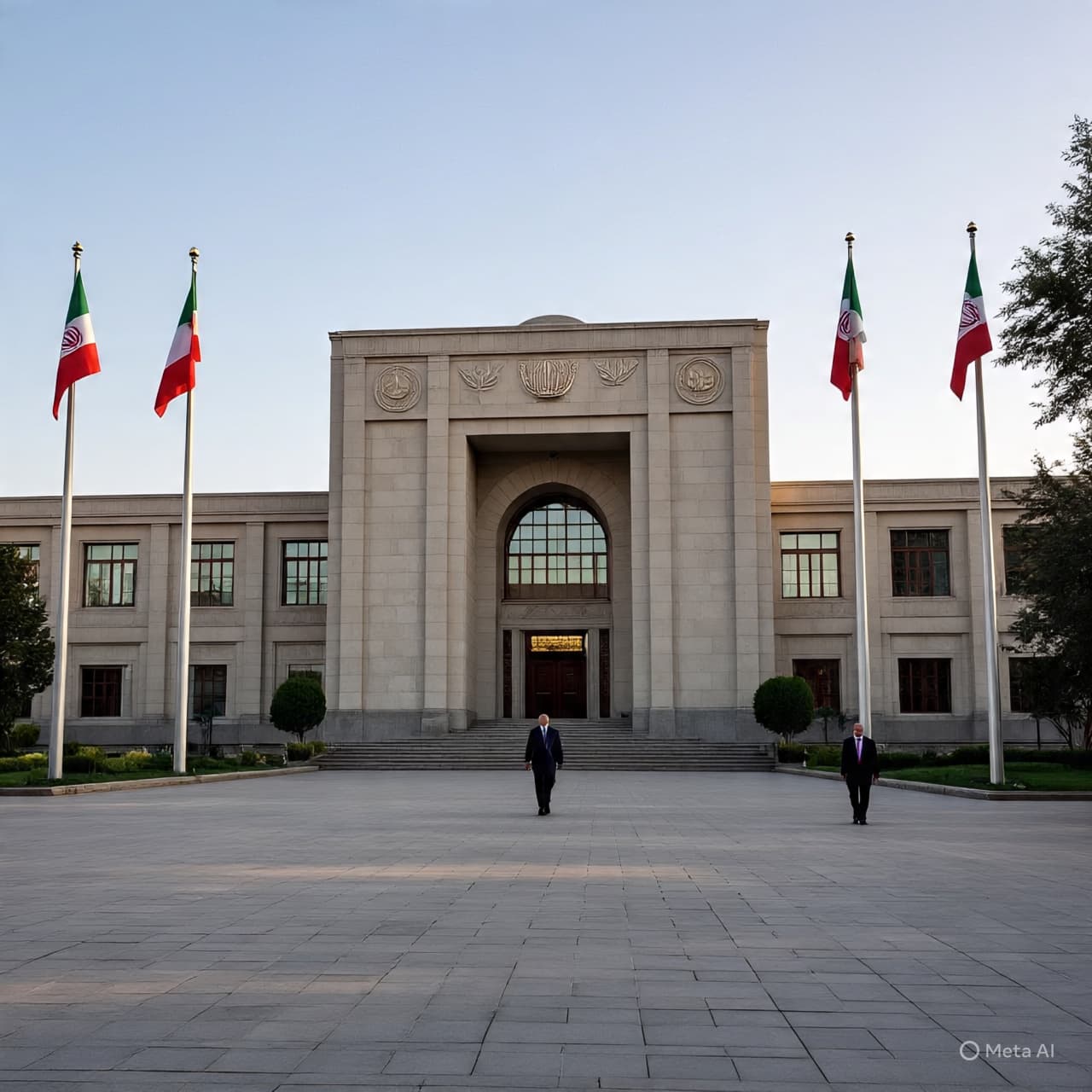
AI Image Disclaimer
Illustrations were produced with AI and serve as conceptual depictions rather than real photographs.
SOURCE CHECK
Credible media currently reporting on Iran forming a temporary leadership structure include: Reuters Al Jazeera The Washington Times Republika IranWire
Published by Banx Network. This article is part of the Banx decentralized media programme, powered by the BXE token on the XRP Ledger.