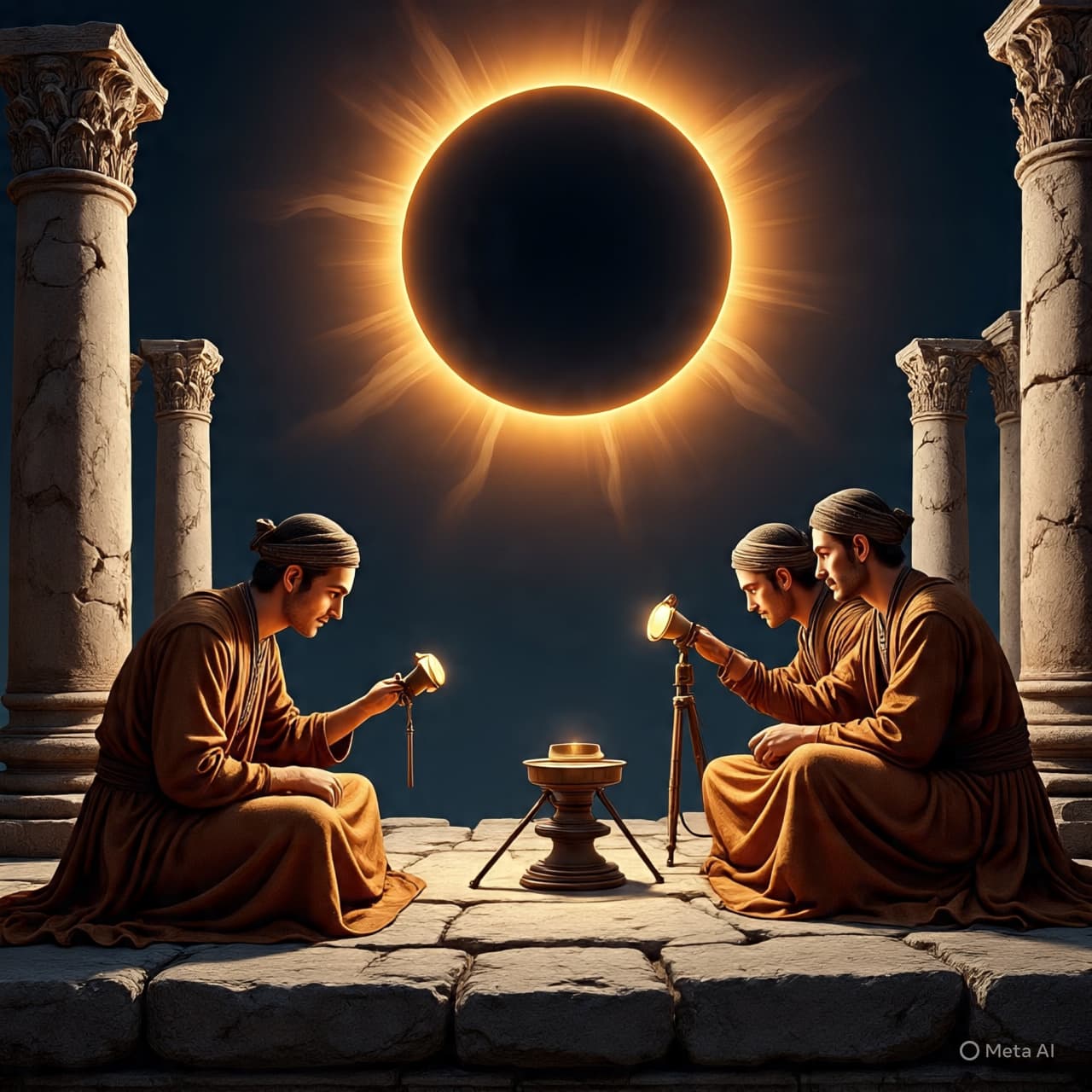
In the earliest nights of human curiosity, the sky was not yet a chart of numbers and predictions but a living story overhead. The Sun rose and set with dependable grace, the Moon waxed and waned like a quiet breath, and the stars traced slow, patient arcs across the darkness. Yet on rare occasions, the familiar order faltered. Day dimmed without warning, birds fell silent, and the Sun seemed to vanish behind an unseen hand. To ancient observers, a solar eclipse was not merely an event but a moment when the universe appeared to hesitate. Out of this hesitation grew a careful watching, and from watching, a desire to understand.
Long before telescopes and equations, ancient astronomers learned to read patterns written across generations. Civilizations in Mesopotamia, China, India, and Mesoamerica kept detailed records of the sky, noting not only the movements of celestial bodies but the moments when light itself withdrew. These observations were not casual. They were preserved on clay tablets, bamboo strips, stone monuments, and manuscripts, each entry a quiet promise that the heavens, though vast, were not entirely unknowable.
In Mesopotamia, astronomer-priests discovered that eclipses were not random acts of divine will but followed repeating cycles. By comparing records spanning centuries, they identified what later came to be known as the Saros cycle, a period of about 18 years after which similar eclipses recur. Though they could not explain the mechanics behind it, they understood its rhythm well enough to anticipate when darkness might return. Prediction, in this sense, was less about certainty and more about attentive memory, a dialogue between past and future.
Elsewhere, Chinese astronomers approached eclipses with equal patience. Imperial court records reveal centuries of meticulous eclipse documentation, driven in part by the belief that celestial harmony reflected earthly order. Patterns emerged slowly, through repetition rather than theory. Over time, Chinese scholars recognized that eclipses aligned with specific lunar motions, allowing them to forecast future events with growing confidence, even if the deeper geometry remained unseen.
In the ancient Mediterranean world, Greek thinkers began to bridge observation with explanation. By the time of Hipparchus and later Ptolemy, astronomers understood that eclipses occurred when the Moon passed between Earth and the Sun. Geometry entered the conversation, turning patterns into models. Calculations based on angles, distances, and cycles allowed predictions to become more precise, transforming eclipses from omens into natural phenomena governed by cosmic order.
The Maya, far from these centers, developed their own eclipse knowledge, embedding it within complex calendars. Their records show an awareness of eclipse cycles and lunar behavior that rivaled those of the Old World. Here too, prediction emerged not from instruments, but from disciplined attention to time itself, carved into stone and preserved through ritual and record.
What unites these civilizations is not a single method but a shared humility before the sky. Ancient astronomers did not conquer eclipses; they listened to them. Each prediction was an act of trust in patterns patiently revealed, a recognition that understanding grows slowly, like dawn after darkness.
Today, solar eclipses are forecast to the second, their paths mapped across continents with mathematical certainty. Yet behind every modern calculation stands a long human inheritance of watching, recording, and wondering. Ancient astronomers predicted eclipses not by seeing farther than we do, but by looking longer, allowing the sky to teach them its rhythms one shadow at a time.
AI Image Disclaimer Graphics are AI-generated and intended for representation, not reality.
Sources (media names only) Encyclopaedia Britannica NASA Smithsonian National Air and Space Museum Royal Astronomical Society Cambridge University Press
Published by Banx Network. This article is part of the Banx decentralized media programme, powered by the BXE token on the XRP Ledger.