Some mornings begin with silence — the quiet hum of computers, the faint glow of monitors in darkened control rooms. And then there are mornings when the universe clears its throat.
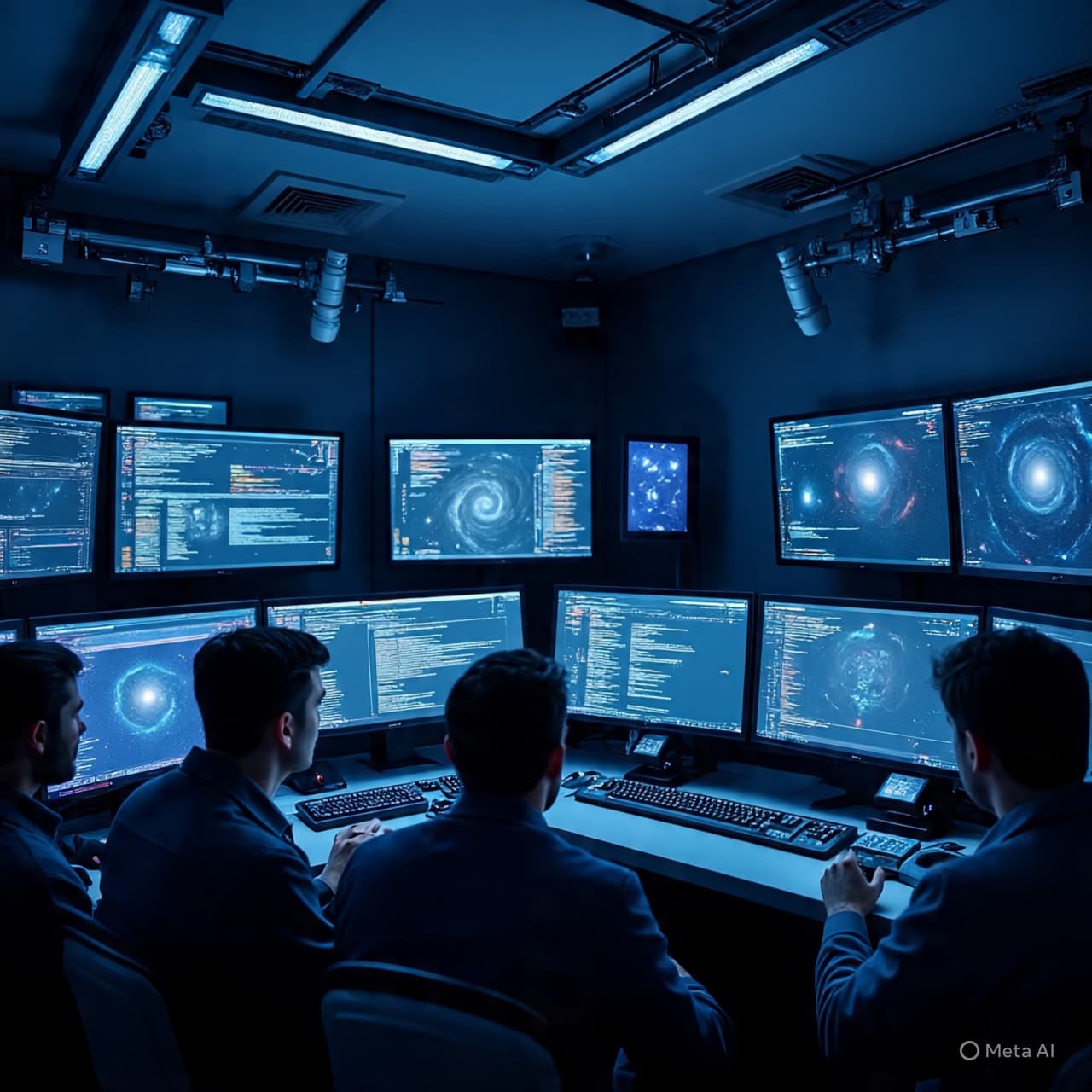
Astronomers recently arrived at their observatory consoles to find something unusual waiting for them: nearly 800,000 notifications generated overnight. The alerts were not errors, nor were they the digital equivalent of spam. They were signals — flickers, shifts, sudden glimmers from distant corners of the cosmos. A sky that had seemed serene only hours before had revealed itself to be restless, brimming with movement.
The observatory, designed to scan vast stretches of the night sky with unprecedented sensitivity, had done exactly what it was built to do. Using wide-field imaging and automated detection systems, it compares fresh observations against archival data, flagging anything that appears to change — whether a star brightens unexpectedly, an asteroid crosses a familiar path, or a distant galaxy pulses with energy.
In one sweep, it identified hundreds of thousands of such changes.
For astronomers, this deluge is both exhilarating and humbling. The modern telescope no longer merely captures images; it listens for variation. It watches for motion in what once seemed fixed. The sky, once charted with pen and paper, is now mapped in streams of data. Each alert is a question mark: Is this a supernova in its earliest breath? A variable star revealing its rhythm? A near-Earth object passing quietly through our neighborhood?
The challenge is not simply in detection, but in discernment. Advanced algorithms now help sort these notifications, distinguishing between known objects, predictable variations, and truly novel events. Artificial intelligence assists in prioritizing what requires immediate human attention. Even so, the human element remains essential. Behind every alert that rises to the top is a team of scientists ready to interpret, confirm, and, sometimes, celebrate discovery.
This surge of alerts underscores a broader transformation in astronomy. Observatories are shifting from static sky surveys to dynamic monitoring systems. Rather than producing occasional snapshots, they create time-lapse narratives of the universe. The cosmos becomes less like a portrait and more like a living film — stars flaring, asteroids drifting, galaxies shimmering in slow motion.
Yet there is also a quiet philosophical resonance to such mornings. For centuries, humanity looked up and saw constellations — steady, reassuring patterns. Today’s instruments reveal that stability is often an illusion of scale. Beneath that apparent calm lies constant change. The 800,000 notifications are not chaos; they are evidence of vitality.
Scientists caution that most alerts will correspond to routine or previously cataloged phenomena. Only a fraction may represent rare or groundbreaking events. But the volume itself signals progress. It reflects the increasing sensitivity of instruments and the growing capacity to process cosmic information at scale.
As researchers begin the careful work of classification and follow-up, the broader message remains clear: the night sky is far from silent. It speaks continuously, in flashes and fluctuations, and now we are finally equipped to hear it in full.
The morning inbox may have been overwhelming. But within those hundreds of thousands of alerts lies a simple reminder — the universe is awake, and so, in response, are we.
AI Image Disclaimer Visuals are created with AI tools and are not real photographs.
SOURCE CHECK
Credible mainstream / science sources covering this story include:
BBC News The Guardian Reuters The New York Times Space.com
Published by Banx Network. This article is part of the Banx decentralized media programme, powered by the BXE token on the XRP Ledger.