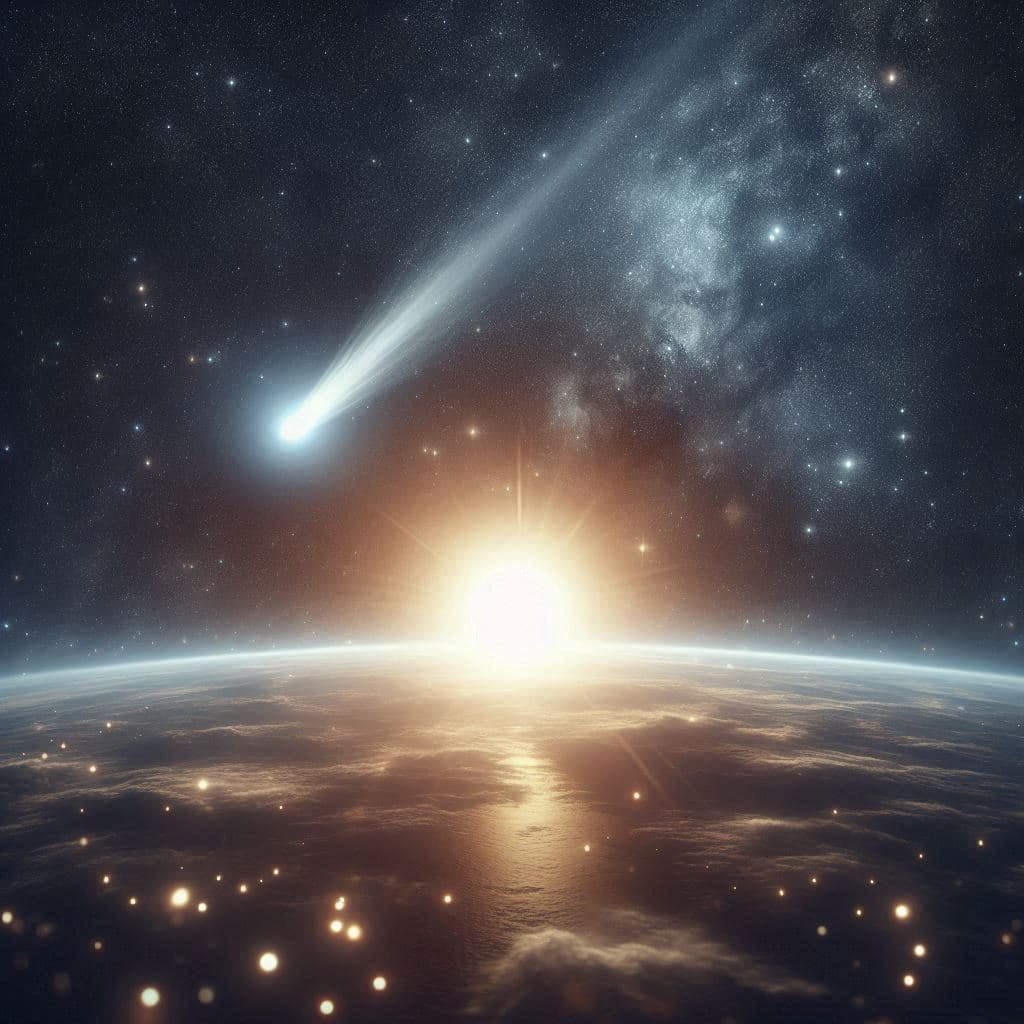
Every so often, the sky reminds us that it is not finished with surprises. A faint blur appears in a survey image, a calculation is checked twice, and suddenly a traveler from the far reaches of the solar system is given a name. A newly discovered comet is not an announcement so much as an invitation, a quiet suggestion to look up and wonder whether the heavens might briefly interrupt the ordinary rhythm of daylight.
Comets carry with them a reputation shaped by history and myth. They are remembered as blazing swords in medieval skies or as omens painted into old chronicles. In reality, most arrive softly, visible only through telescopes and patience. This newly identified comet has prompted a familiar question, asked whenever such an object enters public awareness: could it become bright enough to be seen in broad daylight?
The answer, for now, rests in careful uncertainty. Daylight visibility is rare and reserved for only the most dramatic comets, those that pass extremely close to the Sun and release vast clouds of gas and dust. Astronomers watch for signs of rapid brightening, measuring how the comet responds as solar heat awakens its frozen surface. Early observations suggest interest rather than spectacle, though comets have a long history of defying tidy predictions.
Brightness depends on several factors that unfold slowly. The comet’s size, composition, and trajectory all shape its future appearance. As it approaches the inner solar system, sunlight may cause jets of material to erupt, forming a glowing coma and tail. Yet just as often, comets fade, fragment, or fail to live up to early excitement. The science remains methodical, guided by data rather than hope.
For skywatchers, this period of waiting is part of the experience. Astronomers continue to refine orbital calculations and brightness estimates, sharing updates as new measurements arrive. Even if daylight visibility remains unlikely, the comet may still offer a rewarding sight in twilight skies or through binoculars, a subtle reminder of motion beyond Earth’s atmosphere.
At present, scientists emphasize observation over speculation. The comet’s path and behavior will become clearer in the coming weeks, allowing more accurate forecasts. Whether it becomes a daytime spectacle or a quieter visitor of the night, its discovery adds one more chapter to humanity’s long habit of tracking the slow, graceful wanderers of the solar system.
AI Image Disclaimer Images in this article are AI-generated illustrations, meant for concept only.
Sources NASA Space.com Sky & Telescope The New York Times BBC News
Published by Banx Network. This article is part of the Banx decentralized media programme, powered by the BXE token on the XRP Ledger.