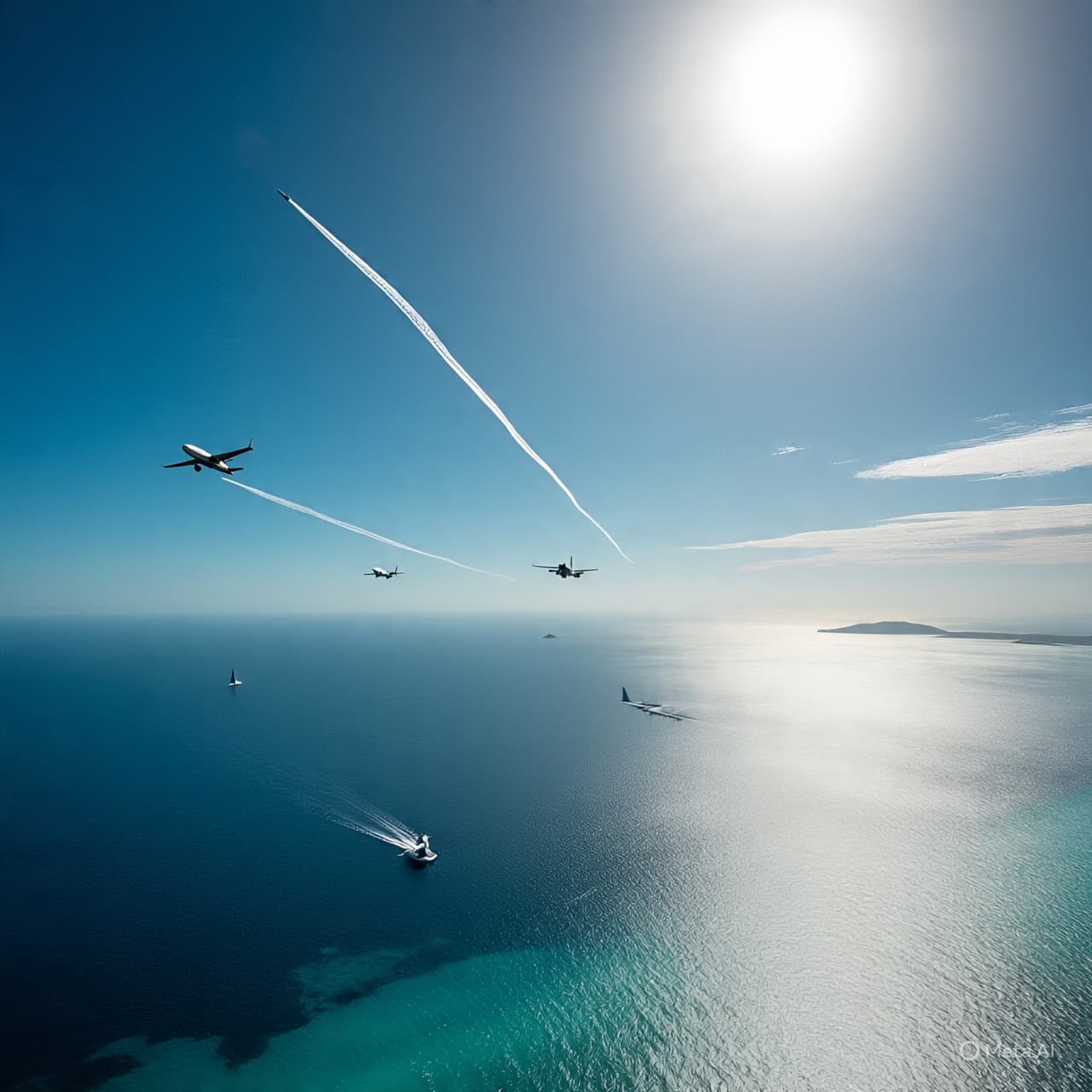
The sky is often imagined as a shared silence — an invisible commons where journeys overlap without ever touching. Over the Caribbean Sea, where commercial flight paths usually drift uneventfully above calm blue waters, that silence was briefly broken in January, not by weather or turbulence, but by falling remnants from a failed reach toward space.
Shortly after liftoff, SpaceX’s Starship spacecraft suffered a catastrophic failure, breaking apart during ascent. What followed was not only a loss for an ambitious space program, but an unexpected complication for civilian aviation below. Debris from the spacecraft spread across a wide stretch of airspace over the Caribbean, lingering long enough to intersect with active commercial flight corridors. In that moment, two worlds — orbital ambition and routine air travel — found themselves uncomfortably close.
Air traffic controllers were forced into rapid recalculation. Aircraft already en route faced altered instructions, sudden rerouting, and difficult choices shaped by fuel limits and distance to alternate airports. Pilots, trained for precision and predictability, instead navigated uncertainty, guided by fragmentary updates as debris continued to fall through airspace normally considered safe. The event unfolded quietly for passengers, yet intensely behind cockpit doors and control room screens.
Subsequent reviews by aviation authorities revealed that the risk to aircraft was greater than initially understood. The debris field persisted longer than expected, raising questions about how expanding spaceflight activity is coordinated with existing aviation systems. While no injuries or collisions were reported, the incident highlighted how even test flights — conducted far from major population centers — can ripple outward into global transport networks.
As regulators, aerospace firms, and aviation officials assess lessons from the January failure, the Caribbean skies have returned to their familiar calm. Planes continue to cross the region daily, tracing invisible lines between continents. Above them, spaceflight continues its push upward. Between the two lies a growing need for balance, where progress does not intrude upon the quiet trust that keeps ordinary journeys aloft.
Published by Banx Network. This article is part of the Banx decentralized media programme, powered by the BXE token on the XRP Ledger.