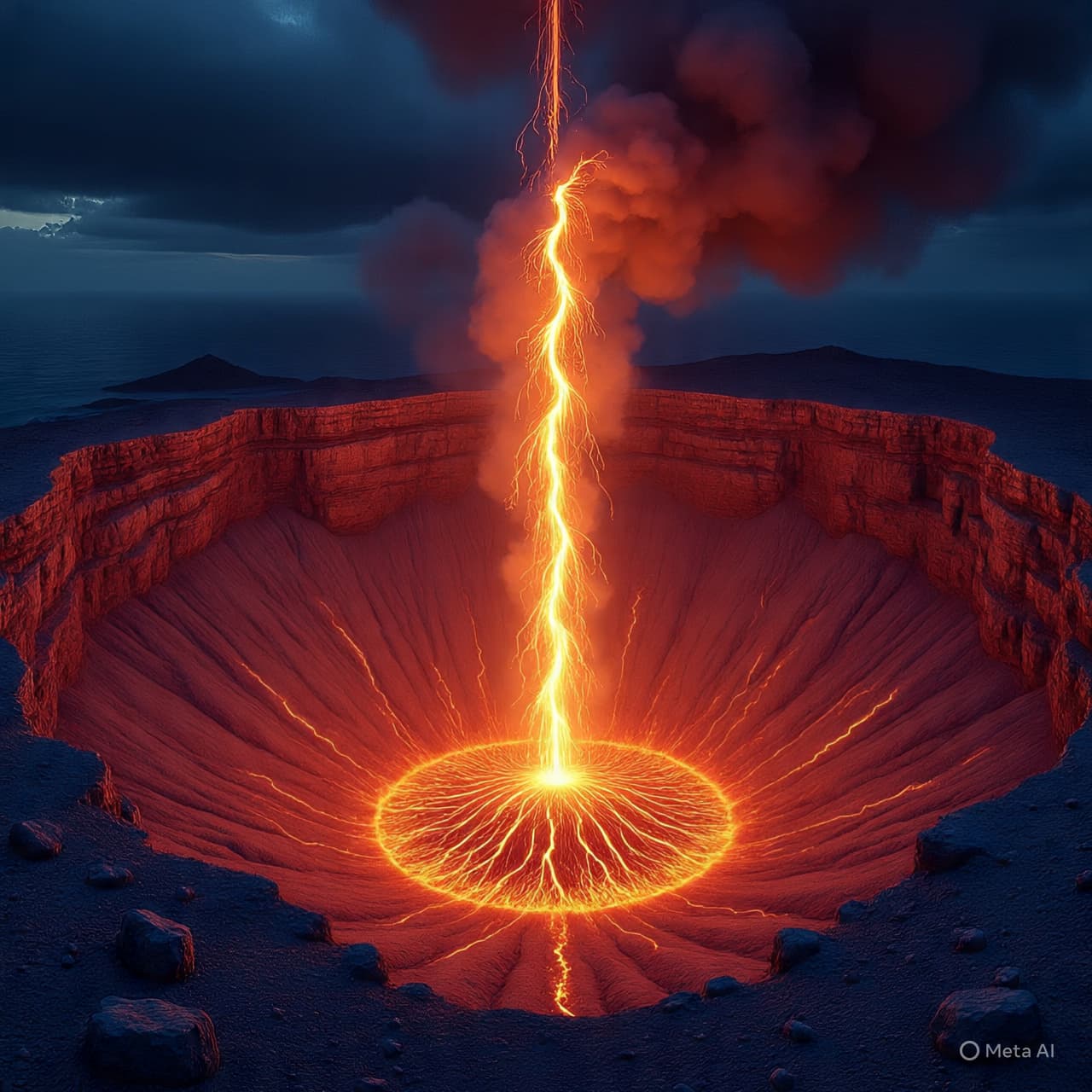
Santorini is an island that wears beauty like a disguise — whitewashed cliffs, blue-domed chapels, and sunset horizons so gentle they almost erase the memory of the fire that shaped it. Yet beneath that postcard elegance lies a restless history. Recent seismic analyses reveal that the island’s latest swarm of small earthquakes was driven by a surprisingly large volume of rising magma, estimated at the weight of twenty Giza Pyramids.
It is a humbling comparison. The pyramids, ancient and immovable, symbolize permanence. Magma, by contrast, is motion incarnate — shifting, expanding, quietly pressurizing the volcanic chamber beneath the Aegean. Researchers studying new geophysical models suggest that this deep, molten reservoir has been accumulating material at a measurable rate. The quakes themselves were subtle, but their pattern told a clearer story: the crust beneath Santorini flexed just enough to betray what was moving below.
The data does not point toward imminent danger. Instead, it offers an unusually precise glimpse into the mechanics of a caldera that has been active for hundreds of thousands of years. By comparing ground deformation with seismic behavior, scientists traced how magma migrated into fractures within the crust. In these movements, they saw a system still alive — not threatening, but gently reminding the region of its volatile lineage.
Santorini’s volcanic past is both dramatic and defining. The Bronze Age eruption that reshaped the island left geological scars visible even now, layering myth and history with ash. But modern monitoring has transformed uncertainty into understanding. Instruments scattered across the caldera measure subtle shifts in land elevation, while satellite imaging tracks expansion in millimeters. Against this backdrop of precision, the recent magma estimate becomes more than a striking metaphor; it becomes a benchmark for long-term volcanic behavior.
Even so, the imagery resonates. Twenty pyramids’ worth of magma moving beneath a landscape known for serenity underscores the paradox of volcanic islands: their beauty exists because of the forces that threaten to undo them. But volcanoes rarely act without warning, and Santorini’s current state appears stable. The quakes were small, the deformation modest, the magma deep.
What the findings truly signal is continuity — the ongoing cycle of heat, pressure, and renewal that has long defined the Aegean’s geology. Santorini is not awakening; it is breathing, as it always has, in slow rhythms that span generations rather than seasons.
In the end, the story is not one of fear but of awareness. The island’s calm surface stands above molten motion, a reminder that even the most serene places hold histories and futures shaped by forces we mostly see only in echoes — the tremble of a quake, a rise in stone, or the quiet weight of magma shifting far below our feet.
Published by Banx Network. This article is part of the Banx decentralized media programme, powered by the BXE token on the XRP Ledger.