In the patient theater of the night sky, planets do not rush. They wander, each along its ancient path, keeping distances that stretch beyond imagination. Yet from time to time, their separate journeys appear to converge from our earthly vantage point, forming what feels like a quiet celestial gathering. It is less a meeting than a perspective—a reminder that alignment, in astronomy, is often about how we stand and look upward.
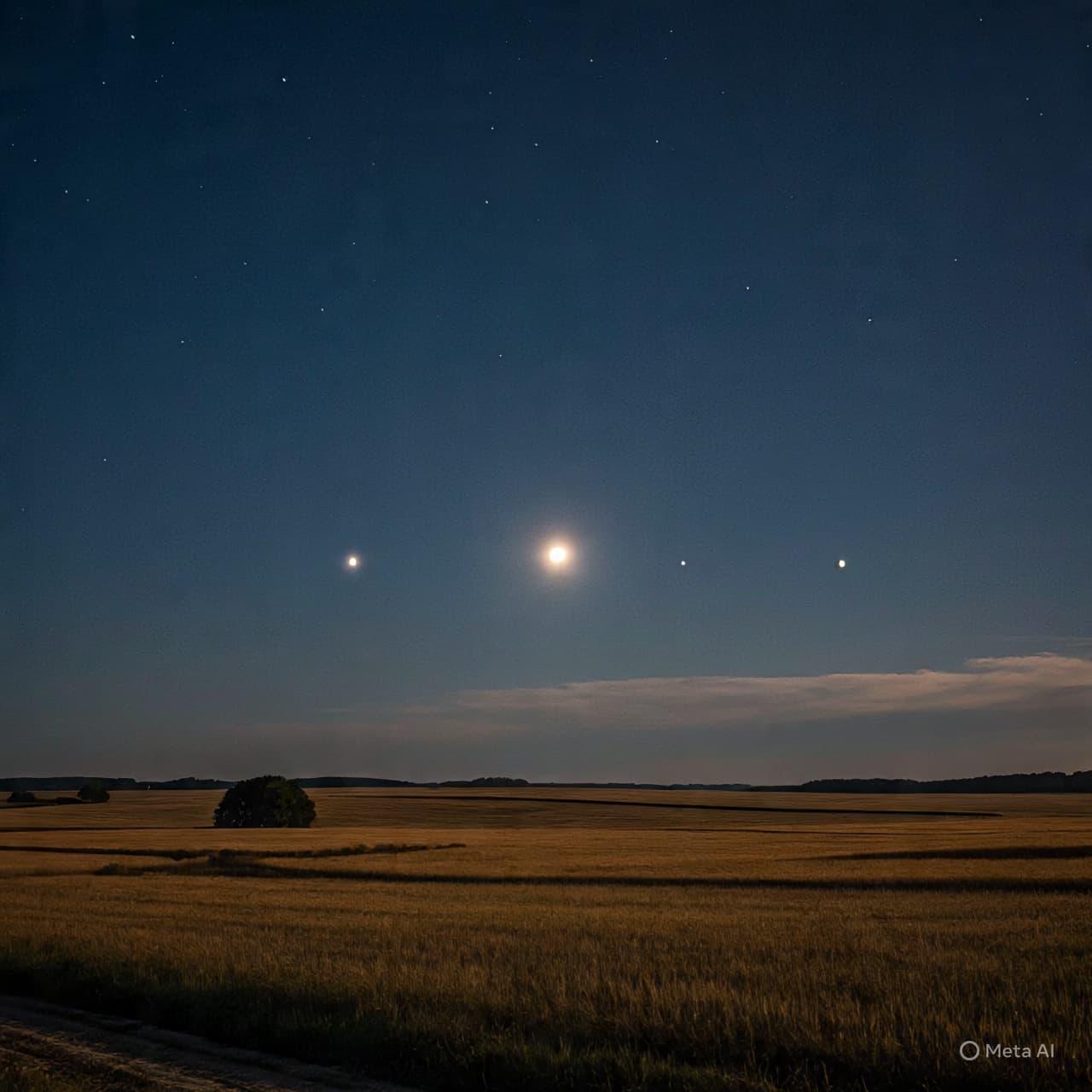
According to NASA, a rare parade of planets will soon become visible in the night sky, offering observers a chance to see several worlds appear in a line across the horizon. Such alignments are not perfectly straight in three-dimensional space, but from Earth they create the impression of a coordinated procession. Mercury, Venus, Mars, Jupiter, and Saturn are expected to be visible during this event, with some planets shining brightly enough to be seen without telescopes under clear conditions.
Astronomers explain that planetary alignments occur because the planets orbit the Sun along roughly the same plane, known as the ecliptic. Over time, their varying orbital speeds occasionally position them on the same side of the Sun, producing what is often described as a “planetary parade.” While smaller groupings of two or three planets are relatively common, gatherings of four or five visible planets are less frequent and tend to draw widespread public interest.
NASA notes that the best viewing conditions will depend on local weather, light pollution, and timing. Shortly after sunset or before sunrise, when the sky is dark enough but the planets are still above the horizon, observers may catch the clearest view. Venus and Jupiter typically stand out as the brightest points, while Mercury can be more elusive due to its proximity to the Sun.
Space agencies and observatories emphasize that no special equipment is required to enjoy the sight, though binoculars can enhance the experience. The alignment poses no physical effect on Earth; it is a visual phenomenon rather than a gravitational event with measurable consequences. Scientists gently remind skywatchers that while the arrangement feels rare, the mechanics behind it are part of the regular rhythm of the solar system.
Public fascination with planetary alignments often carries echoes of ancient traditions, when such configurations were interpreted as omens or signals. Modern astronomy approaches them with calculation rather than prophecy, yet the sense of wonder remains intact. There is something quietly unifying about looking up and recognizing neighboring planets that usually occupy different corners of the sky.
Educational institutions and amateur astronomy groups are preparing viewing guides and community events to mark the occasion. In cities with heavy light pollution, darker suburban or rural areas will provide better clarity. Apps and star charts can assist in locating each planet along the arc of the ecliptic.
As the date approaches, NASA continues to provide updates on optimal viewing times and visibility forecasts. For those willing to pause and step outside after dusk, the alignment offers a moment of perspective—an opportunity to witness the solar system’s geometry briefly sketched across the night.
The planetary parade will unfold over several evenings, depending on location, before the worlds gradually resume their more scattered appearance. In that gentle dispersal, the sky returns to its usual pattern, carrying on with its steady, unhurried motion.
AI Image Disclaimer Visuals are created with AI tools and are not real photographs.
Sources NASA Reuters Associated Press Space.com The Guardian
Published by Banx Network. This article is part of the Banx decentralized media programme, powered by the BXE token on the XRP Ledger.