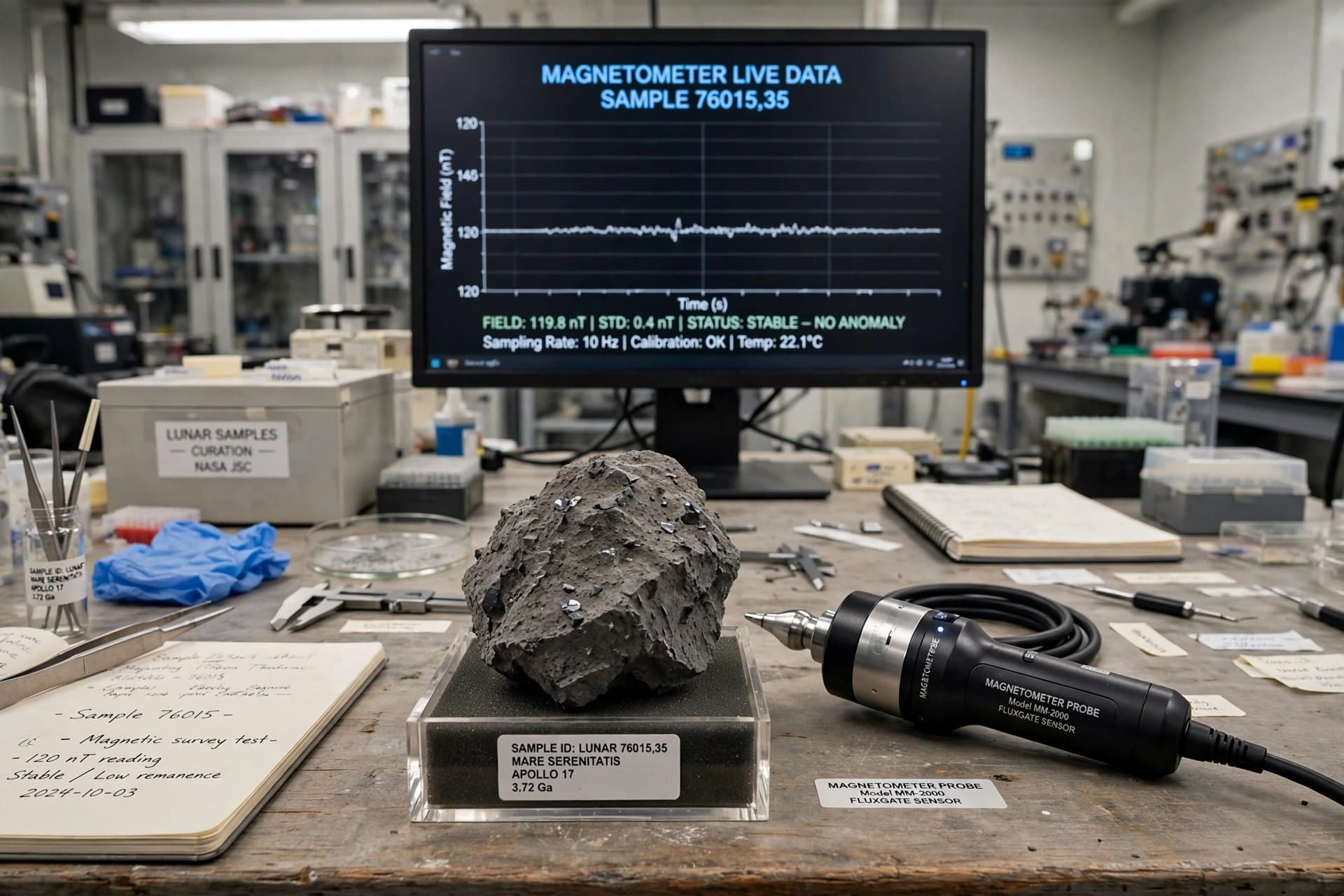
There is a particular stillness to the Moon today—a silence that extends beyond sound to the absence of a magnetic field, the quiet emptiness where a global shield once may have been. For decades, scientists have known that lunar rocks brought back by Apollo astronauts are magnetized, their minerals aligned in ways that suggest they formed in the presence of a magnetic field. But whether that field came from the Moon's own core, or from external forces, has remained a question without a definitive answer.
A new study published in Communications Earth & Environment has added weight to the argument for a lunar dynamo—an internal magnetic field generated by the churning of a molten core. The research suggests that this field may have been limited to the Moon's first approximately 140 million years, a period of intense magnetic activity that faded relatively quickly .
The evidence comes from the analysis of lunar samples and their magnetic signatures. Previous work established that a dynamo field likely existed on the Moon from at least 4.25 to 3.56 billion years ago, with an intensity comparable to Earth's present surface field. The field then declined by at least an order of magnitude by 3.3 billion years ago .
What makes the new study significant is its proposal that the dynamo's lifetime was shorter than some models suggest. A thermally driven dynamo—powered by heat escaping from the core—can sustain a magnetic field for approximately 140 million years without difficulty. Extending it much longer requires additional power sources, such as mechanical stirring from mantle precession or the crystallization of the Moon's inner core.
The implications extend beyond the Moon itself. Without a long-lasting lunar magnetosphere, the solar wind could implant volatiles directly into the lunar regolith, and Earth's atmospheric particles could be transported to the Moon when it passed through our planet's magnetotail. The presence of hematite on the lunar nearside, and inferences about ancient oxygen transport from Earth's atmosphere, are consistent with a Moon that lacked a global magnetic shield for most of its history .
The question of when the lunar dynamo started and stopped remains unresolved. Future exploration—drilling into the lunar crust, sampling impact crater walls, and returning older regolith to Earth—could provide the data needed to answer it. What is clear is that the Moon we see today, silent and still, may once have had a beating heart of molten metal, a field that shielded it from the solar wind and left its signature in the rocks that astronauts carried home.
AI Image Disclaimer: All images in this article are AI-generated and are for illustrative purposes only.
Sources: Communications Earth & Environment, Science, ScienceDirect, Harvard ADS
Published by Banx Network. This article is part of the Banx decentralized media programme, powered by the BXE token on the XRP Ledger.