We have called it the Red Planet for as long as we have had eyes to see it—a name so settled that it feels less like a description than an identity. But the cosmos has a quiet way of reminding us that our names for things are often smaller than the things themselves. When the European Space Agency's Mars Express orbiter recently turned its camera toward the south pole, it found not rust and dust but something closer to a bruise in the sky: swirls of violet, rose, and pale blue, draped across an icy cliff like a watercolor left out in the rain.
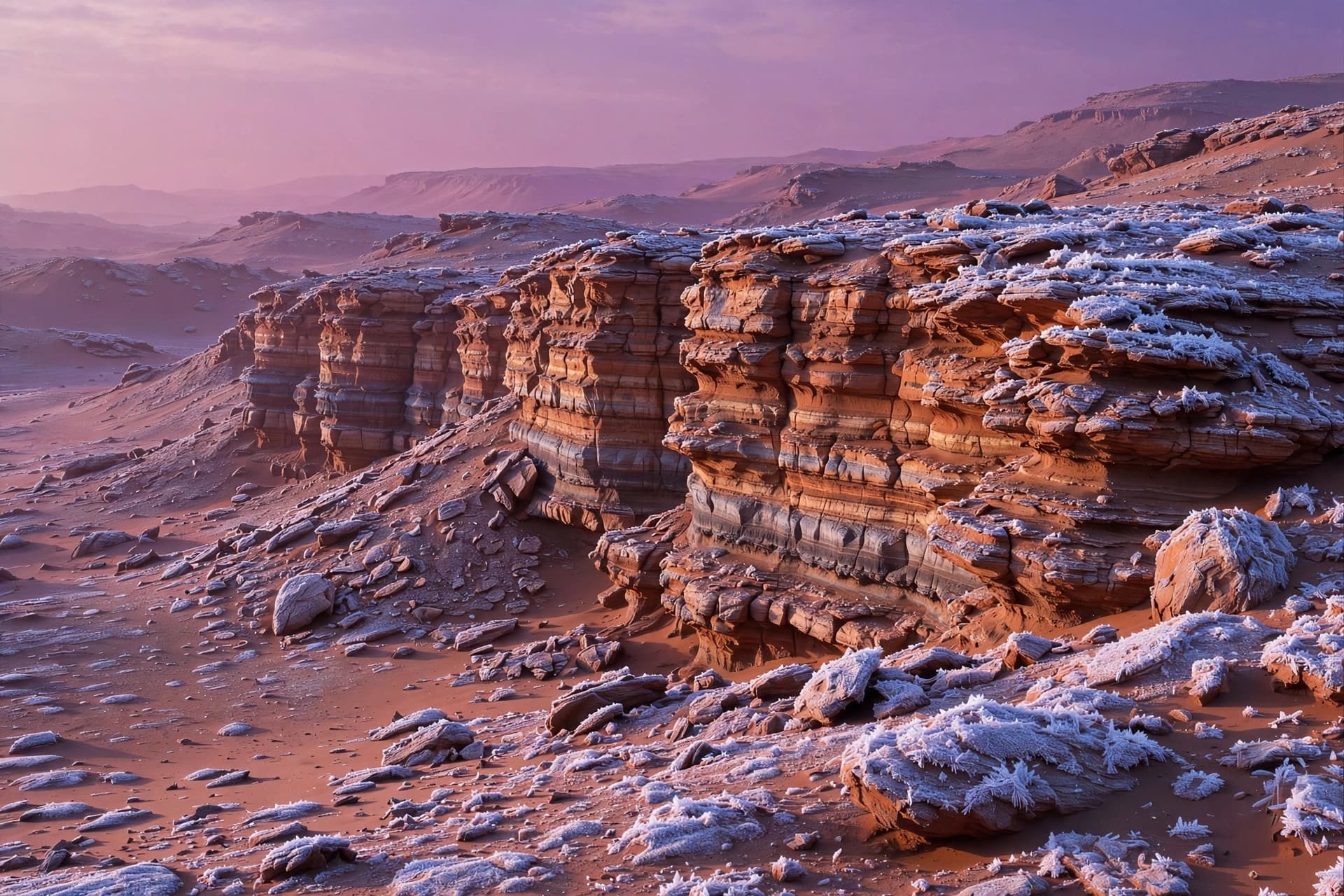
The image, captured by the High Resolution Stereo Camera, shows a region known as Thyles Rupes—an escarpment with cliffs taller than a kilometer, carved by ice and time. The colors are not the product of an artist's hand or a filter's whim. They emerge from a quiet conversation between geology, atmosphere, and light.
The darker tones in the image come from volcanic material, rich in minerals like olivine and pyroxene—the same ingredients found in Earth's mantle, the layer of rock beneath our feet . Their presence on Mars offers a window into the planet's deep past, a time when its interior was warm and restless. The paler areas, by contrast, are coated in frozen carbon dioxide, a frost that persists near the south pole even during the Martian spring when the image was taken .
But the purple itself is not a single substance. It is a phenomenon—a blend of dust suspended in the air, a ground covered in frost, patches of ice and rock mingling together, and the soft, low-angle light of morning . Mars's atmosphere is highly variable, and the same terrain can appear entirely different depending on the hour and the season.
There is something quietly humbling in this. We tend to think of planets as fixed, as places with a single face. But Mars, like Earth, is a body in motion—shifting, weathering, reflecting light differently as the day unfolds. The south pole does not always look violet. It looked that way on this particular morning, from this particular angle, through this particular instrument.
Thyles Rupes itself may have formed as Mars cooled, its crust contracting and buckling over billions of years . The cliffs stand as a record of that slow transformation, a reminder that even a world without tectonic plates is not static. The image is beautiful, yes. But it is also evidence—a clue in the ongoing effort to understand how a planet once warm and wet became the cold, dusty place we know today.
The Red Planet, it turns out, is not so simply red. It is also purple, and pink, and pale blue, and everything in between. What we call it is a convenience. What it is remains a question.
AI Image Disclaimer: The images accompanying this article are AI-generated and are for illustrative purposes only.
Sources: European Space Agency, Universe Today, Gizmodo en Español, Al Bayan
Published by Banx Network. This article is part of the Banx decentralized media programme, powered by the BXE token on the XRP Ledger.