There are moments when space exploration feels less like distance and more like a shared horizon, as if the Moon itself leans closer to listen. In such moments, the boundary between Earth and sky becomes softer, carried not by rockets but by stories, presence, and human anticipation. Montreal recently found itself within that quiet intersection of future and memory.
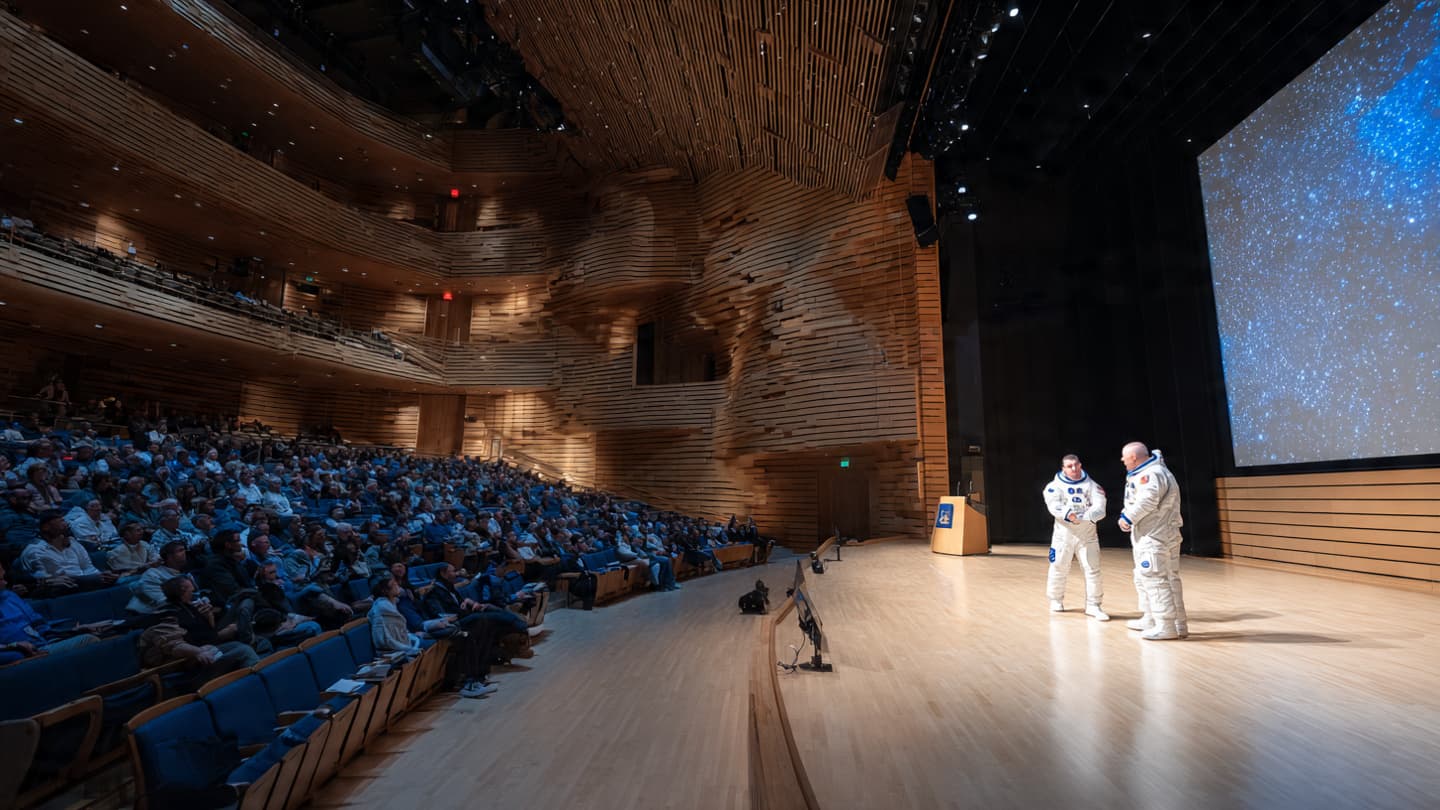
Members of the mission, associated with the broader lunar exploration efforts of , participated in public engagements in Montreal, offering reflections on the upcoming journey around the Moon. Their presence served less as a departure point and more as a bridge between ongoing engineering work and public imagination.
The visit highlighted how crewed spaceflight increasingly depends on shared understanding between astronauts, engineers, and the public. As spacecraft systems evolve, so too does the cultural context surrounding them. Events like these create space for dialogue about what it means to travel beyond Earth in a sustained way.
Montreal, a city with a deep connection to science and aerospace research, provided a fitting backdrop for such exchanges. Academic and technical communities in the region often contribute to aerospace innovation, making the city a natural meeting point for global space narratives.
The Artemis II crew discussions often focus on the technical complexity of a lunar flyby mission, including navigation, life support reliability, and deep-space communication. Yet alongside these technical elements, there is also attention to human experience—how Earth appears from afar, and how distance reshapes perception.
Public reactions tend to reflect a blend of curiosity and quiet anticipation. Seeing astronauts who will soon travel around the Moon can transform abstract mission timelines into something more tangible, closer to lived reality than distant planning.
In this way, the mission becomes not only a scientific endeavor but also a shared cultural moment, one that invites reflection on humanity’s renewed presence beyond low Earth orbit.
As the mission moves closer to launch, engagements like the one in Montreal help frame it within a broader human story of exploration, patience, and preparation.
AI Image Disclaimer Some visuals accompanying this topic may be AI-generated for illustrative and conceptual purposes.
Source Verification Check NASA, Space.com, The New York Times, CBC News, The Guardian
Published by Banx Network. This article is part of the Banx decentralized media programme, powered by the BXE token on the XRP Ledger.